
This Day in Labor History: February 11, 1918
 By
By 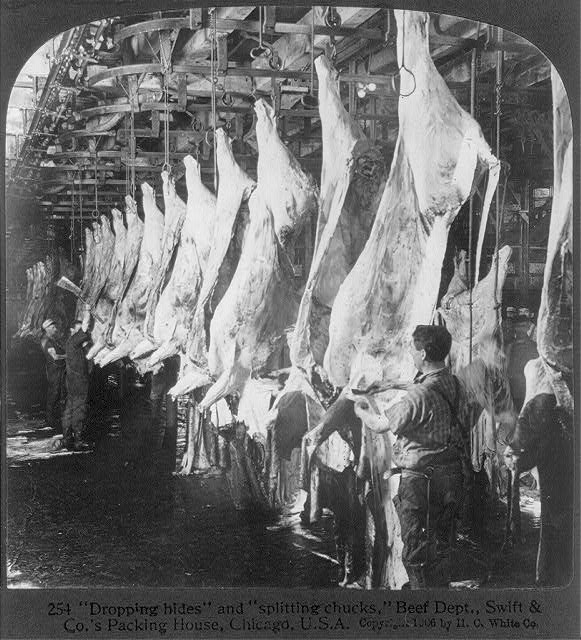
On February 11, 1918, the Presidential Mediation Commission began hearings over conditions in the Chicago stockyards. This was a huge win for the Chicago Federation of Labor’s interracial unionism and important precedent in building racial solidarity in the American labor movement, never the easiest task.
The conditions in Chicago’s stockyards were notorious long before 1918. Upton Sinclair had written about them in The Jungle in 1906, a book intended to spark socialism but instead just made consumers feel gross about their meat while not really caring about the conditions of workers. Ah, Americans. Well, Sinclair’s heroes in this book were the eastern European workers who dominated the stockyards. And in the early twentieth century, that very much was the workforce. But things began to change during World War I. For one, given that working in meatpacking was a terrible job, workers with options wanted to do anything else. By that time, quite a few eastern Europeans and increasingly their children had other options and could get out. At the same time, the beginnings of the Great Migration brought thousands and then many more African Americans out of the rural South to improve their lives. Since they were going to get the worst possible jobs, that meant that as Chicago became a center of Black migration, meatpacking became their employment home.
Of course this led to all kinds of tensions both on the shop floor and in Chicago. It took those eastern Europeans about 5 minutes to realize that anti-Black racism was a way to claim whiteness, something Irish immigrants had pioneered in the mid 19th century. Racialized violence was common throughout Chicago, as the meatpacking owners knew and could take advantage of to undermine unionism.
So any attempts to unionize workers and improve conditions in meatpacking had to take the race issue on in a serious manner. You simply had to have the eastern Europeans and the Black workers willing to join the same organization and work together, as well as the small but still significant number of native born whites working there. The Chicago Federation of Labor, the city-based version of the American Federation of Labor, had gone through hard times in the early 20th century due to unionbusting. It was still pretty irrelevant at the start of World War I. But CFL president John Fitzpatrick had a vision. He saw organizing Black workers as central to rebuilding the city’s labor movement as a powerful actor challenging both class and race-based power. Doing so required moving away from the AFL’s preferred tactics. It required a move toward industrial unionism, to embracing minority populations, and to centering the unions in community activism.
Fitzpatrick’s ideas proved quite successful. There was room to grow. Meatpackers overplayed their hands. Their profits skyrocketed in the 1910s while keeping wages exceptionally low. Conditions had not improved since Sinclair published The Jungle; well, they had for consumers but not for workers. But it wasn’t easy for the CFL, because the AFL was so openly racist. So the CFL had to win Black workers over to unions. Lots of Black activists simply didn’t trust unions and they had good reason to feel that way. So Fitzpatrick worked with William Z. Foster, at this time not yet notorious for his communism, to reshape the Chicago labor movement around industrial organizing and community values that did away with the craft union and racial hierarchies of the AFL.
The CFL itself decided to go around existing unions and just organize the stockyards from scratch, everyone all together. This promoted solidarity between union locals, not competition and back-biting. It created its own Labor Party to promote the political side of class politics outside of the two-party system that did nothing for workers at that time (and it really didn’t). It worked the Black media hard, doing interviews, running advertisements, building support. But it had to take on racist unionism directly and it did. They brought together white and Black workers, sometimes begrudgingly on the part of all involved, and pushed back against the meatpackers in late 1917, showing that employer claims about firings and retaliation were empty if people stuck together. By the end of the year, 40 percent of packinghouse workers were in unions and that number rose significantly in 1918, including a majority of the Black workers.
With growing power, Fitzpatrick issued demands and threatened the war effort with a potential strike. 98% percent of workers voted to authorize a strike. Scared, AFL president Samuel Gompers urged the Wilson administration to mediate before this spread through the American workforce that the union head very much wanted to see remain on the job. A failed strike could threaten unionism in Chicago period and a successful strike could threaten Gompers’ power. Wilson responded and sent the President’s Mediation Commission to Chicago to see what could be done. The meatpackers were furious when the commission gave the union an 8-hour day and a $1 a day increase off the bat. When the employers walked out, the workers threatened to strike again.
So on February 11, 1918, the President’s Mediation Commission held official meetings in Chicago, with testimony from all sides and a clear mandate to both the union and employers that the administration would back with the power of the government whatever decisions were made. Moreover, the CFL had an ace in the hole. Frank Walsh was the former head of the United States Commission on Industrial Relations. The USCIR was established by William Howard Taft toward the end of his term, but it got underway under Wilson, who had hired the crusading Kansas City lawyer to run it. Walsh really took it to the nation’s employers as the USCIR toured the nation to investigate labor conditions. Most famously, he forced John D. Rockefeller Jr. to the stand to defend his company slaughtering workers at the Ludlow Massacre in Colorado in 1914. Rockefeller was deeply embarrassed and incancedently angry over being hauled before the commission and publicly humiliated.
After the USCIR issued its report (deeply divided, with the pro-business figured on the commission really upset), Walsh continued his pro-union work. So he represented the CFL in these hearings. But in some ways, he didn’t even need to. When the Mediation Commission asked questions of the meatpackers, the employers were pretty much “yep, that’s what we do!”
But Walsh also helped a lot in centering the experience of Black workers. He stated to the bosses that the growth of interracial unionism ended “the last barrier in your defense against the American working men.” And this of course is precisely why employers wanted to play races off against each other. It served their interests. Racism is very much not something invented by the rich to divide the working classes, despite the stupid statements of some on the left. I assure you, working people could be plenty racist without any help. But employers absolutely could manipulate this in order to undermine unionization, as they had done through the use of Black strikebreakers from the South, who often were not even told what they were being offered jobs for, going back decades.
The evidence was so overwhelming about the oppression of the workers that the Mediation Commission founded in favor of the CFL on March 31, 1918, which happened to be Easter Sunday. It was a huge victory for the union. They won multiple pay increases over the next year, the end of gendered pay scales, the 8-hour day and 40-hour week, overtime pay, lunch breaks, and dressing rooms. They also won a grievance procedure to arbitrate labor-management conflicts. This completely undercut the packers’ entire labor strategy.
Now, this was not all permanent. The CFL would struggle to maintain its momentum with Black workers and especially its third party strategy. Racial tension did not go away, as the 1919 race riots would demonstrate, and the radical moment faded by 1922. But the groundwork for both better conditions in the meatpacking industry and interracial unionism was laid. In the 1930s, the unions would roar back with the United Packinghouse Workers in 1937, which would become the most important example of strong interracial unionism in the mid-20th century until the Eisenhower administration busted the union by incentivizing packers to move out of Chicago and to rural America in the late 1950s.
I borrowed from David Bates, The Ordeal of the Jungle: Race and the Chicago Federation of Labor, 1903-1922 to write this post.
This is the 590th post in this series. Previous posts are archived here.