
Erik Visits an American Grave, Part 2,089
 By
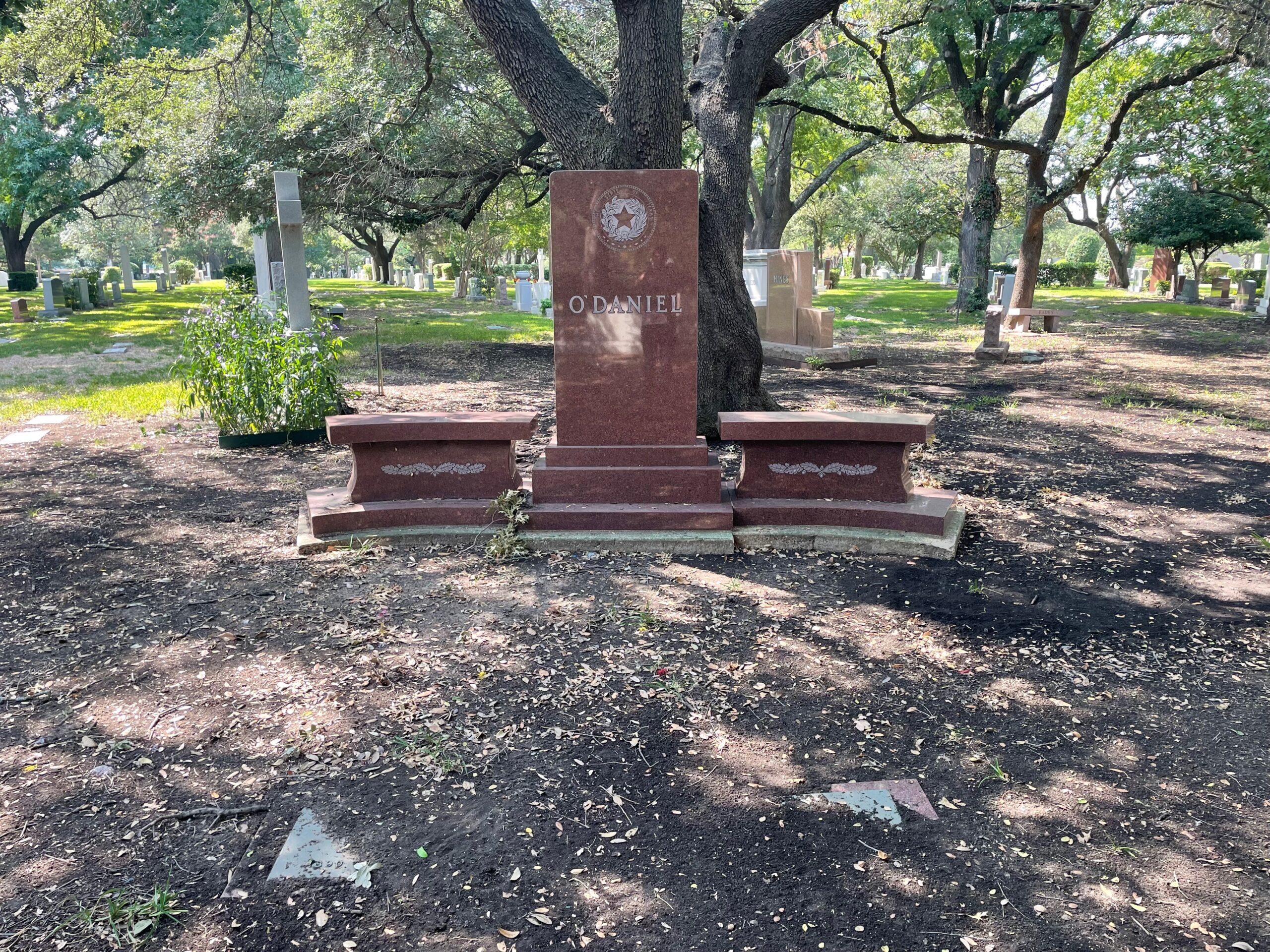
By This is the grave of Pappy O’Daniel.
Born in 1890 in Malta, Ohio, Wilbert Lee O’Daniel grew up mostly in Kansas. His father died in an accident when the boy was young. His mother remarried and the family decided to go into cattle ranching on the Plains, though they were quite poor. That’s where O’Daniel went to the local schools, graduating in 1909. He got a job as a bookkeeper for a milling company in the town of Anthony, Kansas after a short stint as a supposed institute of higher education called Salt City Business College (though really, what else is modern higher education anymore than an early 20th century business college). He was young and interested in moving around. He worked for companies in Kansas City and New Orleans before taking a job in Fort Worth. There he would remain and become a legend of Texas politics.
O’Daniel was an advertising man by this point and he understood how to use modern technologies to promote products. And what if he himself was the product? Well, he would come to understand that too. He was working for a flour milling company and part of his job was promoting its radio advertisements. O’Daniel also liked music. He wrote songs, he sang, and he wanted his own band anyway. So he combined these things. He created something called the Light Crust Doughboys in 1931. This was a band that would sing jingles. The other thing about radio at this time is that companies would sponsor their own shows. So he could have the Doughboys sing their own songs, his songs, and the ad jingles while promoting the flour company. He hired a young musician by the name of Bob Wills to lead this band. He wasn’t sure yet about this fiddle music stuff. He was more sophisticated than that or whatever. But Bob could sell flour or anything else down in Texas.
This all vaulted Wills to fame, clearly the greatest thing O’Daniel ever did. But of course ol’Bob was going to stick around forever. So when the Doughboys broke up O’Daniel started a new band that featured his son. Pat O’Daniel and His Hillbilly Boys never got as famous as Bob Wills, but it did make Pappy famous, because they were still regionally popular and they ended every performance by saying “pass the biscuits, Pappy.”
Now, up to this point, O’Daniel was not known as “Pappy.” But he embraced it. And he moved on to a new hobby–politics. O’Daniel started using the radio show to promote himself. He was a great public speaker and he took advantage of that. Said a magazine profile of him in the mid 30s, “At twelve-thirty sharp each day, a fifteen-minute silence reigned in the state of Texas, broken only by mountain music, and the dulcet voice of W. Lee O’Daniel.” Increasingly, as he centered himself, he wrote bad poems and paens to old-time religion, the Alamo, and fundamentalist culture. Of course, the yokels ate it up. And evidently. using the term “dulcet” to describe his voice was not an exaggeration–according to Robert Caro’s first LBJ biography, the man had a voice that was “captivatingly natural.” He particularly specialized in speaking to women’s issues that appealed to housewives, the real audience for his products and who had the radio on the most in the middle of the day.
So naturally, despite having zero experience in politics, O’Daniel ran for governor of Texas in 1938 and of course he won. When has Texas valued people who know what they are doing? He had a real good way to position himself against his primary opponents, and of course the Democratic primary was all that mattered. He was a businessman at heart and all the business community in the state knew this. But he was great at fake populism and he was famous. So the everyday yokel was happy to vote for him too. He ran on cutting taxes, but totally then tried to raise taxes. None of it mattered though, his fans were his fans. He got bored pretty quickly as governor so he ran for the Senate in 1941, when Andrew Jackson Houston died in the middle of his term.
Now, another rising politician really wanted this Senate slot. That was Lyndon Baines Johnson. He had a fair shot until O’Daniel entered the picture. O’Daniel hired a band to go around with him, of course, and even though his political positions were incompletely inchoate, it didn’t matter. But Johnson developed a great tactic–O’Daniel is too important for Texas to go to Washington. And it worked, or almost did. Whether O’Daniel stole the election or not is somewhat up for debate, but there’s a good chance that he did. Johnson’s campaign–which increasingly did not include the utterly anti-charismatic LBJ himself–really started to chip away at O’Daniel this while claiming himself as the great friend of Franklin Delano Roosevelt who would get all the New Deal money to Texas. O’Daniel ended up winning–or “winning”–by a thread of 1,311 votes in the runoff between the two candidates. What Johnson would learn that he would apply in his second run for Senate in 1948 was to learn that you had to put the apparatus in place to steal the election for himself before it was in doubt. LBJ was a quick learner, no doubt about that.
O’Daniel was a complete nonentity as senator. He spent most of his time ranting against FDR. Texas voters could not have elected someone who was a bigger clown and less relevant to anything happening in the U.S. Sure, in 1941 that might make sense–that was the point where southern Democrats and northern Republicans were teaming up to halt any additional expansion of the New Deal. But once the war started, a lot of that got put on hold to fight the war. O’Daniel wasn’t an isolationist to my knowledge, but he had become such a crank that he wouldn’t play along, even as federal dollars flowed to Texas, which of course LBJ would use so effectively to build his popularity and prepare for a second shot at the Senate. So O’Daniel had won election to a full term in 1942, but did not run in 1948 for a second full term, not after refusing to endorse FDR for a fourth term in 1944.
O’Daniel’s later career saw his crankhood turned up to 11. He went back to his businesses and made a lot of money. But he was a man of the past in a state moving forward. Despite ranting that Brown v. Board was a communist conspiracy and that getting him back into politics by running for governor of Texas, his day had passed. He did not come close to winning the Democratic primary for governor in 1956 or 1958. He died in 1969, at the age of 79. He must have really loved the 60s….
Pappy O’Daniel is buried in Sparkman Hillcrest Memorial Park, Dallas, Texas.
If you would like this series to visit other people who won a Senate race in 1942, you can donate to cover the required expenses here. C. Douglass Buck is in New Castle, Delaware and Edward Moore is in Okmulgee, Oklahoma. Previous posts in this series are archived here and here.