
Erik Visits an American Grave, Part 2,079
 By
By This is the grave of Frank Knox.
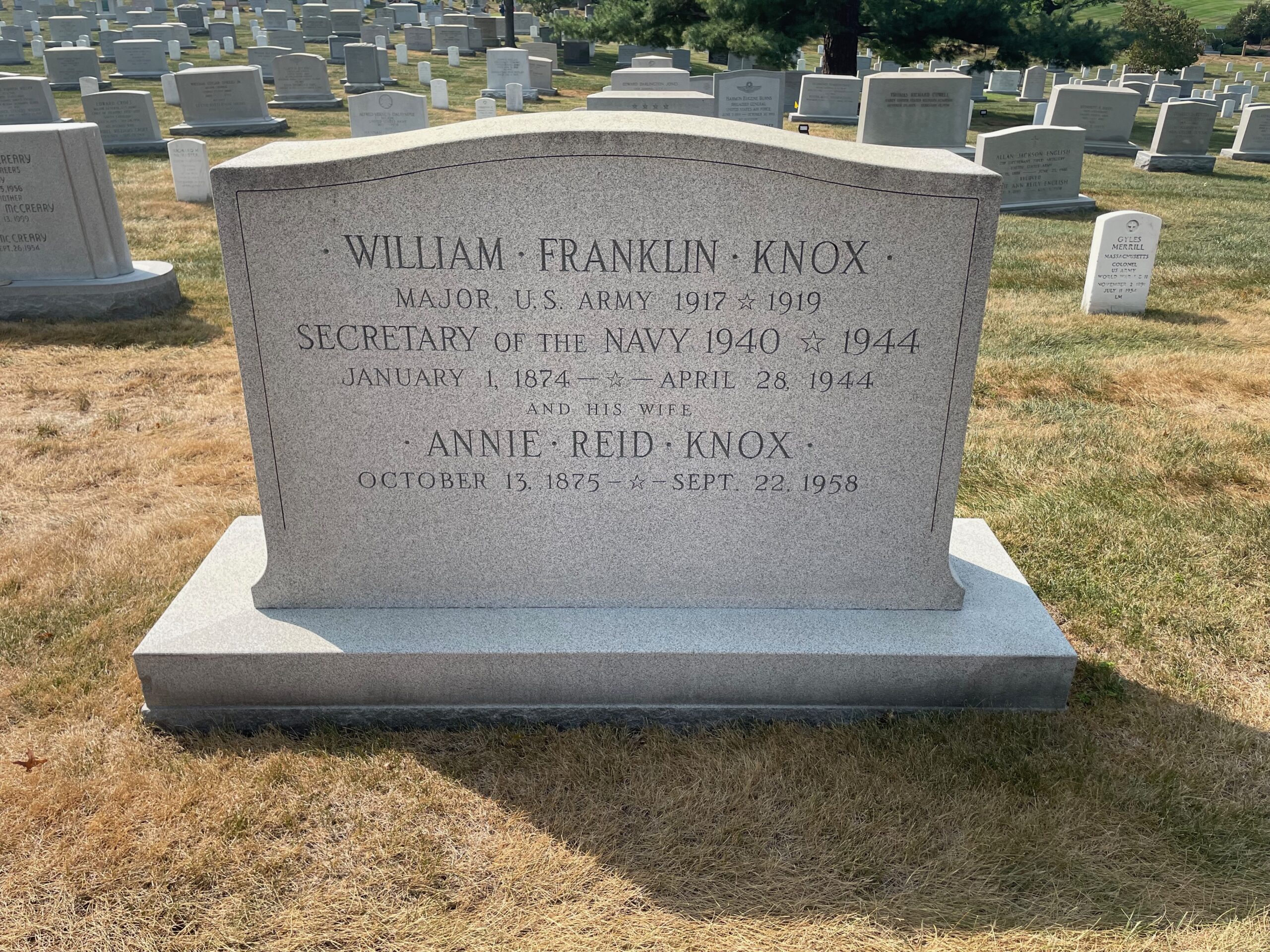
Born in 1874 in Boston, Knox grew up pretty middling. His father was a grocer. The family moved to Grand Rapids, Michigan for a new start in 1883 and his father opened another store there. Knox went to Alma College, a small school out there. Eager for adventure, he signed up for the Spanish-American War in 1898, America’s unjust entrance into imperialism. He was still a senior in college at this time, so he had gotten a slow start. Working for awhile, I assume. Alma granted him his degree without actually finishing she was a patriot and all. Somehow Knox got caught up with the Rough Riders, Theodore Roosevelt’s famous unit that relied on Black soldiers to bail their asses out at the Battle of San Juan Hill, which TR used to make himself famous and which was a total racist lie as to how it happened after erasing Black participation from the battle. Anyway, Knox was in that battle. He didn’t learn anything from being bailed out by Black soldiers either.
Upon his return to Michigan, Knox had no interest in following his father’s path. He was known as William up until this point, his given first name, but about 1900, he started preferring to be called Frank. Seems late to be changing your name, but hey whatever. He became a newspaper reporter and active Republican. By the early 1910s, he was the chairman of the Michigan Republican Party and as such, worked to tilt the party in 1912 to supporting Roosevelt’s Bull Moose rebellion against William Howard Taft’s conservatism and, most importantly to that psychopathic lunatic TR, not being Theodore Roosevelt. But Knox was a good TR-type Republican, pro-business, but within limits and believing in a lot of the Progressive Era reforms of the era that made the old school Gilded Age Republicans want to puke.
Knox rejoined the military in World War I, after using his growing newspaper empire that now stretched well beyond Michigan to promote preparedness. Having some military experience and being semi-famous was a good combination to rise fast in that war and he was commissioned as a colonel and was involved with the artillery in France, so he wasn’t sitting behind a desk.
After the war, the Republicans went far right, the deep conservatism of the 1920s as epitomized by Calvin Coolidge. Knox and a few others, most notably Herbert Hoover, kept the lamp lit for a more liberal Republicanism. Knox had his newspapers and wasn’t afraid to use them to push his points or his ambitions. He tried to move the Republicans to someone not Warren Harding in 1920, being the floor manager for Leonard Wood’s attempt to become the nominee, but that failed.
Then the Great Depression happened. Republicans had no answers. By 1936, they were looking for any kind of combination to take on FDR. So they nominated Alf Landon for president and put Knox on the ticket as VP. Knox ranted about how Roosevelt was taking away the glories of private property and private enterprise from the American people. This was not the message that Americans wanted to hear in 1936. FDR crushed them in one of the biggest blowouts in American history.
As the nation moved toward World War II, Knox continued to push his ideas about preparedness. By this time, he was hooked into the Hearst newspaper chain, but he evidently kept his freedom to editorialize on the topic. He had no patience for the growing isolationism in the Republican Party. Meanwhile, Roosevelt was looking for Republican internationalists to fill out his administration and make it clear to the American public that fighting Nazis was going to be a bipartisan thing, as much as Wheeler or Nye or Lindbergh hated it. So he brought in Knox as Secretary of the Navy in 1940, under the fellow Republican Henry Stimson as Secretary of War. Knox still hated the New Deal, basically. But there were higher principles at play by 1940. He stated, “I am an American first, and a Republican afterward.” I wonder how many Republicans could make such claims in 2026?
Knox used his power to push for racism. He was a major force in the placing of Japanese Americans in concentration camps. In fact, he could claim legitimately that he had fostered hatred against the Japanese for years and he had the newspaper columns to prove it. He had argued that the Japanese Americans on the west coast were a threat to American security all the way back in 1933 and he did not change his position on those slanty eyed fifth columnists for one second. He also wanted all the Japanese in Hawaii rounded up and put in camps. That wasn’t tenable because the Japanese made up such a large percentage of the population and were needed for work. Of course there was no evidence that Japanese Americans in Hawaii or the west coast were involved in espionage or had laid the ground for Pearl Harbor, but when did facts get in the way of American racism or ethnic cleansing, then or now?
Oh, Knox also hated Blacks. He was a big proponent of the segregated military and there was no way he was going to listen to those crazy communist civil rights activists demanding equality in America just because we were fighting against two other racist regimes. See, American racism was totally different than those bad countries.
More to Knox’s credit, he really did believe in a strong navy that could fight in both the Atlantic and Pacific and with the entire power of the federal government behind him, was able to significantly increase ship production and build what became a powerful navy by the end of the war. The navy was at least four times the size of its prewar version by the end of the war. Another thing Knox brought to the government was his friend Wild Bill Donovan, who not only was right there with Knox about needing to support the English and defeat the Nazis, but also would soon lead the Office of Strategic Services, the predecessor of the CIA. Knox also did a ton to see the Lend-Lease Act through and fought before the nation was technically at war against Republicans and a few southern Democrats who were horrified that the U.S. would dare intervene against the Nazis.
However, Knox did not live to see that end. His heart was bad and he started having small heart attacks and then he had a big one in 1944 that killed him. He was 70 years old.
Frank Knox is buried on the confiscated lands of the traitor Lee, Arlington National Cemetery, Arlington, Virginia.
If you would like this series to visit other Secretaries of the Navy, you can donate to cover the required expenses here. Charles Edison, son of the inventor and later John Birch Society leader, is in Montclair, New Jersey. Claude Swanson is in Richmond, Virginia. Previous posts in this series are archived here and here.