
Erik Visits an American Grave, Part 2,073
 By
By This is the grave of Samuel Ovenshine.
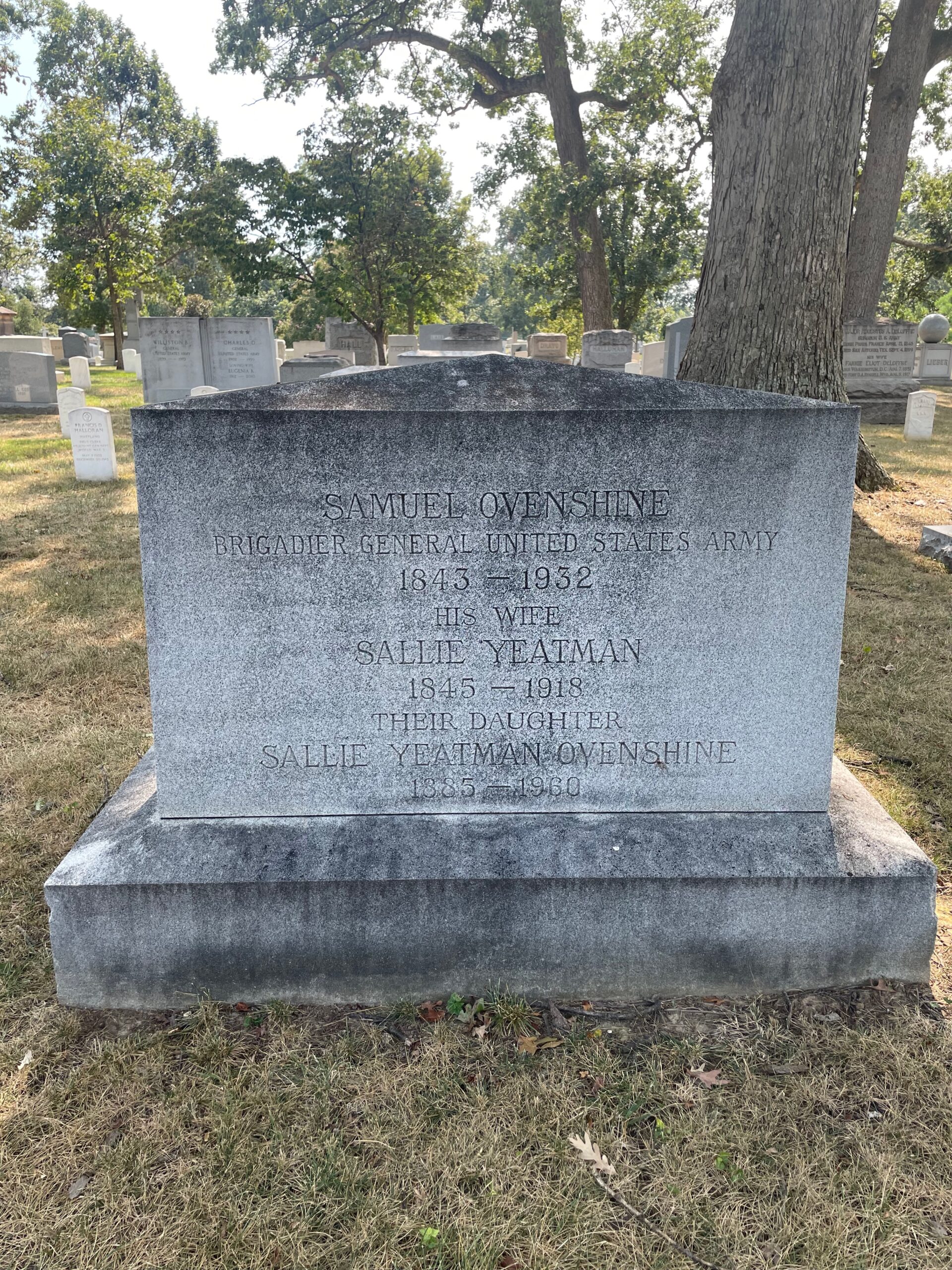
Born in 1843 in Philadelphia, Ovenshine was a kid who wanted to be a lawyer. Then the Civil War happened. Ovenshine joined the military and was commissioned as a lieutenant. Now, for most soldiers, the Civil War meant what you think it does–Antietam, Gettysburg, whatever. But not for Ovenshine. He was sent out to the West. After all, fighting to end slavery didn’t mean that the genocidal project at the heart of everything America means didn’t need its attention too. Plus, the South initially had its own desires to dominate to the Pacific. They were driven back in 1862, but still, soldiers were going to need to be out there.
Now, at one level, Ovenshine’s career isn’t that exciting. He stayed out in the West for a long time. Rather than leave the military at the end of the war, he stayed on, even though he found the West isolated and boring. Still, now a captain, he played a role in the aftermath of the Little Bighorn and then in the Battle of Bearpaw Mountain, under Nelson Miles, where the U.S. finally subjected the Nez Perce to its control and genocide. Ovenshine slowly rose, becoming a major in 1885. With the military so small at this point, the ability to even long-term officers to rise in rank was very limited, basically depending on someone else retiring. He was given command of Fort Davis in west Texas in 1890. He became lieutenant colonel in 1891 and colonel in 1895.
Ovenshine came to some national attention during the imperialist U.S. war to conquer the Philippines, one of the most unjust things to come out of the sheer awfulness of America’s existence on Earth. By the time he got there, the Spanish had been defeated. But it turned out the Filipinos wanted their independence, not to be ruled by Americans. Who knew. So they engaged in a fierce resistance that shocked Americans, led to enormous atrocities by a typically racist and genocidal American army that had learned how to deal with upstart brown people in the West, and eventually dampened enthusiasm for imperialism in the U.S., since wasn’t mass death of brown people in a different country supposed to not be what America was about? I mean, mass death of brown people in North America, sure!
Anyway, Ovenshine was involved in the Battle of Manila, which started when racist American troops opened fire on Filipinos they were supposed to be guarding and led to an uprising that American generals used to massacre a lot of people. He was also at the Battle of Zapote Bridge, another large battle in 1899, in which Ovenshine trained his artillery to massacre a lot of Filipinos. Unsurprisingly, these battles were won by the Americans, but none of that actually pacified the Filipinos, who would eventually sort of acquiesce in 1902. After this, still in 1899, Ovenshine retired when he was given a promotion to brigadier general.
Now, none of this is why we remember Ovenshine, to the extent that we remember him at all. He was just a middling officer for most of his career in obscure positions for a military that wasn’t doing a whole lot between about 1877 and 1898. It’s that historians have used Ovenshine’s extensive letters to a his wife to get a significant understanding of the military’s role in the late 19th century American West. Mostly, Ovenshine hated the West. I don’t really know why he stuck around in the military. You’d think a well-connected military officer would have lots of business opportunities in the Gilded Age. Certainly more than a few of his fellow officers took that path. Instead, mostly he complained in letters to his wife that there was nothing nice about the West at all, even when based around the Yellowstone River in some of the most striking landscapes in the nation, with views today that would mean the land would to some billionaire cosplaying as a cowboy for millions of dollars. He complained all the time to his wife about how much he hated everything about the Army and only did it for the money. He basically hoped that the tribes would escape American control so he could leave the West.
But look, Army life on the frontier was in fact really difficult. It’s easy to romanticize life in the West. Certainly a century of westerns did a great job of it. But that was not the reality. It was alternatively very hot or very cold. There were lots of bugs. What passed for roads were terrible. It was a hard, dirty life. And I think it’s important enough to recognize this somewhere in this series. Ovenshine is a good opportunity to do so, thanks to his honest disdain for the life that he had chosen for himself. Marching across the West here and there to control the tribes was not in fact fun. It was really hard to work. Not feeling too bad for those who commit themselves to genocide for the money–the difference between a guy like Ovenshine and some random grumbling high ranking German officer in World War II seems at least somewhat apt to me. But of course Americans love to pretend that their own crimes against humanity are nothing like those bad people over there.
Ovenshine had a nice long retirement, dying in 1932, while living in Washington, D.C. He was 89 years old.
Samuel Ovenshine is buried on the confiscated lands of the traitor Lee, Arlington National Cemetery, Arlington, Virginia.
If you would like this series to visit other people who wrote extensively about the American West in the 19th century, you can donate to cover the required expenses here. Susan Shelby Magoffin is in St. Louis and John Gregory Bourke is also in Arlington. Previous posts in this series are archived here and here.