
The American right and the “Jewish question”
 By
By 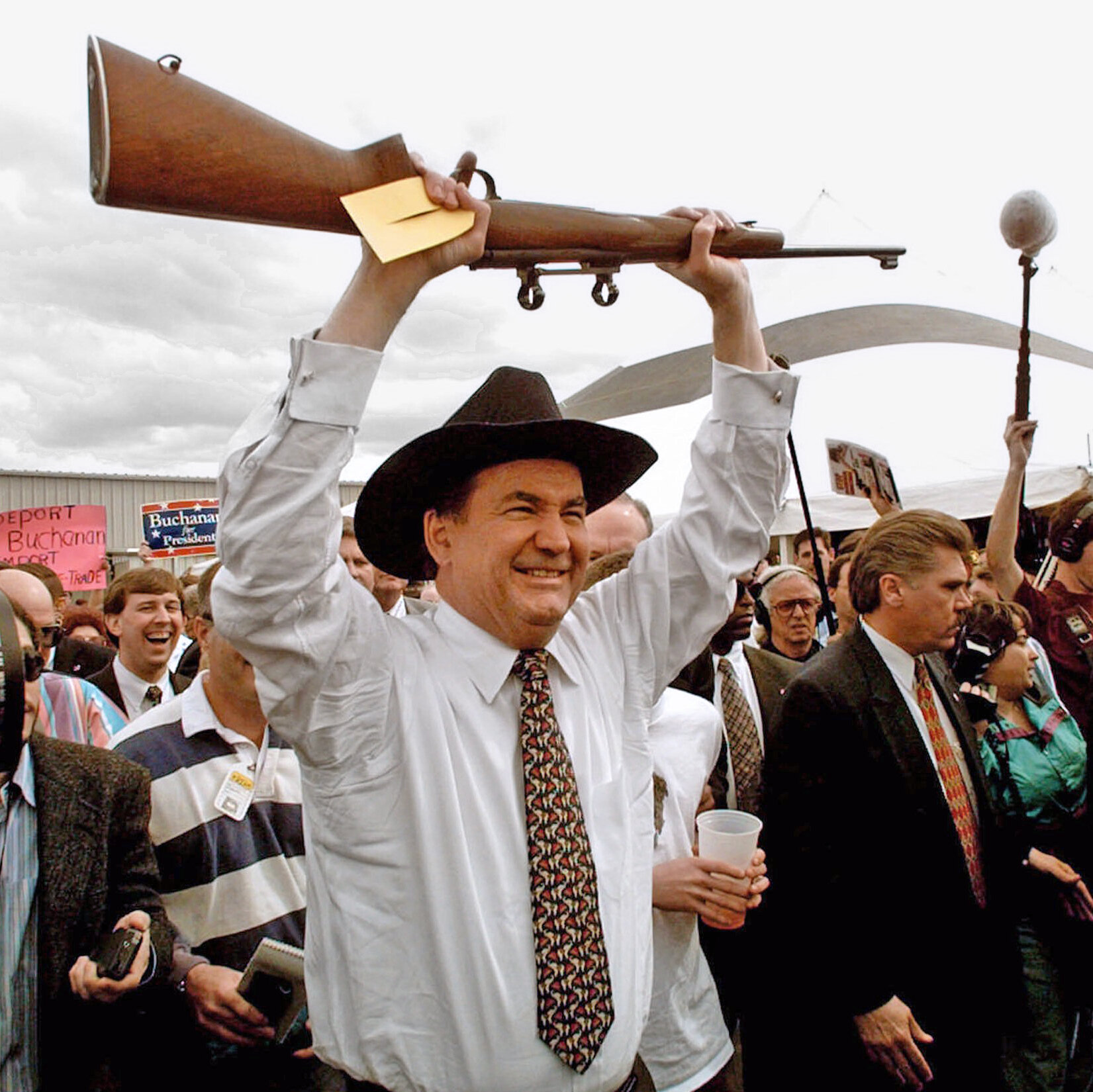
Yesterday I wrote about how a couple of marginal and obscure to the mainstream intellectuals, Murray Rothbard and Sam Francis, who 20 and 30 years after their respective deaths are turning out to have a had a huge influence on the takeover of the Republican by the far right, via the person and cult of personality that is Donald Trump and Trumpism.
A side note: There were a bunch of no true Scotsman comments in the thread, saying these guys aren’t “real” intellectuals because their ideas are ridiculous, obviously wrong, nothing but propaganda etc., and indeed the same can be said about all far right or even conservative so-called intellectuals. Related to this is the belief/idea that the noun intellectual is some sort of honorific, because it means you’re real smart and also think carefully and constructively about stuff. This in my view is not a useful way to think about the concept of an intellectual, which really just ought to mean someone who has an unusual trending toward obsessive interest in ideas as ideas. Understood in this way it’s no more a term of praise than the terms writer or musician are. Being an intellectual doesn’t mean you’re a good intellectual anymore than describing someone as a writer means they’re a good writer. End of side note.
One thing I didn’t mention when describing how these writers revivified and advanced different versions of the somewhat submerged intellectual traditions of the American Old Right is the role of anti-Semitism in all this, which was and is a huge factor.
The TL;DR version here is that the Old Right in America came out of an intensely nativist, racist, and isolationist set of intellectual traditions, that in the context of the New Right that began to emerge with the Goldwater campaign in the 1960s could be thought of as paleo-conservatism, rather than conservatism per se. What happened between, roughly, the middle of the 1960s and the election of Reagan in 1980 was that a kind of counterforce to paleo-conservatism arose as a self-conscious ideological entity in the politics of the American right. This was of course neoconservatism.
Here’s the five-minute university sketch of the split, which naturally involves many not completely accurate generalizations.
Paleos included lots of neo-confederate Southern agrarians, right wing Catholics with tender feelings toward the regime of Generalissimo Francisco Franco, Taft wing hardcore isolationists who didn’t think Hitler was really all that bad, etc.
The neocons were basically red diaper babies from the heavily socialist/communist world of 1930s NYC arguments about Trotsky in cold water walkup tenements, who suffered a collective freakout in the 1960s because of the Dirty Fucking Hippies, the black power movement, the bra-burning feminists, Mick Jagger’s gyrations, etc. A lot of these people were Jewish.
The paleos were often both openly racist and anti-Semitic. The neo-cons had plenty of racists in the mix too, but they tended to be much more of the respectable “I support civil rights of course, but affirmative action has gone too far” types, as opposed to the “Abraham Lincoln was the most evil man in American history” version, which was an opinion that was and is rampart among the paleos, and that naturally horrified the neocons. The neocons were hardcore internationalists and supporters of Israel. The paleos were hardcore isolationists, who were willing to make an exception for the cold war because godless communism had supposedly burned a lot of churches and raped a lot of nuns in Spain in the late 1930s (I’m painting with a broad brush here obviously).
There were and are, to put it mildly, some powerful subterranean tensions between these two key elements of the American right wing coalition. These tensions exploded to the surface during Pat Buchanan’s insurgent presidential campaign against GHW Bush in 1992. Buchanan was and is a Francoist Catholic paleocon, who has never been able to use the word Israel in a sentence without saying something that sounds pretty anti-Semitic either later in that same sentence, or in the next paragraph or two. Some of his most prominent supporters in the right wing intellectual ecosystem, such as Joseph Sobran, were even more overt in this regard.
Before Buchanan’s surprisingly and prophetically successful 1992 presidential campaign, the conflict between the paleos and the neos inside the American right wing coalition first hit a flash point at the beginning of the Reagan administration, when a public fight broke out between the paleos and the neos over who would be appointed to head the National Endowment for the Humanities. Reagan nominated Mel Bradford, a neo-confederate history professor and Lincoln hater, which got the neocons up in arms. They successfully pushed to get the nomination withdrawn, and the job went to their preferred candidate, William Bennett. Over the course of the 1980s resentments of various sorts between the two camps simmered, and by the end of the decade another public squabble erupted over Buchanan’s and Sobran’s increasingly vitriolic statements about the nefarious influence of the Jewish lobby (“Israel’s amen corner” in Buchanan’s words) in Congress etc.
This led William F. Buckley to, at the same time Buchanan was announcing his presidential campaign in the fall of 1991, to publish a long essay in the National Review, discussing the problem of anti-Semitism on the right, with specific reference to Buchanan and Sobran, along with Gore Vidal and the Dartmouth Review. Buckley ended up condemning Buchanan’s statements on the role of Jews in American politics as impossible to defend — a judgment that made it all the more remarkable when, just a few weeks later, Buckley’s magazine endorsed Buchanan for president.
Yet, as John Ganz points out, this kind of complicated tango with the problem of anti-Semitism on the right has been and remains a consistent theme, from Reagan and Buckley in the 1980s, to Donald Trump and J.D. Vance today. For instance, when Trump was asked about David Duke’s endorsement of him in 2016, he claimed not to know who he was, which was a brazen lie even by Trump’s standards: Trump had discussed Duke extensively when he was considering running for president on the Reform party’s (this was Ross Perot’s short-lived vehicle) ticket in 2000. See also Trump’s statement about “very fine people on both sides” after neo-Nazis murdered a progressive protestor at the infamous Charlottesville (“Jews will not replace us”) rally during his first term.
Now in 2025, with the paleos and their ideological descendants having taken over the Republican party more or less completely, and with the Israel-Palestine conflict increasingly front and center in the foreign policy realm, the deep cleavages on the right in terms of the Jewish question are becoming particularly salient, as illustrated by the ongoing Nick Fuentes/groyper fiasco at the Heritage Foundation.
The plain historical fact is that anti-Semitism has never been epiphenomenal to the Old Right, or the paleo-conservatives, or to Trumpism, which largely represents the former movements in their triumphal rather than marginalized forms. That a nativist, racist, and isolationist ideology would be profoundly anti-Semitic is something that has always been, as the social scientists say, “overdetermined.”
The practical political significance of all this at the present moment is that important roles that, in different ways, people like Stephen Miller and Bari Weiss and Ben Shapiro are playing in the radical reactionary movement that has taken over both the Republican party and the American government may end up heightening various contradictions in that movement, in ways that opponents of the regime need to be ready to exploit. This of course is a delicate matter, but it also presents opportunities to open up painful and destructive fissures in the rickety coalition of nativist white nationalists, deeply reactionary religious zealots, authoritarian plutocrats of the dystopian techie genus, rage-filled incels, and the rest of the melange of cranks, misfits, grifters, and six-time losers that make up the contemporary American right wing.