
Fashion and Historical Memory
 By
By 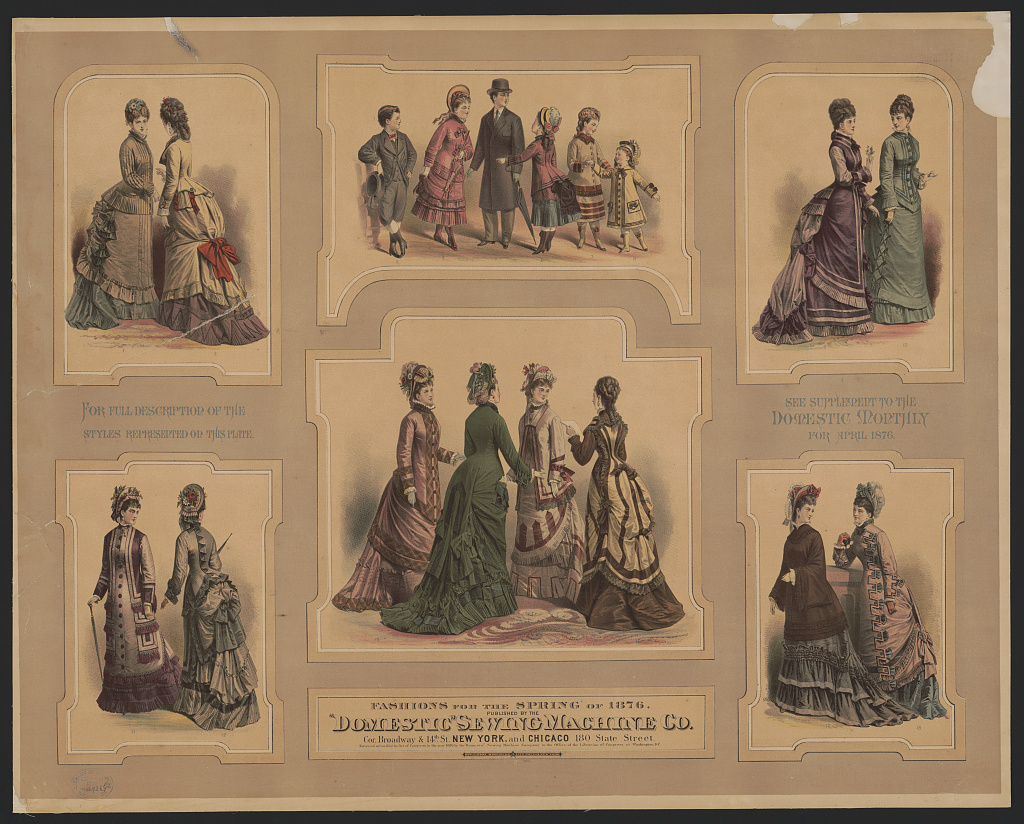
While fashion is not exactly my forte, historical memory is. And I am interesting in how ideas of fashion became ways of representing the past, often papering over the reality for nice easy visions of a past with better dresses and suits than the present. Certainly that was some of the appeal of Mad Men, great show that it was. But the 1960s are too close to paper over and in fact, one of Mad Men’s weaknesses was having to stop and spend an episode on every Extremely 60s Event, in case viewers needed a reminder about the Kennedy assassination or the moon landing. More problematic is The Gilded Age, a show that turns the horrors of the late 19th century into a Newport-based fashion show. But no one wants to hear about the real Gilded Age, with its violence, massive inequalities, racial exclusion, corrupt politics, and other horrors. The past is so much more fun when it is just nice dresses!
The London Review of Books has a short review of a new Marie Antoinette and fashion exhibit that makes some good points, even if the overall review of the exhibit is positive because, you know, dresses.
The catalogue captures all the visual attraction of the exhibition; the text, however, would have benefited from a closer reading of Caroline Weber’s Queen of Fashion: What Marie-Antoinette Wore to the Revolution (2006). Weber understood the difference between an explanation and an excuse. She turned away from monarchist blather about a queen’s martyrdom or the glories of privilege and instead offered a credible account of a very young bride whose sexually dysfunctional husband prevented her from fulfilling her only obligation: providing an heir to the French Crown. Weber lets her readers consider Marie-Antoinette’s decisions as errors in judgment whose consequences would be disastrous, not only for herself but also for her family, and for France. Frustrated and foolish, she ignored her mother’s advice to moderate her impulses and distracted herself with fashion – expensive fashion. She regularly spent more than twice her annual allowance on apparel. In 1776 she bought so many diamonds from the jeweller Charles Boehmer that she owed him 550,000 livres. The 400,000 livres’ worth of diamonds and pearls on which her trousseau money had been spent in 1770 and the two million livres’ worth of jewels she was given that year by her new family were only the start.
he V&A seems intent on shutting off consequences: the exhibition only occasionally and by omission, but the catalogue frequently. Sums of money are cited without any suggestion of their value. It might have been helpful to point out, for example, that 550,000 livres was almost two thousand times the annual income of a skilled craftswoman. Early on, the show makes the revealing point that Marie-Antoinette loved having her initials inscribed on her things. Cued to look carefully, the viewer proceeds to search for ‘M.A.’ and finds it inlaid, inscribed, embroidered and painted. Then a vitrine presents a nécessaire emblazoned ‘M.A.’, identifying it as the one that Marie-Antoinette took with her when the royal family attempted to escape France. What sort of person, whose children’s lives depend on secrecy and disguise, takes along luxurious items customised with her initials?
The issue of expense comes up repeatedly in the catalogue, only to be brushed aside. Or else extravagance is treated as an end in itself, as though it were automatically a style, whose justification could therefore be aesthetic. Is, however, ‘44 small motifs in rubies and diamonds and 44 small motifs in emeralds and diamonds’ sewn (by a chambermaid) on the heels of slippers necessarily ‘elegance’? Marie-Antoinette’s expenditures were not made in a vacuum. The money she spent on what were, after all, appearances, was drawn from a country in financial crisis. Ninety-eight per cent of her subjects lived in or near poverty, yet she expected almost all of them to pay the taxes that funded her gowns and jewels. Encouraging her closest friends, such as the Princesse de Lamballe, who was born into the aristocratic minority who owned almost all French land yet paid no taxes, to wear the latest fashion in ‘rustic’ but exorbitantly priced delicate muslin gowns, had violent consequences. In September 1792 the Princesse de Lamballe was caught by an angry mob and stabbed to death before her severed head was paraded on a pike.
Specialised fields, especially when they are marginalised, sometimes get the local facts right and miss the larger historical meanings, or hide behind technical and period terms. In the case of clothing, a pull from the opposite direction is also dangerous. The fashion industry has the money and power to divert what could be the most democratic branch of art history, including museum exhibitions, towards its profit motives and incentives to waste.
This all seems really important to me. But in the end, people want to see dresses, whether on TV or in museums. I mean, people will actually go to art museums in droves to see the kind of clothes they want. I imagine there’s a resistance to really challenging viewers here, for very clear financial reasons. It’s still a problem.