


Erik Visits an Non-American Grave, Part 2,001
 By
By This is the grave of Rudyard Kipling.
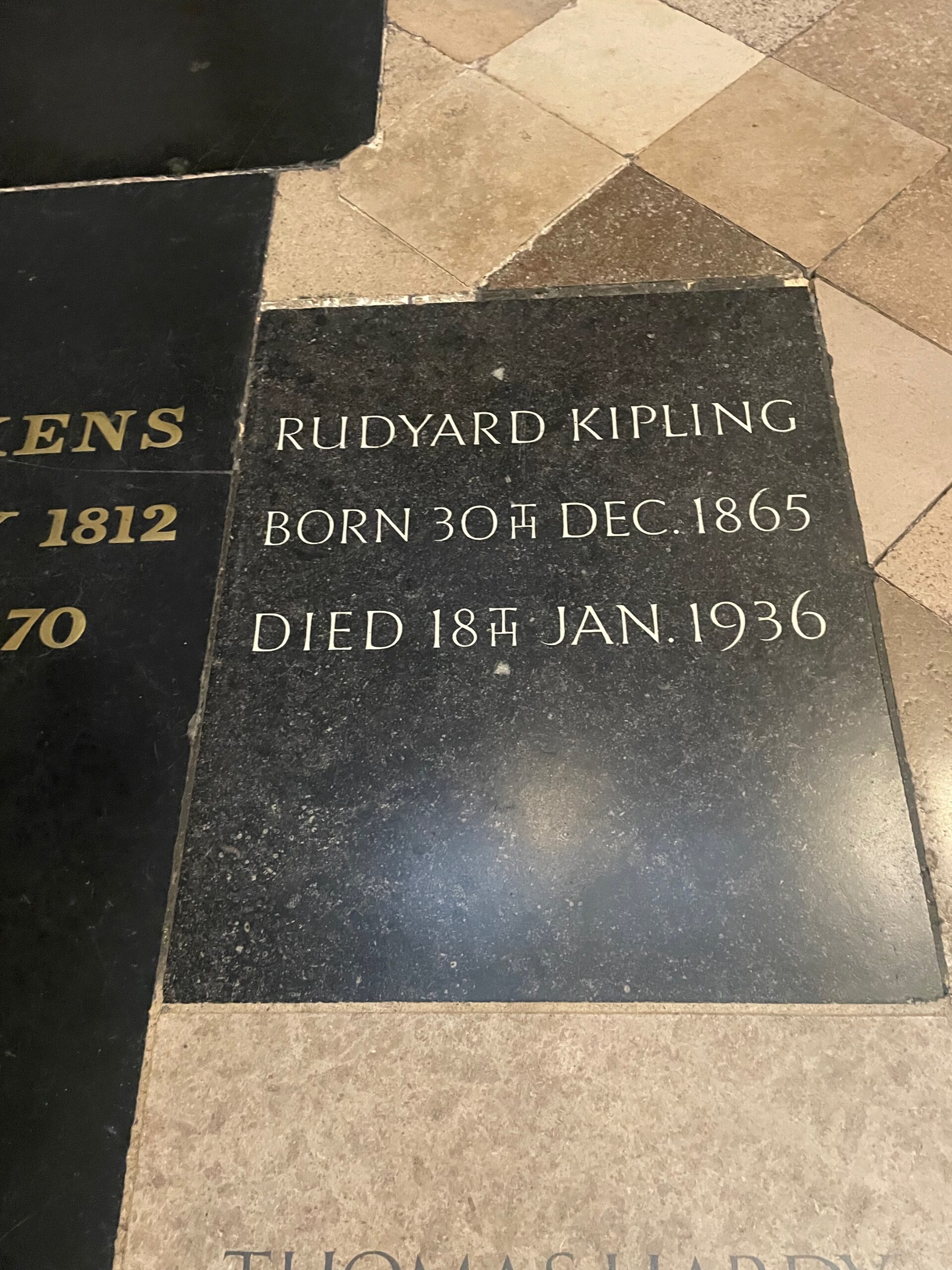
Born in 1865 in Bombay, India, Kipling grew up in the colonialism of 19th century Britain. His parents were less active imperialists than others–they were in India because his father was hired as an art professor at a school there, but even that is still an active colonialist position. There was really no way to be in India as a Brit at that time without acquiescing to colonialism. That would be Kipling’s world. But when he was 5, the kids were sent back back to England for education. Yep, at 5, and with a 3 year old sister, they were boarded out. That must have led to a fun relationship with your parents! They would stay with a couple until 1877 and hated every second of it. Will it shock you that a couple taking in kids for cash with the parents many thousands of miles away would not treat them with love? It should not. Kipling later called that house “The House of Desolation” and bemoaned the great cruelty he and his sister dealt with. Finally, his mother came back from India.
Now, the hope of the family was to prepare Kipling for Oxford. But he wasn’t a very good student and the family didn’t have the money to pay tuition so with no scholarship happening, they brought him back to India to be the assistant editor of a local newspaper in Lahore. He was fine with that. He was a very British man, but he would also identify with India, at least in his own colonialist way. Like a lot of colonial figures, he enjoyed being the man in charge in the empire than being back in cold old England. From 1883-89, he worked on various newspapers. He started writing poetry and short stories and the papers were open to publishing them. Dozens appeared. Kipling believed himself to have skill as a writer, which was true.
Kipling worked like a beast, writing all the time. He published more and more short stories–six collections appeared in 1888 alone, which is crazy. I have no idea if they are any good though. Not sure anyone really reads Kipling anymore period and if they do, probably not six books of imperialist-based early short stories. In 1889, he sold a bunch of stories and decided to see the world. He traveled through Asia and the United States, even meeting Mark Twain after simply finding his house and knocking on the door. Not sure I would be as receptive to that as Twain was.
Kipling ended his trip in London, where he wanted to establish himself as the best writer of his era. It didn’t take too long for a lot of people to believe he had a claim to it. He kept selling stories, married, and decided to live in the U.S. for awhile, renting a house in Brattleboro, Vermont. While in that town, he started thinking up what would become his real coming out party–The Jungle Book. That was published in 1894. It was a huge hit. This, like many of his stories before and after, were romanticized visions of his time in India, colonialism written onto the page in ways that had mass appeal. Major themes of his writing as well, including in his most famous book, are his anger over being abandoned as a child to terrible circumstances, as well as the need for law and order.
Kipling continued to write too. I’m really only familiar with The Jungle Book, but he was a serious story writer. He has a ton of admirers today for his style at least, though I can’t speak to it. Even in his lifetime, people would criticize him for his right-wing political views, though it was a softer form of being on the right than a lot of folks, but still praise his style. He wrote The Second Jungle Book in 1895, realizing he had a winner that needed a quick sequel. Other key books include Kim in 1901 and Just So Stories in 1902.
And then of course there’s Kipling’s most famous poem that really sums him up. “The White Man’s Burden” was published in 1899. This was a poem about the need for the United States to embrace colonizing the Philippines because they could provide those savages the kind of Anglo-Saxon civilization that they needed. Shall we read it together?
Take up the White Man’s burden—
Send forth the best ye breed—
Go bind your sons to exile
To serve your captives’ need;
To wait in heavy harness
On fluttered folk and wild—
Your new-caught, sullen peoples,
Half devil and half child.Take up the White Man’s burden—
In patience to abide,
To veil the threat of terror
And check the show of pride;
By open speech and simple,
An hundred times made plain.
To seek another’s profit,
And work another’s gain.Take up the White Man’s burden—
The savage wars of peace—
Fill full the mouth of Famine
And bid the sickness cease;
And when your goal is nearest
The end for others sought,
Watch Sloth and heathen Folly
Bring all your hopes to nought.Take up the White Man’s burden—
No tawdry rule of kings,
But toil of serf and sweeper—
The tale of common things.
The ports ye shall not enter,
The roads ye shall not tread,
Go make them with your living,
And mark them with your dead!Take up the White Man’s burden—
And reap his old reward:
The blame of those ye better,
The hate of those ye guard—
The cry of hosts ye humour
(Ah, slowly!) toward the light:—
“Why brought ye us from bondage,
Our loved Egyptian night?”Take up the White Man’s burden—
Ye dare not stoop to less
Nor call too loud on Freedom
To cloak your weariness;
By all ye cry or whisper,
By all ye leave or do,
The silent, sullen peoples
Shall weigh your Gods and you.Take up the White Man’s burden—
Have done with childish days—
The lightly proffered laurel,
The easy, ungrudged praise.
Comes now, to search your manhood
Through all the thankless years,
Cold-edged with dear-bought wisdom,
The judgment of your peers!
Yucky!
Kipling actually loved the U.S. He wanted to stay. He enjoyed it more than England. But there was one thing that bugged him–the Americans didn’t respect British imperialism. I find it fairly hilarious that the reason he stormed out of the U.S. in a huff, going back to England, was the Cleveland administration and especially Secretary of State Richard Olney invoking the Monroe Doctrine to say that the British didn’t have the right to unilaterally set its boundary with Venezuela over British Guiana at a time when the limeys were threatening invasion against the Latin American nation. How dare the Americans be so anti-British!!!!
Kipling was unbelievably popular, both with young people and serious older writers. For example, Henry James said of him, “Kipling strikes me personally as the most complete man of genius, as distinct from fine intelligence, that I have ever known.” This gives you one example of how overwhelmingly people loved him and his stories. In 1907, Kipling received the Nobel Prize for Literature, the first English language writer to win it and the youngest person at the time to win it at all. He’s also almost certainly the first winner of the award that anyone still reads today. And look, whatever you want to say about the man–and his works do not hold up well politically at all–he was the most popular interpreter of imperialism in his lifetime and at the very least is extremely important for this reason.
Kipling was a fervent supporter of the Allies in World War I. He hated the Germans anyway and so was happy to whip the winds of war against them. He paid the price too–his son was killed in the trenches. He dedicated much of the rest of his life to remembering his son and other soldiers. He was involved in the movement to create nice cemeteries for the dead in postwar France. He wrote a history of the Irish Guards, where his son had served, which he published in 1923. He also had a huge freakout over the rise of communism and hated the Labour Party. He called the government of Ramsey McDonald “Bolshevism without bullets.” Seems a bit extreme, no? To his credit though, while he had a brief interest in Mussolini, unlike a lot of his conservative ilk, he saw fascism as a major threat quite early and argued for a militarized Britain and France before the war, which was definitely not in fashion. And with his books often adorned with the swastika, which comes from India of course, once Hitler took power, he ordered that to end.
Kipling died in 1936 of a perforated ulcer. He was 70 years old.
Rudyard Kipling is buried in Westminster Abbey, London, England.
If you would like this series to visit American Nobel Laureates in Literature, you can donate to cover the required expenses here. Sinclair Lewis is in Sauk Centre, Minnesota and John Steinbeck is in Salinas, California. Previous posts in this series are archived here and here.