
Gaming Notes
 By
By 
Greetings from the doldrums of summer, LGM! I’ve had a rather exciting August. I went to Seattle, did a Worldcon, saw them throw the fish at Pike Place Market, had a delightful dinner with Scott and spouse. And, oh yeah, I won another Hugo—and lost one, to an excellent piece of science fiction criticism that is both trenchant and timely, so I’m not too cut up about that.
I’ve also done a bit of gaming this summer, a nice mix of titles that have been sitting in my Steam library forever, others that everyone has been yelling at me to try, and one that came out of nowhere to become my favorite game of the year. As usual, consider this an open thread to discuss your recent gaming.
One bit of game-related news before we get started with the reviews: Bad Viking, creators of Strange Horticulture (2022), which I discussed here several years ago, have announced the forthcoming publication of a sequel, Strange Antiquities. I’ve played the demo, and it seems very much of a piece with the original game—a shop simulator with a vaguely goth-y vibe and an underlying mystery story, this time with occult artifacts instead of magic plants. If you enjoyed Strange Horticulture, I think there’s a solid chance that Strange Antiquities will be up your alley.

The Exit 8 (2023)
Japanese studio Kotake Create’s short, disquieting game dumps you into the action with absolutely no fanfare. You start the game walking down an underground passage in a Japanese metro station, on your way to the titular exit. You walk past a blank-faced salaryman going in the other direction, vaguely observe the informational signs and advertising posters, and turn the corner to discover.. exactly the same passageway. And then again. And again. Eventually a helpful sign appears to explain the rules (if not the cause) of your predicament. Some of the corridors you walk down contain “anomalies”. Some don’t. You can only continue down corridors that aren’t anomalous, and otherwise you must turn back. Do this correctly eight times, and you’ll be allowed to leave. Screw up, and you’ll be reset back to zero and have to start all over again.
I’m not much for horror games (my lifelong 7th Guest situation notwithstanding), and I probably wouldn’t have even heard of The Exit 8 if it weren’t for Adrian Hon’s excellent newsletter. Hon mostly writes about escape rooms and other live action roleplaying, but you can see why The Exit 8 appealed to him. It’s a simple, mostly realistic game mechanic that one could easily imagine being replicated in an escape room setting, and yet it’s also almost endlessly versatile, requiring the player to pay attention to changes both big (an oncoming rush of dark-red water) and small (an uncanny change in one of the advertising posters) in an environment that is designed to be as nondescript as possible. At the heart of The Exit 8‘s horror is the fact that places like an underground station are a sort of liminal space where we’re expected to move without awareness, temporarily shutting off our humanity. The idea of being stuck in one endlessly is a terror that comes across instantly without the game having to resort to much in the way of overt horror imagery. The challenge of getting out, though simple to understand, is quite difficult to achieve.
It’s such an instantly compelling—and disturbing—conceit that I wasn’t surprised to learn that The Exit 8 has already received a film adaptation, directed by Genki Kawamura. At the moment the film appears to be screening mostly in festivals and in Japan, but I’m going to try to track it down, for the simple reason that if I do manage to watch it, it will be the very first time I will have watched a video game movie after playing the game.
Botany Manor (2024)
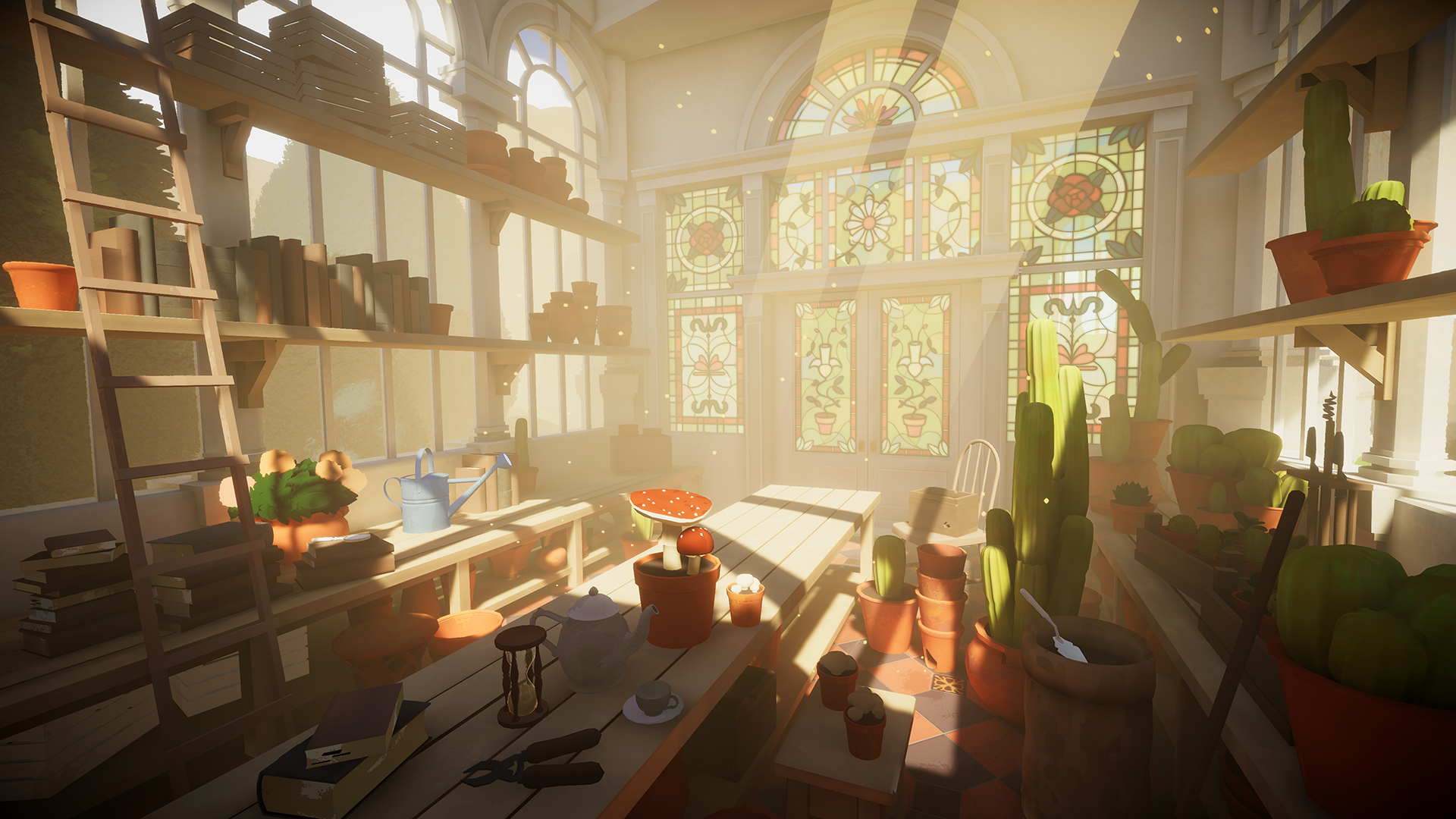
In my last games roundup I wrote about the excellent, creepily atmospheric Lorelei and the Laser Eyes (which then went on to place last in this year’s best game Hugo; pfeh). Lorelei was so good and so original that it was possible to forget, while playing it, that its basic conceit, of a large, locked-down house that must be opened up through the device of solving puzzles placed within it, is one of the cornerstones of computer gaming. Along comes UK-based Balloon Studios’ Botany Manor to remind us not only of this fact, but of all the many different emotional registers that this type of game can support. If Lorelei was a game about memory, guilt, and abstract art, Botany Manor is about, well, plants. You play Lady Arabella Greene, a 19th century amateur naturalist who has returned to her stately home from her travels to discover that the house is empty and locked down. This is a particular problem because Arabella needs to complete a manuscript about unusual plants. There’s nothing for it, then: the player must grow each of the plants, and through doing so, unlock the forbidden rooms of Botany Manor.
There is, it must be acknowledged, something rather silly about Botany Manor‘s conceit, even in a subgenre where people supposedly leave coded keypads throughout their homes. Questions such as “where did the servants go?”, “why is Arabella writing a book about plants she’s never grown?”, and perhaps most importantly, “why does one person need such an enormous house and grounds?” constantly occur to one while playing the game, and ultimately just have to be ignored. If you can do that, however, you’ll discover a fun, charming game. As dozens of farming simulators have demonstrated, there are few things gamers love more than to grow things without having to interact with pesky dirt, bugs, and weather, and if you add to that challenge some puzzles—working out that this plant grows in orchards because it is fertilized by windfall fruit, or that that plant exists in symbiosis with a particular moth—you get something very satisfying. Along the way, there’s a bit of environmental storytelling about Arabella’s difficulties being taken seriously as a woman scientist, and her choice to ultimately go around the scientific establishment. Botany Manor is not a particularly challenging game, but it works perfectly well as a few hours’ distraction while you wait for the next all-consuming brain-teaser to show up. And if you know children who are interested in exploring this type of puzzle game, I think that it would be a great introduction to the form.

Type Help (2025)
There may come a day when the phrase “inspired by Return of the Obra Dinn and Her Story” will not send me rushing to play before the sentence even concludes, but the day on which I heard about Type Help, a free web game by William Rous, was not that day. And the thing is, I’m rarely wrong in that impulse. Something about this lineage of conceptually bold logic puzzles seems to bring out the best in indie developers, who go on to produce one banger after another. Type Help is no exception. It presents the player with a selection of transcripts of events that took place in an English country home on an evening in 1936—shortly before a dozen bodies were discovered on the property. Each transcript is identified by a timestamp, the room it took place in, and the people who were in the room. To uncover the story, the player has to discover more transcripts—that is, to work out how people moved around, and who was in what room at each given time.
It’s a clever mechanic, at once simple and challenging, The cleverest thing about it, however, is how, having figured it out, it lulls you into the false belief that you have discovered all the game’s twists. As bodies begin appearing throughout the house—and as the radio play nature of the game’s storytelling obscures some extremely pertinent information—you slowly begin to understand that there is a much bigger, more mind-blowing conceptual leap that you need to make to crack the game’s case. To reveal any more about this twist would be unconscionable, so I’ll just say that it makes not only for a clever puzzle, but a great story, one that draws as much from Doctor Who as Agatha Christie. As Type Help approaches its climax, and as the full extent of what happened in the house grows clearer, the game becomes genuinely terrifying, introducing the player to an existential menace whose dread lingers, even decades after the events at the house took place.
It’s such a good story that it almost makes up for the fact that, like Obra Dinn and most of the games that follow it, Type Help struggles to come up with a suitably cathartic conclusion to its story. The flip side of letting the player make their own path through a mystery is that you can find yourself struggling to write the final chapter—all the more so in the case of Type Help, which has several hidden endings, each of which ups the dread quotient without managing to feel like a solid period on the game. The game has, unsurprisingly, already been snapped up for commercial development (under the somewhat uninspiring title The Incident at Galley House), and perhaps this new partnership with studio Evil Trout will help Rous discover a way of ending this sort of story that has eluded the likes of Lucas Pope and Sam Barlow. Even if it doesn’t, however, what will result is sure to be exceptional. I will absolutely be lining up to buy the commercial version of Type Help when it appears, and I hope you’ll do the same. But in the meantime, run, do not walk, to play the free web game. It is just that good.
Balatro (2024)
I tend to only write about games in these posts after I’ve finished them, but I’m making an exception in the case of 2024’s blockbuster casual gaming phenomenon. First, because as a game that, despite its pretense to be a twist on poker, is actually a sophisticated, versatile form of solitaire, there isn’t actually any way to “finish” Balatro—you can always just start another run. And second, because I have been struggling to clear even the intermediate hurdle that would allow me to claim to have won at least some part of the game, and I wanted to talk about why that is.
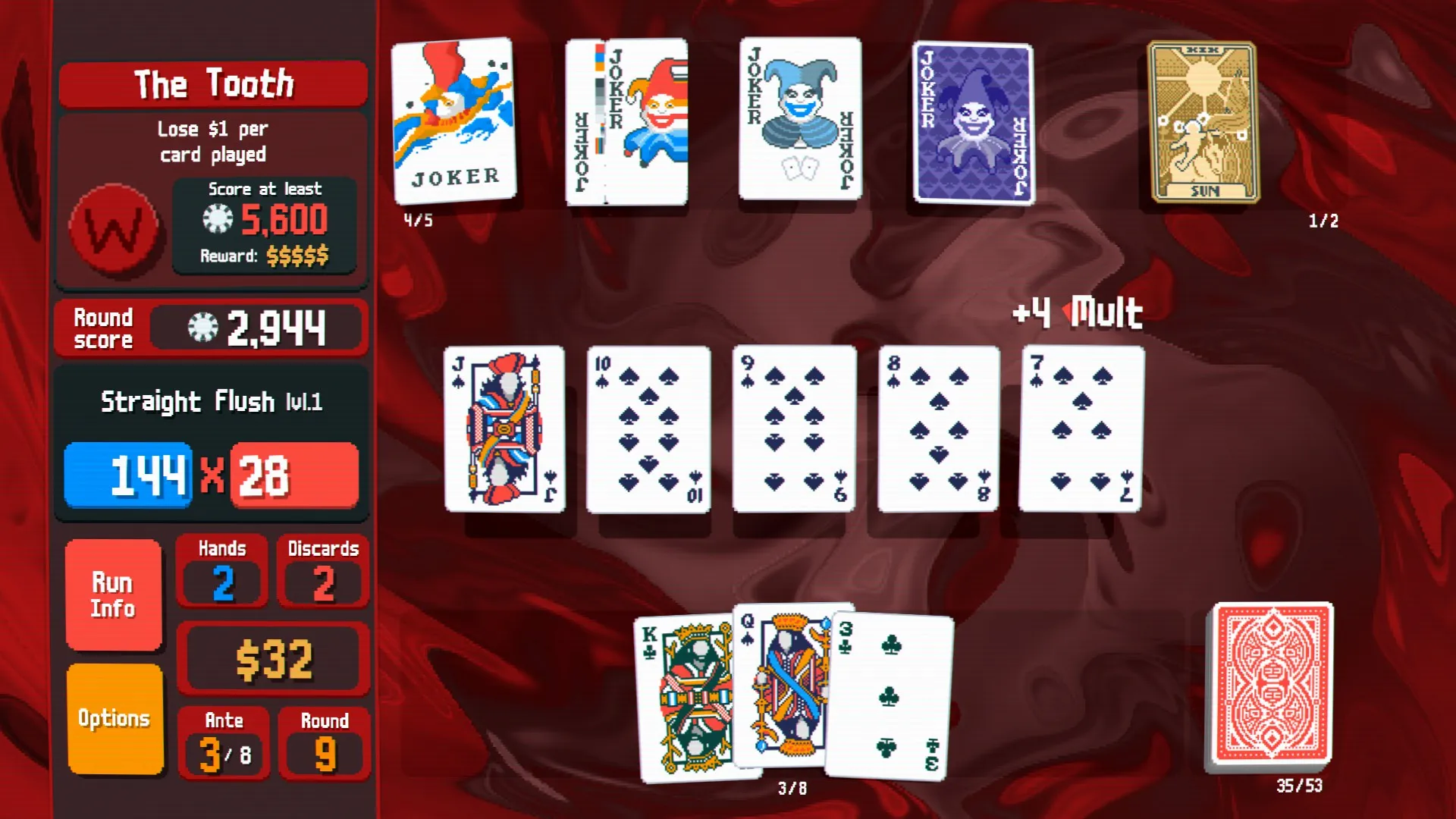
In every round of Balatro, you’re dealt a hand of around eight cards (already not very poker-y), which you can discard and replace several times (ditto) in order to make up patterns like a full house or two pairs (aha! some poker terms!) which are then scored against the number of points you need to complete the round (ah; well, nevertheless). Very quickly, the game introduces complications to this basic game. One in every three rounds is a “boss” round with an added difficulty—cards being drawn face down, for example, or a certain suit delivering no points. Winnings from previous rounds can be used to buy special abilities—to increase the point number of regular cards in the deck, or upgrade the scoring of a certain hand, or, most importantly, buy jokers that manipulate and multiply the scoring of individual cards and hands. A hand that scored a hundred points in an early round can score 5000 points in a later one, which is good, because the barriers to completing each round get higher and higher with alarming speed.
The genius of Balatro, which was created by a pseudonymous Canadian developer known as LocalThunk and has since become a global phenomenon, is in marrying a logic game—figuring out what combination of the truly dizzying number of jokers, action cards, and special abilities will best maximize your scoring potential—with sheer luck. By which I mean not just the cards that are drawn in each hand, but the jokers and other cards that become available every time you go shopping. This, however, is also the source of the game’s frustration. Getting a truly killer deck is at least as much about chance as it is about skill, and sometimes even that it isn’t enough—no matter how good your deck is, a shitty draw of the cards can still kill your run dead. After a few weeks of playing, I’ve found that I can usually build a deck that scores four figures every round, but that’s hardly enough in the game’s higher levels. As much as that’s a reflection of my skill, it also represents the immense number of variables in the game, which make it difficult (for me, at least) to come up with a coherent, effective strategy. My experience is that it’s very easy to come back to Balatro—the allure of the game’s combination of simplicity and complexity is pretty much irresistible—but also really easy to get frustrated and put it down, and I’m not sure I’m ever going to put enough time into it to get past the barriers that are currently holding me back.
Blue Prince (2025)
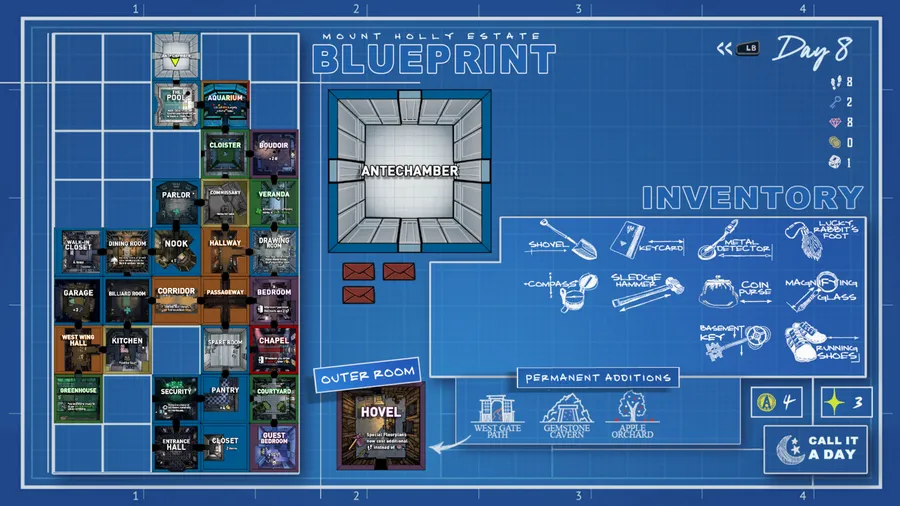
If Balatro is a game I haven’t finished, Blue Prince, from LA-based developer Tonda Ros, is one that I have barely started. I’ve played the game for a few hours, and though I’m sure I’ll have more to say about it in a future post, I wanted to get a few initial thoughts down, mainly because of how it intersects with several of the games I’ve talked about above. Like Botany Manor and Lorelei and the Laser Eyes, this is fundamentally a story about solving a puzzle that is also a house. You play Simon, a young man who has inherited his great-uncle’s estate, so long as he succeeds in finding “the 46th room in a 45-room house”. And like Balatro, this is a game with a lot of variables, whose gameplay comes down to luck as much as it does solving puzzles.
The key innovation of Blue Prince is that the house it takes place in does not have a fixed map. Every time you open a door, you’re offered several rooms to “draft”, essentially building the manor as you go. Different rooms have different properties—some contain resources; others slow you down; and others change the conditions of your progress through the manor. Because each room has a fixed layout (including outgoing doors) and orientation, it’s possible to lock yourself out of the more distant parts of the mansion; and because the number of rooms you can traverse is limited, it’s possible to create a path that you can’t backtrack. Either of those conditions can trigger a reset of the game (what’s considered a new day). But each day, the house you build will be different from the one you explored the day before.
There are puzzles in some of the rooms in Blue Prince, but so far the ones I’ve encountered have been fairly simple. The real challenge of the game lies in working out what combination of rooms and other conditions is necessary to get past certain obstacles. To obtain a certain padlock code, for example, you need to generate the darkroom, and the breaker room where you can activate the darkroom’s lights, and be in possession of a magnifying glass with which to examine the photos that you can now see. Items picked up on one day will disappear on the next—there’s a coat check room where you can store them, but that requires you to find it on two separate days, which is by no means guaranteed. I can easily imagine that being so dependent on chance will become wearying, as it has in the case of Balatro. But in the meantime, it’s staving off frustration. It feels a lot less possible to get stuck in Blue Prince, to find yourself banging your head against a specific puzzle as you do in traditional puzzle house games—since, after all, you can always just start another day, and go down a completely different path. Stay tuned for the next post in this series to see how long that feeling holds—not to mention, how many of the house’s secrets I’ve yet to discover.