Subscribe via RSS Feed

Reproductive Freedom Roundup

[ 0 ] April 14, 2006 | Scott Lemieux
  • I think it’s correct to say that it’s frequently “a background assumption of the conversation — so much so that neither participant questions it — that women have the ability to plan how many children they will have. No one even asks how it is that women will be able to make this decision; it’s taken for granted. And I wonder how often do we have a conversation with a casual, background assumption that families will be able to plan the number of children they will have.” In this sense–as we can see by the number of people in South Dakota who voted for Republicans on tax or agriculture issues and got an atavistic abortion ban instead–the pro-choice movement has been a victim of its own success. A lot of women don’t have to think of abortion as a political issue; when they discuss things like whether to have a planned c-section, its availability is just an underlying assumption rather than something which requires struggle to achieve. One potential positive that can be derived from the less-disingenuous-than-usual success of the forced pregnancy lobby South Dakota is that it might make that point clear. But it won’t just happen– pro-choicers have to be proactive about it.
  • Matt does a great job with the obvious unseriousness of attempting to ban Mifepristone on “public health” grounds. Given that it’s both safer than many other drugs nobody is trying to ban but also far safer than childbirth, there’s obviously no principled justification that doesn’t circle back to wanting to restrict abortion rights. (And, of course, we have yet more examples of what a pathetic dodge the focus on late-term abortions is; people who were serious about avoiding them, as opposed to using them as a rhetorical wedge to get much broader regulations passed, would want to make RU-486 more easily available.)
  • The ratcheting-up of silliness with respect to pharmacists interposing themselves between the people with the actual authority to write prescriptions and the medical interests of their patients in order to impose your moral convictions on others (which has now extended beyond dishonest claims about Plan B to reach to giving antibiotics and vitamins to women who make moral choices that you don’t like) compels me to point out again how ludicrous the claims that such actions constitute acts of “principle.” The “principled” action in this case would be to say that “because I cannot in good conscience dispense drugs that are, er, accessories after the fact to abortion or something–I’m sure it it’s in the Bible somewhere if you squint really hard, and if James Dobson books are religious texts–I must resign.” Conversely, the argument that “I should continue to get paid although I refuse to do my job” is the antithesis of an act of principle. It’s sure easy to be “principled” if this means “never having to accept any negative consequences for your actions.”

LPD: The New Dreadnought?

[ 1 ] April 14, 2006 | Robert Farley

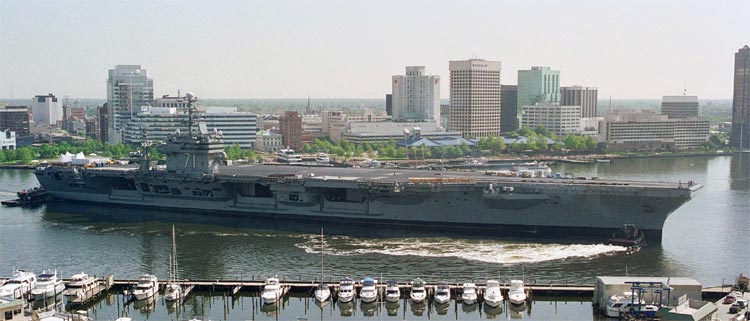
Another interesting article in the April 3 Defense News concerns the increasing focus of the world’s navies on “expeditionary” ships, like LPDs, LHDs, LCCs, LHAS, command ships, and so forth. Broadly, this group includes just about any ship that is designed to manage, project, and protect ground expeditions as a primary mission. These ships are large, expensive, tend to carry helicopters, and usually have the capability to deliver and keep supplied a contingent of ground forces.

The USN has long been in the amphibious assault game, and currently has 12 amphibious assault ships (Tarawa and Wasp classes- LHA), and a dozen amphibious transport docks (LPDs). The Royal Navy has one LHA and two LPDs, and the French Navy has recently commissioned the first of the Mistral class, a large amphibious command ship. That the Americans, British, and French have such ships isn’t particularly surprising, given that these three countries have decided to maintain both blue water navies and expeditionary capabilities. What’s more interesting is that smaller navies are increasingly getting into the amphibious assault game. The Dutch commissioned Rotterdam, a 17000 ton LPD, in 1998. Spain has built two large LPDs and is building a big LHA, the Italians are building three LPDs, and Portugal is building one. Canada has expressed an interest in purchasing one of the US San Antonio class LPDs, roughly at 25000 ton ship. The trend extends to Asia, where India in attempting to buy a US LPD, and Japan operates three small LPDs. South Korea, believe it or not, is building a 19000 ton LHA. Malaysia is considering building two new 18000 ton LHAs.

The amphibious assault ship spree is somewhat reminiscent of the drive, around 1910, of a number of major and minor powers to purchase or build dreadnought battleships. Countries that had no business owning major modern units, like Brazil and Argentina, spent enormous sums on modern vessels for reasons of national prestige. However, the Defense News article suggests a more rational purpose to the purchases. As major warfare operations have increasingly become coalition expeditionary efforts, states with small militaries want a way to contribute. An amphibious assault ship gives a country like Spain, the Netherlands, or Canada a way to involve itself in an expeditionary operation without being excessively dependent on one of the major naval powers. Like their armies, the navies of these countries are becoming less focused on the traditional forms of territorial defense and more on the need for policing, peacekeeping, and other forms of expeditionary warfare. Also, amphibious assault ships are easier to sell to defense-spending averse European publics (and legislators) because they can be portrayed as more flexible and less “aggressive” than traditional naval vessels.

Still, I wouldn’t discount a constructivist explanation focused on national prestige and “appropriateness”. If Portugal has an LPD, then what does it say about Canada that they lack one?

[ 0 ] April 14, 2006 | Robert Farley


Friday Cat Blogging… Nelson

On Fish And Originalism

[ 0 ] April 14, 2006 | Scott Lemieux

One strange thing about Stanley Fish’s defense of an originalism based on discovering the intentions of the author is that most defenders of originalism see the obvious fallacy involved. In addition to Scalia, who Fish mentions, even Robert Bork’s notoriously flimsy defense of originalism understands that “[t]he requirement that the judge know what the specific intention of the lawgiver was regarding the case at hand would destroy all law.” (TTOA, 162) In addition to the philosophical problems Matt notes is the additional problem that when it comes to law there is no meaningful individual “intent” because statutes and constitutional provisions have multiple authors, and hence multiple subjective intentions. Indeed, many of the most interesting problems of statutory and constitutional interpretation arise because ambiguity is useful in generating the support necessary to ratify them; different actors can assume that they mean different things. As Bork and Scalia realize, if you define originalism in this way, then originalism fails as a grand theory before you even get out of the starting blocks.

This also explains why Fish can go in this direction, since he is quite open about the fact that originalism completely fails to produce anything resembling determinate results. And Fish is also right, of course, that Scalia and Bork’s textualist originalism–while passing one obvious killer objection–also completely fails to produce determinate results. To talk about deriving determinate meanings from broad and/or ambiguous texts ultimately runs into all the same problems that the cruder form of originalism has. This can be easily seen by looking at originalist defenses of Brown v. Board. It’s not strictly accurate to say that you can’t come up a plausible originalist defense of Brown, but you can do so only by defining legal principles at such a high level of abstraction that anybody can call themselves an “originalist,” and this then leads you to Dworkin’s point that choosing among the multiple level of abstraction at which constitutional principles can be read is something for which “originalism” provides no help, permitting the “originalist” judge to make arbitrary choices that are congenial to the outcome she desires. And even in cases in which originalism would seem to produce a fairly compelling result, in practice its purported adherents generally feel free to set it aside. But I don’t think Fish’s move backward solves any of these problems, and it remains unclear why the point of interpretive work “will always and necessarily be the specification of intention.”

The Strange Decline of Ressentiment

[ 0 ] April 14, 2006 | Scott Lemieux

Odd; maybe it’s that I had a good news/company/food kinda day, but I’m actually inclined to celebrate the 2005-6 Northwest Division champions while noting the admittedly glorious Canucks elimination as a secondary item. Of course, the ressentiment frame doesn’t really fit in this case anyway, since I cheer for the marginally more historically successful team.

I would like to say that I am also happier when the Mariners win than when the Yankees lose, but let’s just say I was dancing up and down in my apartment when the Diamondbacks won the 2001 World Series…

Lemay II

[ 0 ] April 13, 2006 | Robert Farley

Matt notes that the Weekly Standard has a pet Air Force general, Thomas McInery, who is willing to recycle every bit of nonsense about airpower that you can think of; overestimating the ease of decapitation, overemphasizing the role of airpower in conventional warfare, ignoring or dismissing the civilian consequences of airstrikes, and so forth. That there is considerable correspondence between the Air Force’s vision of warfare and the neocon understanding of the world isn’t particularly new or surprising, but I didn’t realize that there are still people out there who want to grow up to be Curtis Lemay.

Minesweepers

[ 0 ] April 13, 2006 | Robert Farley

Interesting article in the latest Defense News (subscription required) about the Navy’s decision to fold its minesweeping assets into the Anti-Submarine Warfare Command. The move obviously doesn’t make sense to the minesweeping community, and doesn’t make much sense to me, either. The Navy has been quiet about the move, but the article suggests that the decision was made by officers without much interest and experience in mine warfare. The move will also result in the retirement of half the USN minesweeper fleet. Some of the material gap will be covered by the minesweeping module of the new Littoral Combat Ship, but the folding of mine warfare into ASW has some officers concerned that minesweeping will get the short end of the budgetary stick in a Command dominated by ASW.

Why is this a problem? Mine and submarine warfare are both naval equivalents of asymmetric warfare. They are weapons of the weak, designed to offset an enemy surface or air advantage. Of the two, mine warfare is less expensive and potentially more dangerous, especially as the USN’s focus has moved toward littoral areas where mines will likely be most effective. Anti-submarine warfare is more expensive, more interesting, and higher tech, which is probably why the Navy seems more interested in it than minesweeping. While this isn’t the most serious crisis facing the Republic, it is evocative of a Pentagon culture that continues to focus on expensive, high tech solutions to problems and ignore low tech, asymmetric threats.

The Guy Who Screwed Up My Order At the Drive Through? He Wanted Hitler To Conquer Europe!

[ 0 ] April 13, 2006 | Scott Lemieux

William Kristol–who I would say was “phoning it in” except that punching the numbers on the phone requires effort; it’s more like that Alec Baldwin “how to be a handsome actor” sketch where you just pick up the phone and start talking, or in this case recycling ludicrously inappropriate analogies–doesn’t even bother with a serious argument and heads straight for Munich like any fourth-rate blogger for whom “Peace In Our Time” is the only knowledge about foreign affairs not derived from Civ 2:

IN THE SPRING OF 1936–seventy years ago–Hitler’s Germany occupied the Rhineland. France’s Leon Blum denounced this as “unacceptable.” But France did nothing. As did the British. And the United States.

In a talk last year, Christopher Caldwell quoted the great Raymond Aron’s verdict: “To say that something is unacceptable was to say that one accepted it.” Aron further remarked that Blum had in fact seemed proud of France’s putting up no resistance. Indeed, Blum had said, “No one suggested using military force. That is a sign of humanity’s moral progress.” Aron remarked: “This moral progress meant the end of the French system of alliances, and almost certain war.”

Look, enough already. The analogy with Iran and Nazi Germany is a little better than it was when it was dusted off three years ago; Iran going nuclear would actually be a security threat to the United States, while Hussein for all intents and purposes posed no security threat to the United States at all. But all analogies with Chamberlain are null until Iran has the potential capacity to conquer and initiate full-scale genocide over a large region, or in other words not in any foreseeable future. Iran having nuclear weapons is certainly suboptimal, but at least two nasty Stalinist regimes have had nuclear weapons and the republic still stands, with its gravest security threats having nothing to do with either. These analogies are pathetically quarter-assed smear jobs, glossing over every difficult question.

It’s also worth noting that the purported domino effect that the Iraq war would purportedly unleash throughout the middle east, causing dictators to surrender in trembling fear to pro-American and -Israeli liberal democracies, seems not to be working in this case. Strange. It’s almost as if invading a country for no obvious reason makes it all the more important for states to acquire nuclear weapons. What a surprise!

Dissatisfaction

[ 0 ] April 12, 2006 | Robert Farley

Make sure to read Fred Kaplan’s column on the increasing discomfort of the officer corps with the Bush administration, and with Don Rumsfeld in particular. Also take a look at this NYT op-ed by Major General Paul Eaton, which I unfortunately missed at the time. General Eaton gave a lecture in my American Foreign Policy class back in the spring of 2000, while he was stationed at Fort Lewis.

I’m of two minds on the question of dissatisfaction in the officer corps. I recall, at SWAMOS 2000, Eliot Cohen talking about how the Clinton administration had allowed the senior brass far too much latitude, and that a Republican administration would likely see the firing of a few generals in short order, just to put them back in line. I do think that Clinton was too deferential to the uniformed military, and that the one ray of light in the Rumsfeld DoD has been the willingness of civilians to assert control. But that is obviously also a double-edged sword, and the restoration of civilian authority would undoubtedly have gone more smoothly and been less destructive if a) it hadn’t involved the silencing of military voices when that expertise was most necessary, and b) the civilians in question weren’t so goddamn stupid.

UPDATE: Brad Plumer says the same thing, only better.

Bruce Tinsley: As Smart As He Is Talented

[ 0 ] April 12, 2006 | Scott Lemieux

The problem with the wingnut math put forward by the likes of Tinsley is that between running the IRS, foreign aid, grants to Robert Mapplethorpe and buying Cadillacs for welfare mothers they generally account for about 250% of the budget. (via Atrios.)

At least your slightly classier brand of wingnut grossly overestimates the cost of drop-in-the-bucket federal spending to cover the Iraq war, rather than the whole federal budget…

The Wolf That Cried "Media Bias!"

[ 0 ] April 12, 2006 | Scott Lemieux

Treason in Defense of Slavery Yankee and Captain Ed edition. (See also Mahablog.)

This reminds me of one of my favorite techniques of warblogger hackery–use conflicts between the administration and intelligence agencies to exculpate the President over his lies about WMD, (poor Bush, duped by George “Slam Dunk” Tenet) while leaving out the fact that the source of the conflict was that the administration thought that intelligence agencies were underestimating Iraq’s capacity. (A little more creative than the “no, really, they’re still there! And anyway, this war wasn’t about WMDs, it was about the enforcement of UN resolutions!!!!!!!” gambit, anyway…)

…or, as Ezra puts it:

Some politicized desk jockey in DC was heeded over nine experts each with a decade plus of experience in a relevant area. He was listened to because his judgments squared with that of “Curveball,” the Iraqi defector who claimed to be a chemical weapons engineer, turned out to be a liar, and appears to have singlehandedly concocted around 50% of our case for war. Impressive work, considering his code name, basically, means betrayal. How cunningly Shakespearian of him.

Drinking Liberally-Lexington Recap

[ 0 ] April 12, 2006 | Robert Farley

The inaugural meeting of DL-Lexington went well, as far as I can recollect.

Submitted without editorial comment, Minka:

  • Switch to our mobile site