
Erik Visits an American Grave, Part 2,228
 By
By This is the grave of Jan Matzeliger.
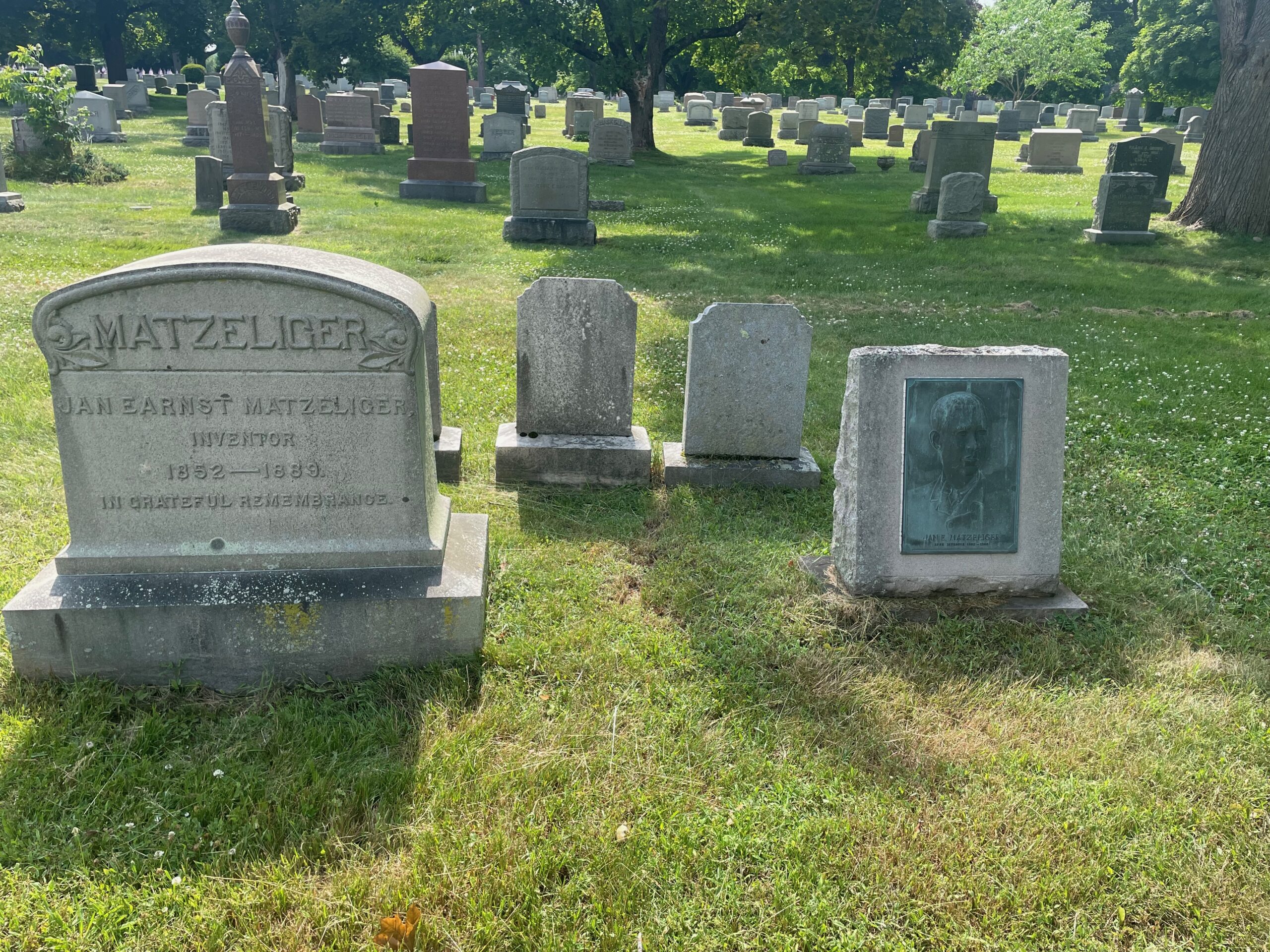
Born in 1852 in Paramaribo, in which is today Surinam, but was then Dutch Guiana, Matzeliger was the child of a relationship between a free man and a slave. Whatever that relationship was, it cannot be called consensual, by definition, since she had no legal choice. His father was a German descended Dutchman living there. He was a shipbuilder and rich man, one of the big shipping capitalist of the shrinking Dutch empire. His father owned his mother.
While I don’t know the specifics of how Matzeliger’s father thought about all of this, the fact that the young man was apprenticed out in a shipyard at the age of 10 isn’t too surprising. White fathers of mixed-race children often gave them some limited advantages, at least more than other slaves. That’s not universal–plenty of fathers would happily sell off their own children for profit, such was the moral degradation of slavery. But still, this isn’t that unusual of a situation. It was still a slave society too–the Dutch didn’t end slavery until 1863.
Well, the kid was obviously quite intelligent. Matzeliger was very good at mechanics. He became a tinkerer and that’s the kind of guy who makes a lot of sense in a shipping industry where boats are always a bit of a dicey proposition, where small changes can lead to improvements. So he had chances to do different things. Then slavery ended shortly after he started his apprenticeships, so he had more opportunities than he would have. That meant that he could get out. He left Dutch Guiana when he was 19, so about 1871. It wasn’t hard for him to be hired on a ship as a mechanic given his proven skills.
Matzeliger did this for several years before deciding to live in Philadelphia. He didn’t speak English at this time, but that wasn’t that big of a barrier in an immigrant world. He did learn enough to get by of course. After a short time though, he moved to Lynn, Massachusetts.
Lynn was the home of the American shoe industry. It was already a pretty advanced industrial town, having seen a major strike in 1860, the largest American strike before the Civil War, for example. To this day, it is a working class town, now in the deindustrialized world with all the problems that leads to. But because he was good with his hands and with machines, Matzeliger found a lot of opportunities to help the shoe capitalists automate their industry. He took out a bunch of patents in the 1880s, but the big one was the lasting machine. Lasts are the wood or metal models that shape the shoes (best I can understand it anyway). To automate this was to vastly improve production and eliminate a lot of labor. Now, much of that eliminated labor was pretty bad work–a lot of that was contracted out to sweated home work so it’s not like these were high-paying jobs. But they were jobs. Let me just quote from here as to precisely what Matzeliger did with his new invention, since it’s easier than me poorly describing it:
At that time, shoes were made mostly by hand. For proper fit, molds of customers’ feet had to be made with wood or stone called “lasts” from which the shoes were sized and shaped. Though the cutting and stitching of leather involved some degree of mechanization, the final process of shaping and attaching the body of the shoe to its sole was done entirely by hand with “hand lasters.” This was considered the most difficult and tedious part of the assembly, and it presented a major problem in that workers could not complete the assembly of a shoe as quickly as a machine could produce its parts. In effect, a bottleneck was created.
Matzeliger set out to find a solution to this problem. He thought that there had to be a way to develop an automatic method for lasting shoes. He started to develop designs for machines that could do the job. He experimented with wooden models, then iron models, and finally, in 1883, he applied for a patent on a “lasting machine.”
On March 20, 1883, Matzeliger received patent number 274,207 for a machine that held a shoe on a last, gripped and pulled the leather down around the heel, set and drove in the nails, and then discharged the completed shoe. His machine could turn out between 150 to 700 pairs of shoes per day, versus a typical skilled hand laster’s fifty.
Matzeliger’s automated lasting machine increased the speed of shoe making by up to 14 times, so this is really a revolutionary technology. Today of course, lasts are some kind of super advanced plastic. Matzeliger took out his patent on the lasting machine in 1883. Shoe prices in the nation dropped by half in the next couple of years. It’s not really the most important thing here, but it’s worth again noting that this invention was by a black man in a racist society. Even in a place such as Massachusetts, such a thing as a black inventor making major money off his invention was mighty unusual.
Matzeliger made a bunch of money here too–his machine really did revolutionize the shoe industry. He started the Consolidated Lasting Machine Company and by 1889, it dominated the shoe industry.
But there was one big problem for Matzeliger. He had tuberculosis. Hard to say how he got it, it was so common and these dark and dreary places where people lived and worked could spread it like wildfire. So just as the real money was starting to come in on his invention, he died in 1889. He was 36 years old.
Jan Matzeliger is buried in Pine Grove Cemetery, Lynn, Massachusetts.
If you would like this series to visit other black inventors, you can donate to cover the requried expenses here. Garrett Morgan, who invented the three-light traffic stop light, is in Cleveland. Sarah Boone, who invented the modern ironing board, is in New Haven, Connecticut. Previous posts in this series are archived here and here.