
Erik Visits an American Grave, Part 2,223
 By
By This is the grave of John Dunlop.
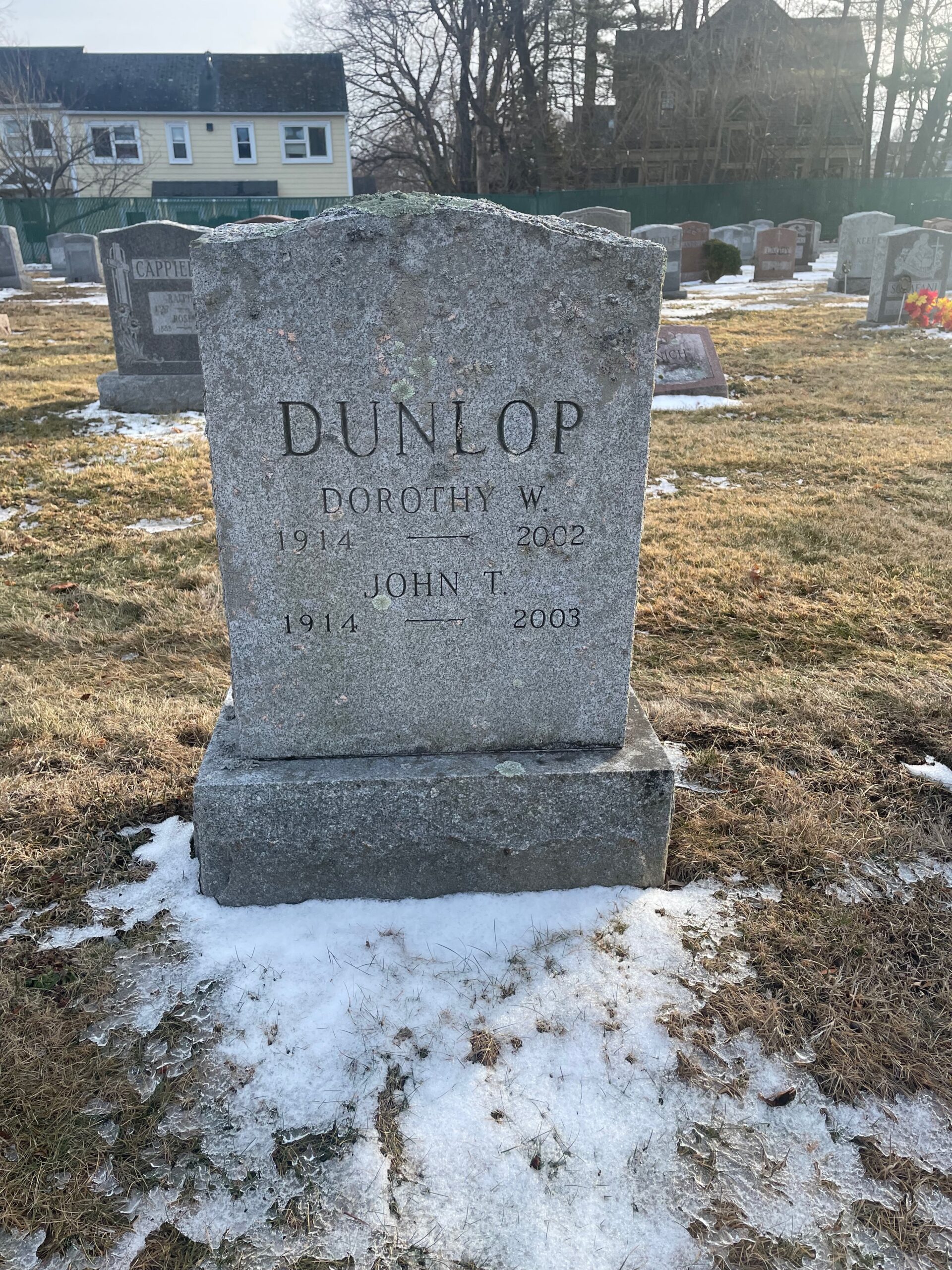
Born in 1914 in Placerville, California, Dunlop grew up in the Philippines when his parents decided to become missionaries in 1918. He lived on Cebu all the way until he finished high school in 1931. He wanted to go to the University of California, but the school didn’t admit him because they had no idea what to do with someone of this background. So he enrolled at what is today the College of Marin, a community college, and then transferred to Berkeley. He did very well and stayed for a PhD in Economics. He had a fellowship at Cambridge too, where he studied under John Maynard Keynes.
Dunlop was a successful economist right at the time than the modern economy was building during the Great Depression and New Deal and then World War II, when the government finally intervened enough in the economy and Americans got over their desire that everything was still how it was in the 19th century. He got a job at Harvard and never left, not completely anyway. I guess why would you?
Dunlop’s expertise became wages and how markets and institutions determined them. Of course that meant unions too. He was OK with unions as a bargaining agent. He was no radical or anything, but he was very much a man of the mid-20th century, where organized labor, organized business, and organized government would all play a role in the tripartite running of an economy, even if business would ultimately take the lead. He became known for publishing a lot of articles suggesting that unions cared more about wages in collective bargaining than their effect on employment itself, which I think generally remains true.
Dunlop was also a mediator. I know a labor mediator. These are mostly good people. In a functioning system, this is the kind of person who you should really value. Labor and management can’t come to an agreement, so they enter arbitration, binding or advisory. The mediator is neither an overt unionist nor an overt hack of corporations. But this is why the employers tend to not like mediators–the hack is exactly what they want, whereas the unions are usually happy with a genuinely neutral party, both because they are usually more right on the merits than the employer and because simply leveling the playing field means that labor can often win. So this is the kind of guy Dunlop was. He was a Republican, but a moderate one. His 1958 book Industrial Relations Systems built upon this, with some broader theory, to discuss how the tripartite system, taking into account the market and technological transformation to shape industrial policy. He was close with people such as Clark Kerr and wrote with them.
Unsurprisingly, Dunlop’s work had an enormous impact on the nation. That started early. He was named Chief of the Research and Statistics Branch of the National War Labor Board in 1943 and held that position until the end of the war. Then Harry Truman placed him on the Atomic Energy Labor Panel, mediating issues around the nation’s atomic workplaces. Beginning in 1948, he chaired the National Joint Board for the Settlement of Jurisdictional Disputes in the Building and Construction Industry. Starting in 1950, he was on the Wage Stabilization Board, doing that until 1952. He was mostly at Harvard for the next twenty years after, building the Harvard Trade Union Program, serving in administration, and negotiating contracts for the university with the unions who organized its services (not the faculty, lord knows, no we aren’t workers, we’re special, etc)
Dunlop was mostly out of government until the early 70s, when the Nixon administration brought him back to work on its wage and price control programs. This was the kind of thing he was good at, after all. In 1973, he took over for a lovely young man named Donald Rumsfeld as the director of the Cost of Living Council. Meanwhile, Nixon resigned and Gerald Ford became president. Most of the Cabinet remained for awhile though and that included Peter Brennan, the Secretary of Labor who got the job by being the scumbag New York building trades leader who led and encouraged the 1970 Hard Hat Riots in New York so his workers could beat up hippies and anti-war protestors. But in 1975, Brennan stepped away and Dunlop got the job.
Dunlop had ideas. He was kind of the ideal Secretary of Labor in that, again, he was fundamentally a mediator who believed in the system. That’s where he focused his energy–how can we make the system of collective bargaining work more effectively? There was one big problem though–Gerald Ford was a liar.
See, despite the idea that we have that Ford was this kind of nice guy in over his head, in fact, he was a very conservative man who vetoed tons of bills Nixon would have signed. Ford was fundamentally an early 20th century man who mostly wanted the New Deal repealed, to the extent possible. When Ronald Reagan started challenging Ford from the right, that only gave him more political reason to do what he always wanted anyway. So he undermined Dunlop. The details are pretty technical–Dunlop was open to the building trades’ desire to reform the National Labor Relations Act to make it easier for them to organize worksites. To get this, they made an agreement with management that created larger industry reforms that the industry wanted. OK, seems reasonable. The law passed Congress. Then Ford vetoed it as a show to the party’s Reaganites that he would stand up to those evil unions.
Dunlop resigned in protest. William Usery replaced him. He wasn’t bad either.
Dunlop spent the rest of his life doing what he always did. Carter hired him to chair the Pay Advisory Committee. Reagan brought him in too, on the National Productivity Advisory Committee. Then Bush put him on the Social Security Advisory Council. Clinton named him chair of the Chair of the Commission on the Future of Worker Management Relations, which became known as the Dunlop Committee. Again, Dunlop hoped to change the NLRA to make it more fair and easier for unions to win, but the Gingrich takeover of Congress in 1995 killed any chance of that.
Dunlop continued working on labor-management issues until shortly before his death in 2003. He was 89 years old.
John Dunlop is buried in Belmont Cemetery, Belmont, Massachusetts.
If you would like this series to visit other Secretaries of Labor, you can donate to cover the required expenses here. Bill Brock is in Arlington and James Day Hodgson is in Hollywood. Previous posts in this series are archived here and here.