
Erik Visits a (Non) American Grave, Part 2,196
 By
By This is the grave of Vaughn Williams.
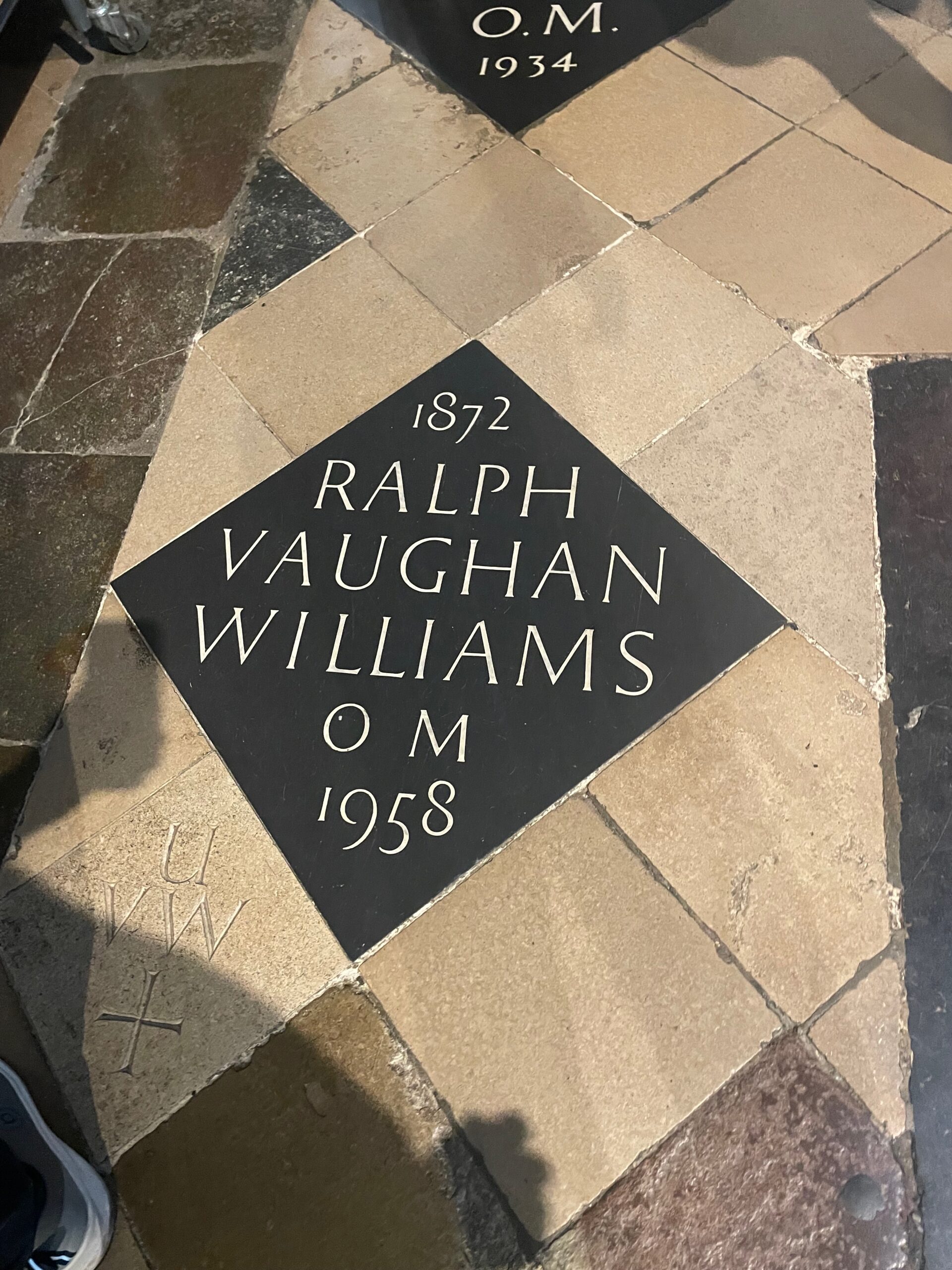
Born in 1872 in Down Ampney, Gloucestershire, England, Ralph Vaughn Williams–but he would go strictly by Vaughn as his preferred name–grew up the son of a prominent minister. In the family were a few prominent jurists and his mother was the niece of Charles Darwin. So pretty prominent. But his father died in 1875. Still, his mother had plenty of money and so he and his sibling were taken to her family’s home and raised by the women in his family and, of course, a lot of hired help.
Williams’ future would not be a scientist, a minister, or in the law. From the time he was a small child, he was exceptionally skilled at music. The history of British classical music composition is far from the greatest in Europe, but this is where Williams would make his quite significant mark. His aunt started him on the piano. He was good at it and picked it up right away, but he didn’t like it much and switched to the violin. He was so good at music that he was training in it as a student before he was 10 years old. He of course was at all the top schools and rose quickly in that environment, although he did not like much about the other boys and their snobbery. It didn’t take long for Williams to be a nonconformist, declaring himself an atheist while in his teens, while also thinking the Bible was a great piece of literature and inspiration for his compositions. As a biographer said of him, Williams was “that extremely English product the natural nonconformist with a conservative regard for the best tradition.”
Williams ended up at Cambridge, even though he didn’t want to be there and just wanted music, but his family insisted. It took a long time for Williams to really hit his stride after he graduated. He was in his early 30s and, well, he hadn’t done much. In fact, it took until his late 30s for him develop a style considered unique and his own. That’s a pretty late bloomer for someone trying to make it in the classical world. Helps to be rich enough to support this lack of success of course, but then how many artists based in New York struggling along are able to do so because they are married to someone who works on Wall Street? I know some.
Now, English music just wasn’t considered very interesting before Williams. So much of it was just borrowed from Germanic styles and the 19th century German composers were really the leaders of Europe. Williams moved beyond a lot of this by harkening back to styles of music popular in the Tudor era and reworking them for the early twentieth century. He also, like so many high artists of the 20th century, was heavily influenced by his nation’s folk music, even if he was radically reworking those ideas into modern art. It just took him a long time to get to that point. In 1907, Williams started working with Maurice Ravel, the French composer also working to move away from the Hun, though during World War I, Ravel resisted the calls in France to ban German music from performance.
Anyway, Williams really clarified what he was trying to do when working with Ravel and as the 1910s dawned, his compositions took an enormous step forward. That really started with 1910’s Fantasia on a Theme by Thomas Tallis, which has become a big part of the global choral repertoire. He got this commission from the Three Choirs Festival in Gloucester, which was a big deal for him; he was 38 years old and totally unknown. Thomas Tallis was a 16th century English composer and was inspired by his works. He conducted the London Symphony Orchestra in the first performance and everyone was wowed. It made Williams’ name. The other major work in this era was The Lark Ascending, from 1914, a solo violin with orchestra piece that took until the 20s to really hit but remains one of the most popular British compositions to this day.
One of Williams’ strong points–and here he prefigured such figures as Aaron Copland in the United States and other leftist composers of the decades after him–was to make his music accessible to the average person. To the extent that these composers really succeeded is a different question, though certainly within the U.S. context, probably far more people can recognize some of Copland’s works as “something I’ve heard before” much more than nearly anything else in the canon of classical music, even if they can’t identify who wrote it and even if it’s just because it shows up in commercials. But the political aims of Williams were quite solid and the working classes of that era were in fact more in tune with parts of high culture than today’s–think of the quote books that mass produced for, say, salesmen and the like, since any person who got any respect from anyone at all would need to know a few Shakespeare lines and such. So it wasn’t completely self-delusional to think that your work could touch the masses. Must have been nice to live in an optimistic era, I wouldn’t know what that’s like.
Williams joined the Royal Army Medical Corps during World War I, despite being in his 40s. What he saw, well….it was not good and he was pretty messed up for years. He didn’t write during the war or until the early 20s. He did start working again and works such as Mass in G Minor, Hugh the Drover, John in Love, and Flos Campi. But his wife was also increasingly an invalid and he was taking care of her. His work got more violent in tone in the 30s, with works such as Job: A Masque for Dancing and Fourth Symphony. He stopped writing again for five years between 1936 and 1941. During World War II, he headed the Home Office Committee for the Release of Interned Alien Musicians. His wife died in 1951 and he married Ursula Wood, who had been probably having an affair with back to the 30s, probably with his invalid wife’s knowledge and not complete disapproval of. The second marriage led to a late-life revival of work. His health remained great until the moments before his death in 1958. He was 85 years old. That’s kind of a quick overview there, but this post is too long as it is, so those of you who care can expand on it in comments.
Vaughn Williams is buried in Westminster Abbey, London, England.
Let’s listen to some of Williams’ work:
If that doesn’t satisfy your early morning needs for English compositional music, there’s not much I can do for you. Turn on your Emerson, Lake, and Palmer records I guess.
If you would like this series to visit American composers of Williams’ era, you can donate to cover the required expenses here. Charles Ives is in Danbury, Connecticut and Aaron Copland is at the Tanglewood Music Center in Lenox, Massachusetts. Previous posts in this series are archived here and here.