
Erik Visits an American Grave, Part 2,080
 By
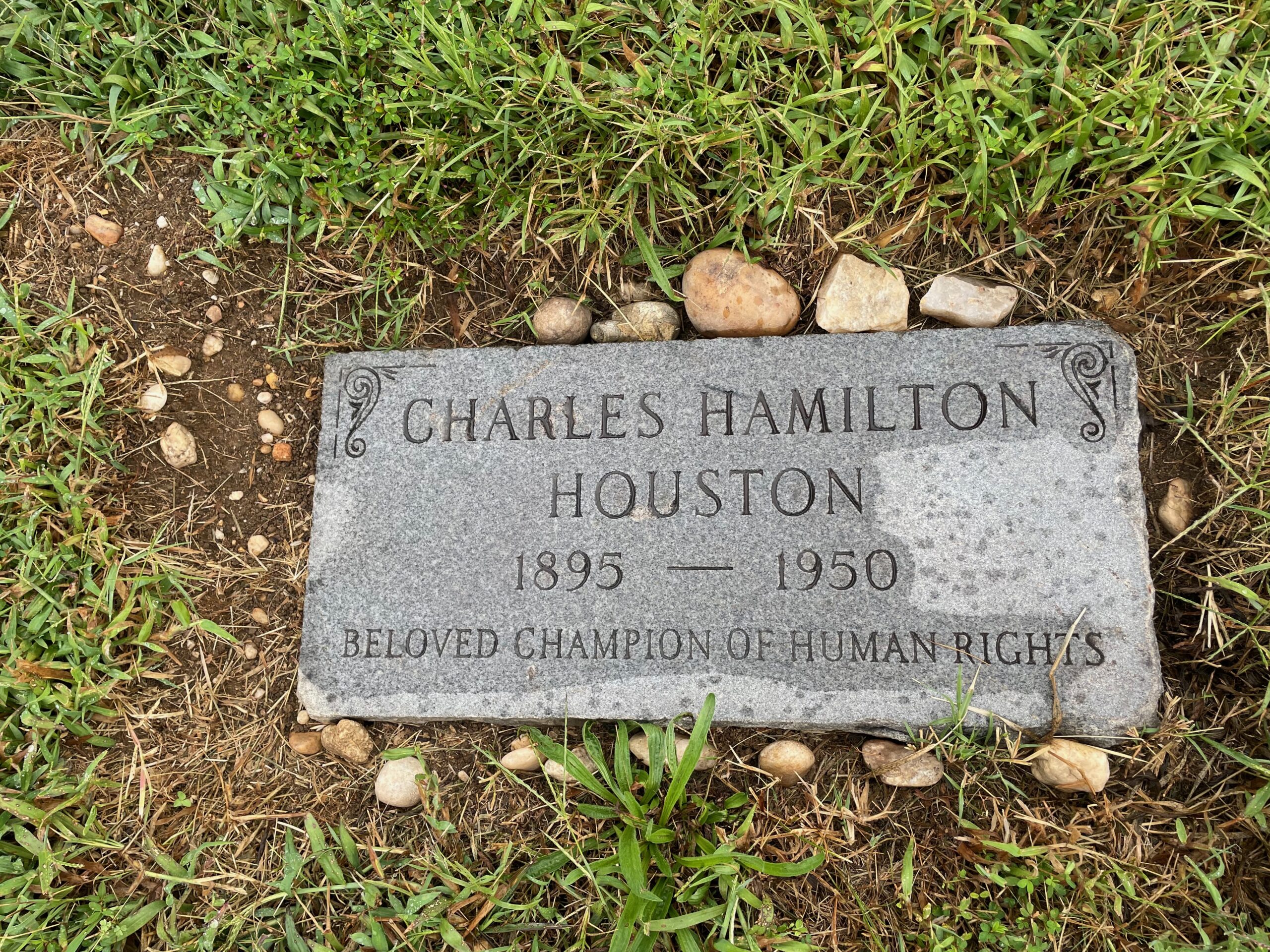
By This is the grave of Charles Hamilton Houston.
Born in 1895 in Washington, D.C., Houston grew up relatively prosperous, especially for Black America in these years. His father, born a slave, was a lawyer in Washington. We think of the Black legal class as critical to civil rights and of course that’s true, but let’s not forget that Black Americans needed lawyers for everything that white Americans needed lawyers for, whether divorce or inheritance or property or taxes or whatever. So there was a robust number of Black lawyers by this time. Even though the family did relatively well, his mother still worked as a seamstress, which was the type of work that Black women could get.
Houston was a real bright kid and started at Amherst College in 1911, only 16 years old. He was the only Black student in his class and he graduated as valedictorian too in 1915. He got a job teaching English at Howard University. But then World War I came. He joined up and was commissioned as a first lieutenant, of course in a segregated unit. He was horrified and angry at the racism that Black troops faced. It’s possible he had not really seen that level of open racism before. Undoubtedly, he was not ignorant about racism in America and undoubtedly he had experienced it himself in some ways, but it was a little different in urbane DC and Amherst than white officers from Alabama bringing their ways of treating Black folks into the Army. In fact, Houston was so disgusted, his conclusion at the end of the war was that the United States was not a nation that Black people should fight and die for. He decided he would follow the law himself to protect Black people from the horrors of white America.
So that’s what Houston did. He returned to the United States in 1919 and enrolled at Harvard Law. He did very well. He was the first Black person named to the Harvard Law Review editorial board. He finished a bachelor of law there in 1922 and then a further law degree the next year. He passed the bar and joined his father’s firm in 1924. The American Bar Association was, of course, lily white. So Houston joined other Black lawyers in founding the National Bar Association in 1925 to represent their interests as Black lawyers in this hopelessly racist country.
In 1929, Houston took a job back at Howard in the law school. He wanted to train the next generation of Black lawyers to fight against American horribleness. He was dean of the law school and trained a lot of people. Among his students? Thurgood Marshall. In fact, he was so committed to using the law to fight against American racism that he finally left Howard in 1935 to become special counsel for the NAACP. There, he worked on many of the major cases of the 1930s and 1940s that began to chip away at Jim Crow. Some of those cases included forcing juries in the South to accept Black members, fighting against attempts to execute Black people dubiously committed of crimes by all-white juries, and of course education cases. There was a long lead-up to Brown v. Board of Education in 1954 and Houston played a critical role in them.
Among the key cases he worked was Hollis v. State of Oklahoma, a 1935 capital murder case where a Black man faced an all-white jury and was sentenced to death. They won this case, sort of. Hollis was not killed. But a new trial was ordered and he received a life sentence, dying in prison in 1950. Still, such small victories were important in the larger context. This also laid the groundwork for including Black people on juries, since they were routinely excluded because they weren’t on voter rolls in much of the South, though not all the South. Black voting in the South was around 20%, even during Jim Crow, which is often forgotten.
Another really important case–and this is one that I mention in class–is Missouri ex rel Gaines v. Canada. This was a 1939 case that challenged Plessy v. Ferguson. See, as soon as Plessy was decided, new cases came up. What if instead of separate but equal, there was just something for whites but nothing for Blacks. This was Cumming v. Richmond County Board of Education from 1899, right after Plessy and the Court was fine with that too. I’m not sure why we don’t talk about this more, since it is more telling than Plessy. Anyway, Missouri excluded Black people from the University of Missouri Law School. But it didn’t provide an alternative law school. So the case was that the state violated Plessy. The Court, a very different court in 1939 than 1896, decided in favor of the state’s Black law school aspirants. Houston argued this case before the Court.
Houston’s position was to constantly challenge Plessy. The idea was that you could have your separate schools if you really wanted them, but it was going to cost you in a ton of headaches and legal fees and we are going to make it so troublesome for you that you should just integrate your schools. Probably that never would have worked, but in the 1930s and 1940s, you held on to what positions you could and the courts were slowly chipping away at Jim Crow in these years so there was reason to hope. He went to South Carolina with a camera to film the differences between white and Black schools for judges to actually see this. It was easy to dismiss the real differences if you didn’t have to see it. It was much harder if you did. This is of course a key strategy of, well, everything today since we have all have little movie cameras on our phones (the fact that we use these for fucking selfies is another sign of how degraded society has become, but that’s for another post). Houston also did brave work to challenge racist housing covenants, doing tons of work to lay the groundwork to get these thrown out as unconstitutional, which eventually succeeded.
Houston should have been around for Brown. But he had a massive heart attack in 1950 and died. He was only 54 years old. A tragic loss. He would have played such a key role in the repeal of the entire Jim Crow legal structures over the next twenty years. Imagine what he would have seen had he lived to 1970. Of course, what he would have seen is northern whites freaking out over sending their kids to schools with them. After all, don’t our children deserve the best schools? And who am I to do anything to stop de facto segregation anyway? It’s my kid we are talking about! Christ.
Charles Hamilton Houston is buried in Lincoln Memorial Cemetery, Suitland, Maryland.
If you would like this series to visit some of the other key lawyers of the civil rights movement, you can donate to cover the required expenses here. William Hastie is in the same cemetery as Houston. William Bryant is in Brentwood, Maryland. Previous posts in this series are archived here and here.