
Erik Visits an American Grave, Part 2,220
 By
By This is the grave of Abbott Lawrence Lowell.
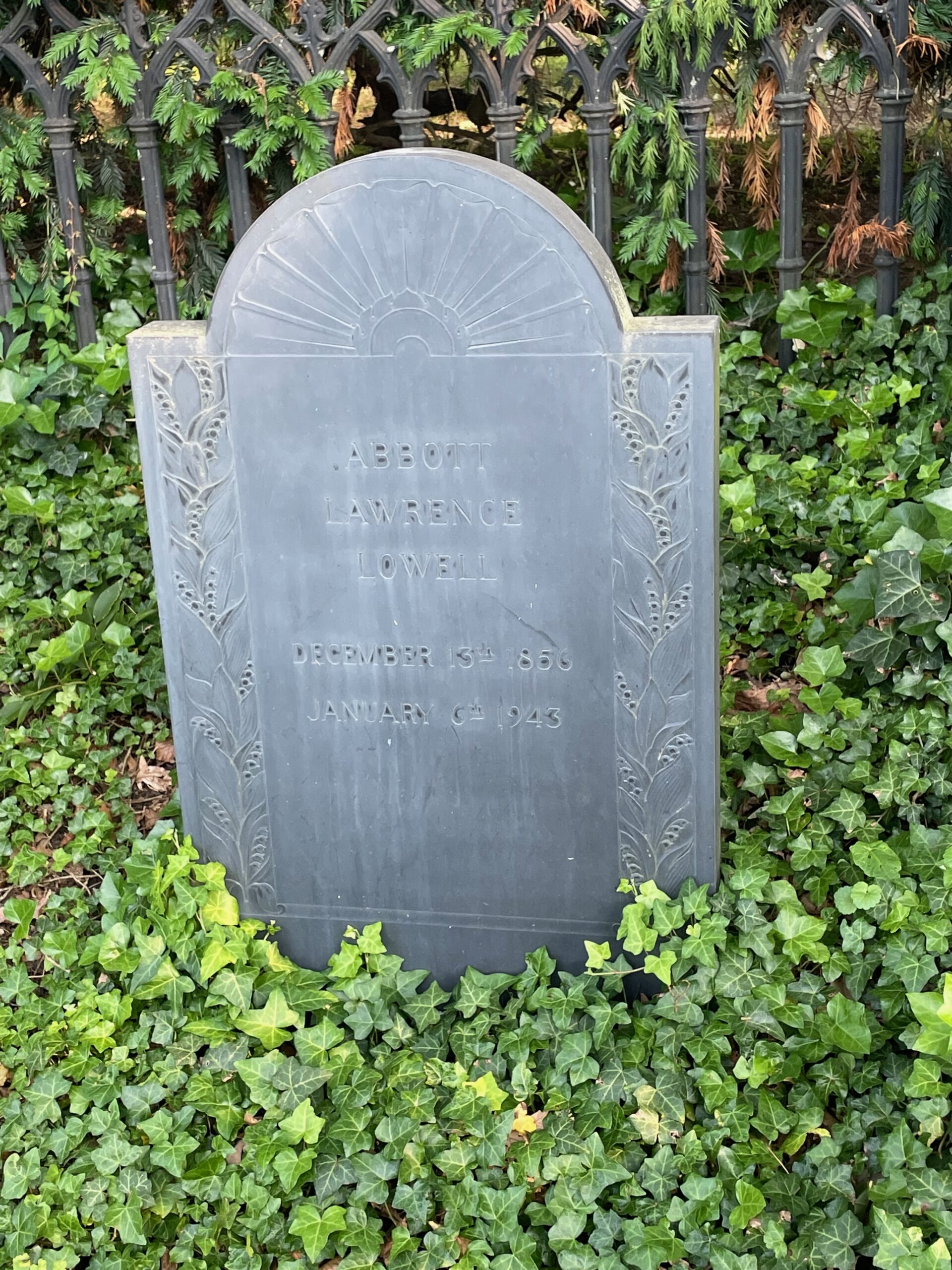
Born in 1856 in Boston, A. Lawrence Lowell, as he would usually be known, was born into massive Boston money, with all the Brahmin background that implies. All the kids were expected to do big things and most of them would. His sister was Amy Lowell, the Pulitzer Prize winning poet, just as one of several examples. He went to all the fancy schools and then to Harvard. He studied mathematics and finished his degree in 1877. But he chose Harvard Law next rather than a math or science career. He finished that degree in 1880 and then practiced corporate law nearly twenty years, just classic Gilded Age stuff, representing horrible corporations doing horrible things most of the time.
But Lowell had other interests as well. He started to publish treatises on government. The rising academic Woodrow Wilson had published Congressional Government in 1885 to widespread interest. He thought Congress had too much power and a stronger president was needed to counter the local interests that dominated government. That might well have been true in the Gilded Age, but living something like Wilson called for under Trump….ain’t so great! Well, not everyone liked this then either and Lowell published Essays on Government in 1889 that was agaisnt Wilson’s ideas. That got him started thinking about government more often. In 1896, he published Governments and Parties in Continental Europe. Then it was Colonial Civil Service in 1900 and The Government of England in 1908. By the time the latter books came out, he had given up his law work and become a professor at Harvard, working as a lecturer in 1897 and then a full time professor starting in 1898.
Lowell was a classic figure of Gilded Age and Progressive Era elite politics. As such, he felt the Irish were a huge threat to the nation. Like a lot of people with these ideas, he combined believing in assimilation of who was already here with supporting immigration restriction. So it’s not like he was calling for mass deportation of the Irish, but he was supportive of closing the borders over time. In 1906, he was made an honorary VP of the Immigration Restriction League. He most certainly did support the continuation of Chinese exclusion. He definitely felt that the South was right in Reconstruction and if the states wanted whites-only voting, they should be able to have it. He’d be a good supporter of Stephen Miller today, minus the fact that Miller is in fact Jewish, a fact that Miller himself seems to prefer to forget.
In 1909, Lowell was named president of Harvard. He had a very long tenure in that role, remaining there until 1933. He imposed enormous changes. He got rid of the elective system of classes, believing most of the students to be lazy and intellectually uninterested in taking advantage of that in a good way to get a real education. Instead, they were just taking whatever was easiest. No lies told there. So he created the major, which would soon become the standard in the American higher education. He opened the admissions system so that more high quality students who didn’t have the background for normal Harvard admission could get in. Charles W. Eliot, his predecessor, had already gotten rid of the silly Latin and Greek prerequisites, so the ground was laid. By 1913, students from public schools were the majority at Harvard. I wonder if they are today?
Lowell was often a hypocrite as Harvard’s president. He talked a good game about making the university elite. He wanted to integrate students from different classes and pull down some of the extreme displays of wealth and power that created generation after generation of American leadership with little connection to ability. So he built a lot of dormitories and forced students to live in them so they would intermix. That’s good. But on the other hand, since he was also a racist, it was hard for him to get his head around what that would really take. So, for example, he worried a lot that Harvard would have too many Jews. So he tried to push a 15% enrollment cap on Jews. The Harvard Board of Overseers overturned this idea. He didn’t have that much of a problem with black students per se, but my God, integrated housing? What have I done? So he wanted to stop that, but the Board also basically told him, you created this system, you have to live with the consequences and overrode him again. Also, Lowell engaged in a mass purge of homosexuals from Harvard, in 1920, all too common at the time. He opposed Louis Brandeis’ nomination to the Supreme Court publicly, you know, being a Jew and all how could he figure out the law for America….
Lowell seems like a bad guy and in many ways he was. But during World War I, he was a lot less terrible than a lot of the American leadership class. He resisted the calls to fire any professors critical of American participation in the war. Like during Trumpism, most of the university leadership class proved themselves to basically be on the side of the monster and the situation gave them cover to do what they really wanted to do anyway: fire leftists. But Lowell wasn’t that. He defended academic freedom. He also thought dropping the study of German and German-based topics, which right-wingers were pushing, was idiotic, as of course it was.
Lowell also was a big believer in the League of Nations and spoke out in favor of it on many occasions, running into the tide of Americans opposed to being a grown up nation and working with others and solving problems collectively. Sadly, the U.S. has decided to not be a grown up nation again today.
Unsurprisingly, Lowell hated unions. When the Boston police went on strike in 1919, he urged Harvard students to be unionbusters. College students fucking loved scabbing and beating up strikers, cops or not. There’s a huge history of this and Harvard students are at the top. Class solidarity and all. Even for the poorer students, this was a way to show that they were good future members of the elite. But then when some faculty opposed that and supported strikers, Lowell also said their job was safe and they had the right to do that. So despite Lowell being awful in many ways, he had a principle that most contemporary university presidents, the biggest bunch of suck up cowards ever created, do not. Lowell was also on the commission to review the Sacco and Vanzetti trial and made sure that those Italian anarchists were going to be executed, guilt or not.
Lowell’s health began to decline in the early 30s. His wife died in 1930, which really threw him. He retired in 1933, but lived another full decade, finally dying in 1943. He was 86 years old.
Abbott Lawrence Lowell is buried in Mount Auburn Cemetery, Cambridge, Massachusetts.
If you would like this series to visit other college presidents, you can donate to cover the required expenses here. Mary Lyon is in South Hadley, Massachusetts and James McCosh is in Princeton, New Jersey. Previous posts in this series are archived here and here.