
Erik Visits an American Grave, Part 2,219
 By
By This is the grave of Lucille Lortel.
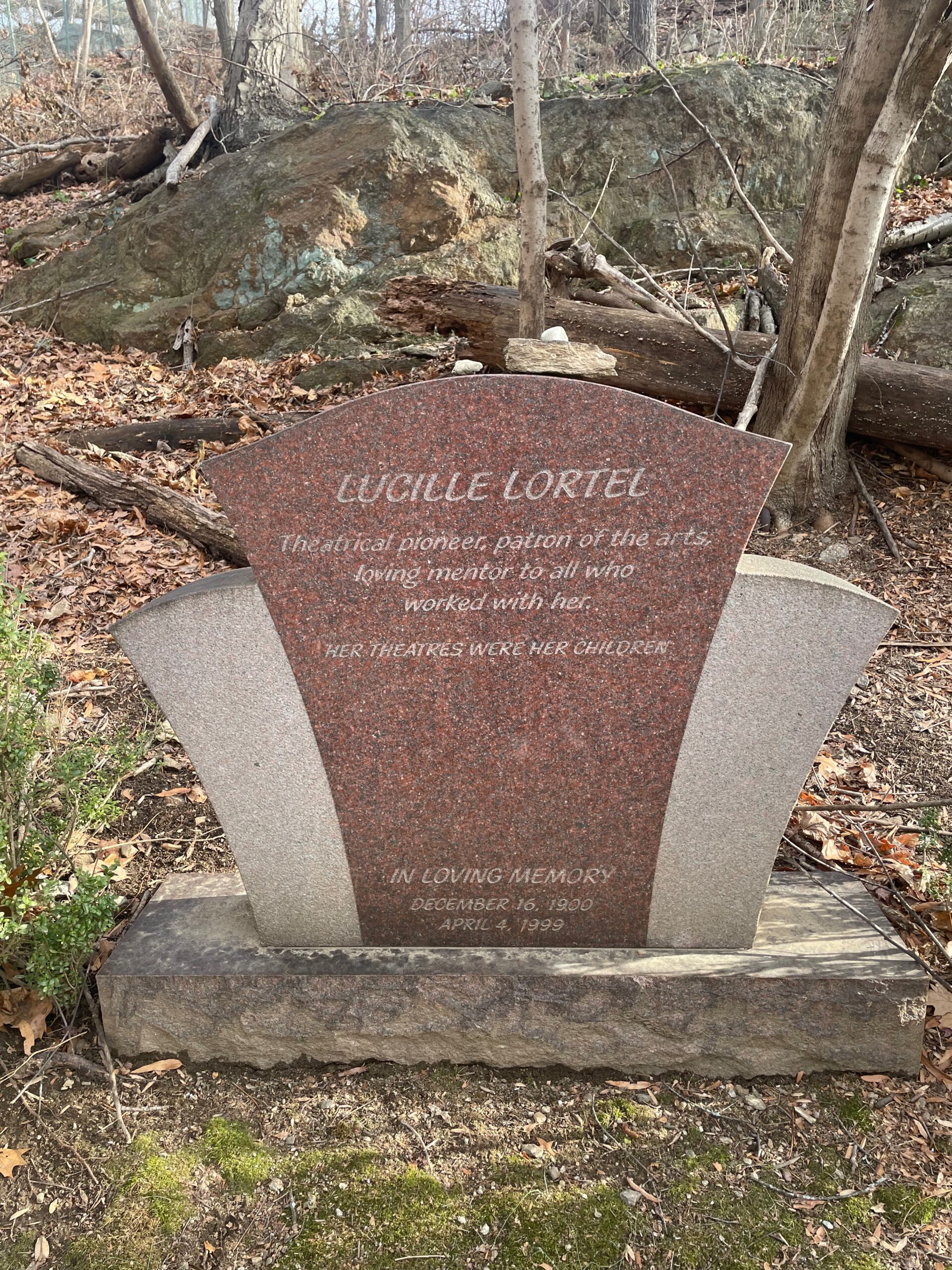
Born in 1900 in New York City, Lucille Wadler grew up in a Jewish immigrant family, but one that was upwardly mobile. Her father was in apparel, like just about every other recent Jewish immigrant to the city, but he was successful enough that he was manufacturing the clothes instead of stitching them in the sweatshops. I am sure he owned and operated sweatshops as well; the owners of the Triangle sweatshop that killed 146 workers were also Jewish who cared little about killing their own people (quite literally–after Triangle they just opened another sweatshop under the exact same conditions). He would go to Europe to see the latest designs and then make some version of that in his places, so young Lucille grew up in that kind of world.
Wadler was a socialite by the time she was a teen. She wanted to dance and perform. Wadler was not a good name for a career, or so she thought. So she adopted the stage name Lucille Lortel and we will refer to her by that name going forward. She went to Adelphi University and then the American Academy of Dramatic Arts. She had the money and talent to go to Berlin and study under Max Reinhardt. It didn’t take her long to get established on Broadway and she became something of an iconic figure of the 1920s. She was cast with Helen Hayes in Caesar and Cleopatra in 1925 and then Michael Kallesser’s play One Man Woman. She did a bunch of other plays in the next few years. Then in 1929, she did The Man Who Laughed Last with the Japanese actor Sessue Hayakawa, who had established himself as a pretty big star in the U.S. That got adapted into a film and they both starred in this as well. It’s a very early talkie.
Lortel was a rising figure. But in 1931, she married Louis Schweitzer. He was a big rich paper capitalist who was around the arts and spent his money on a lot of strange philanthropy ideas, one of which was establishing decent radio stations. In fact, he would found WBAI and give it to Pacifica Radio in 1960. Well, he might have been an interesting fellow for a rich guy. But he hated the idea of his wife working. He discouraged her from continuing her work as an actress and after some years of resisting, she retired in 1939, having not worked much since their marriage.
Now, that might have been the end of Lortel’s story in New York or in the public. She could have been the rich wife of a domineering husband, a socialite, all that stuff, and we would have forgotten about her. But she forced her way back into the theater world. She was still friends with all these famous people. Her good friend Danny Kaye suggested that perhaps she could open her own theater if she couldn’t act. And that’s what she did. In 1947, she opened the White Barn Theater on her and her husband’s land in Norwalk, Connecticut. This was evidently OK with him. This became an enormously important space in theater history because it is where major plays would soft open before going to the big New York theaters. Among the plays that first started at the White Barn were Samuel Beckett’s Embers, Eugene Ionesco’s The Chairs, Sean O’Casey’s Red Roses for Me, Adrienne Kennedy’s The Owl Answers, Terence McNally’s Next, and Jerome Kitty’s Margaret Sanger: Unfinished Business.
White Barn became Lortel’s passion and she was there for all of it, for a very, very long time since she made it to a quite old age. Schwetitzer seemed to think that his wife running a theater was OK even if acting wasn’t. Who knows how a guy like that makes these sorts of decisions. But in any case, seeing how well White Barn went, he bought her the Theater de Lys in New York as a present (hard living) in 1955. This became a serious place for Off-Broadway productions. She had run at White Barn Marc Blitzstein’s version of Threepenny Opera so she ran it there too–for the next seven years. It became the first Off-Broadway production to win a Tony, which I believe remains the case to the present. For the rest of her life, the Theater de Lys remained a major location for good plays. She produced Jean Genet’s The Balcony, Charles Morgan’s The River Line, Tom Cole’s Medal of Honor Rag, and a lot of other plays. The theater was also where plays such as David Mamet’s A Life in the Theater and Sam Shepard’s Buried Child went on. So that’s a pretty impressive legacy. Some of these early plays happened because she pushed her board to allow two plays to go at the theater at the same time. She loved Threepenny Opera and of course it made a ton of money. But she wanted to support new plays as well so she introduced a matinee performance and then Threepenny would go on at night. I wonder what the stage logistics were for all that.
Lortel also started a series of plays at the Library of Congress in 1960, bringing work to the savages in Washington. She produced a lot of plays on Broadway over the years too. She was nominated for a couple of Tonys herself, though I don’t think she ever won one. She did get an honorary doctorate from Fairfield University and at CUNY and endowed an annual lecture in her name at Columbia–Arthur Miller gave the debut talk.
In 1981, Theater de Lys was renamed the Lucille Lortel Theater. It remains named that today. It continued to host quality plays for the rest of her life. In 1998, a still active if very old Lortel created the Playwrights’ Sidewalk outside of the theater, placing one playwright a year into a sidewalk tribute that passers by can stop and read. I’ve long wondered how many people really do stop and read stuff in sidewalks. I do sometimes, but then I’m a weirdo who looks out for historical memory as a force of habit. But hey, someone must and it is a good idea under any circumstances.
Lortel died in 1999 after a brief illness. She was 98 years old.
Lucille Lortel is buried in Westchester Hills Cemetery, Hastings-on-Hudson, New York.
If you would like this series to visit some of the playwrights Lortel helped along the way, you can donate to cover the required expenses here. Murray Schisgal is in East Hampton, New York and Paul Zindel is in Staten Island. Previous posts in this series are archived here and here.