
Erik Visits an American Grave, Part 2,218
 By
By This is the grave of Oscar Lewis.
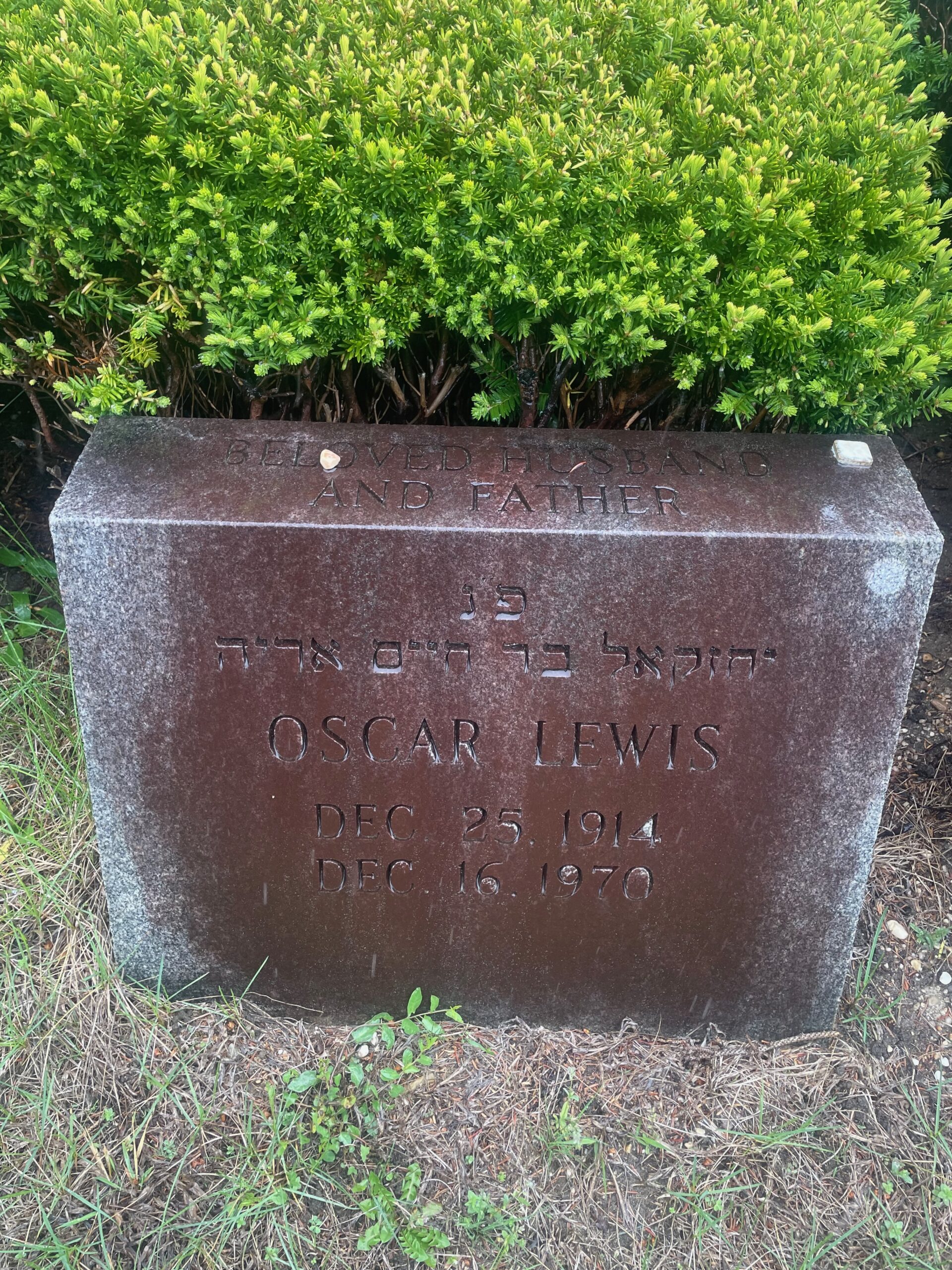
Born in 1914 in New York, Oscar Lefkowitz grew up in a Jewish immigrant family. His father was a rabbi. Unusually, the family did not stay in the city. His father bought a farm upstate and raised his family there. But like a lot of Jewish immigrant kids, Oscar ended at City College. At some point, he changed his last name to Lewis, not uncommon of course in early 20th century America, but he also didn’t exactly hide his Jewish background. Anyway, he then enrolled in Columbia for a PhD in History. But not finding it satisfactory, he switched to Anthropology. This happened because his brother in law was Abraham Maslow, the psychologist, and Maslow knew Columbia’s Ruth Benedict, so that switch took place. Lewis was pretty happy with the Anthropology program and he began studying Native Americans. Particularly, he was interested in how contact with whites had impacted the tribes. He studied the Blackfeet on this topic, finishing his degree in 1940 and publishing its results in 1942.
Lewis first taught at Brooklyn College and then Washington University. He then started the anthropology department at the University of Illinois. He became known for his culture of poverty theory. This has long been controversial, for it tends to blame people for their own poverty. The short version of it is that if you are born and bred into a poor situation, you will be very unlikely to get out of it and make poor decisions that will reinforce your status, not exactly because you have a choice but because you live in a culture that makes it hard to make different choices. It’s hard to argue that this is completely incorrect, but it does erase human agency in a lot of ways. On the other hand, it acknowledges that poverty is a bad thing and that what happens is not completely the fault of the person who does the thing.
To really get at this, I consulted the scholars. Particularly, I read Emilio de Antuñano’s 2019 article from Journal of Urban History titled “Mexico City as an Urban Laboratory: Oscar Lewis, the “Culture of Poverty” and the Transnational History of the Slum.” So a lot of the rest of this discussion draws from it. Lewis had moved from initial research on the Blackfeet to do a lot of work in Latin America. He got involved in Latin America when the National Indian Institute appointed him a field representative in Mexico in 1943, working with Manuel Gamio, the most important Mexican anthropologist and a student of Franz Boas.
His first book on Mexico was 1951’s Life in a Mexican Village, about Tepoztlán, which was becoming a working class slum at the edge of Mexico City. There was Five Families; Mexican Case Studies in the Culture of Poverty, in 1959, which got a lot of public attention. Life in a Mexican Village; Tepoztlán Restudied was published in 1960. The Children of Sanchez: Autobiography of a Mexican Family was Lewis’ most influential book on these topics and that was published in 1961. Then there was Pedro Martinez – A Mexican Peasant and His Family in 1964.
Lewis became a big deal in anthropological and sociological circles in the early 50s for a much more positive vision of internal Mexican migration than was previously considered. The idea had been basically that Mexican families would suffer cultural breakdown when they moved to big cities such as Mexico City. In a 1952 article, Lewis rejected that, demonstrating that kinship and community networks made such transitions not so bad. But a lot of what happened after this was changes in the U.S. city and both Lewis and the reactions to Lewis were framed by the civil rights movements and fears of urban crime, as would later be promulgated by the racist Daniel Patrick Moynihan, influenced by Lewis’ culture of poverty and of course his white family pathology of racism. Lewis became influential to such people because they were looking for answers for the ghettos and civil rights issues in the U.S. and they could see his culture of poverty as a way to understand this world that took the blame away from racism and capitalism and placed it back on these communities, even if it wasn’t really their fault. But then you could argue for more policing and incarceration and things of this nature without dealing with the structural conditions.
Lewis himself got super obsessed with the ideas that people never left these villages/neighborhoods and created cultures there that were opposed to outsiders or outside ideas, which wasn’t true. Of course, Mexico City was rapidly transforming in these years and Lewis’ work was important in chronicling that, as few North American scholars knew as much about the place. His supporters and his critics both misunderstood him to some point, but he also gave service to discredited ideas connecting culture and poverty that served the interests of people in power at a specific time. Moreover, Lewis (and especially his followers) concluded that it was pointless to engage in massive welfare programs for people because the culture of poverty would overwhelm any benefits created through said programs. The social inferiority will remain. You can see how such arguments would be useful for racists who didn’t want welfare programs in black communities in the U.S., even if this was not really Lewis’ point.
In fact, The Children of Sanchez was despised by Mexican authorities. Some of that is that it criticized the PRI, well on its way to being a quasi-dictatorship who would massacre students just a few years later. But some of it is that this felt like an American imperialist coming into their nation and criticizing it for things out of control of the people. So the book was banned there for a few years. But for a time, Lewis’ books were seen as important and were positively reviewed by people such as Michael Harrington.
Lewis was surprised by the attacks his culture of poverty thesis came under by the late 60s, when new generations of scholars and activists rejected its victim-blaming entirely. He got real defensive and spent the rest of his short career defending himself. The thesis was attacked for the idea that these were in fact cultures that limited options going forward for people in them, as opposed to economic and social factors that created structures such as racism and educational disadvantages that were almost impossible to overcome. It wasn’t the culture that was the problem, it was the structure.
Lewis’ last major work was La Vida, where he made tapes of a Puerto Rican sex worker in New York talking about raising her children in extreme poverty. Once again, this got a lot of attention, both because it shined a light on conditions most middle class Americans couldn’t imagine and because it seemed to denigrate Puerto Rican communities at that moment of cultural nationalism.
Lewis ended up having a bad heart. He started having heart attacks and died in 1970 of another one. He was 55 years old.
Oscar Lewis is buried in New Montefiore Cemetery, West Babylon, New York.
If you would like this series to visit other anthropologists, you can donate to cover the required expenses here. Elizabeth Colson is actually buried in Zambia. I’d go if you want. Within the U.S., Robert Knox Thomas, who worked with the Cherokee, is in Mount Sterling, Kentucky. Lambros Comitas, who worked heavily in the Caribbean, is in The Bronx. Previous posts in this series are archived here and here.