
Erik Visits an American Grave, Part 2,210
 By
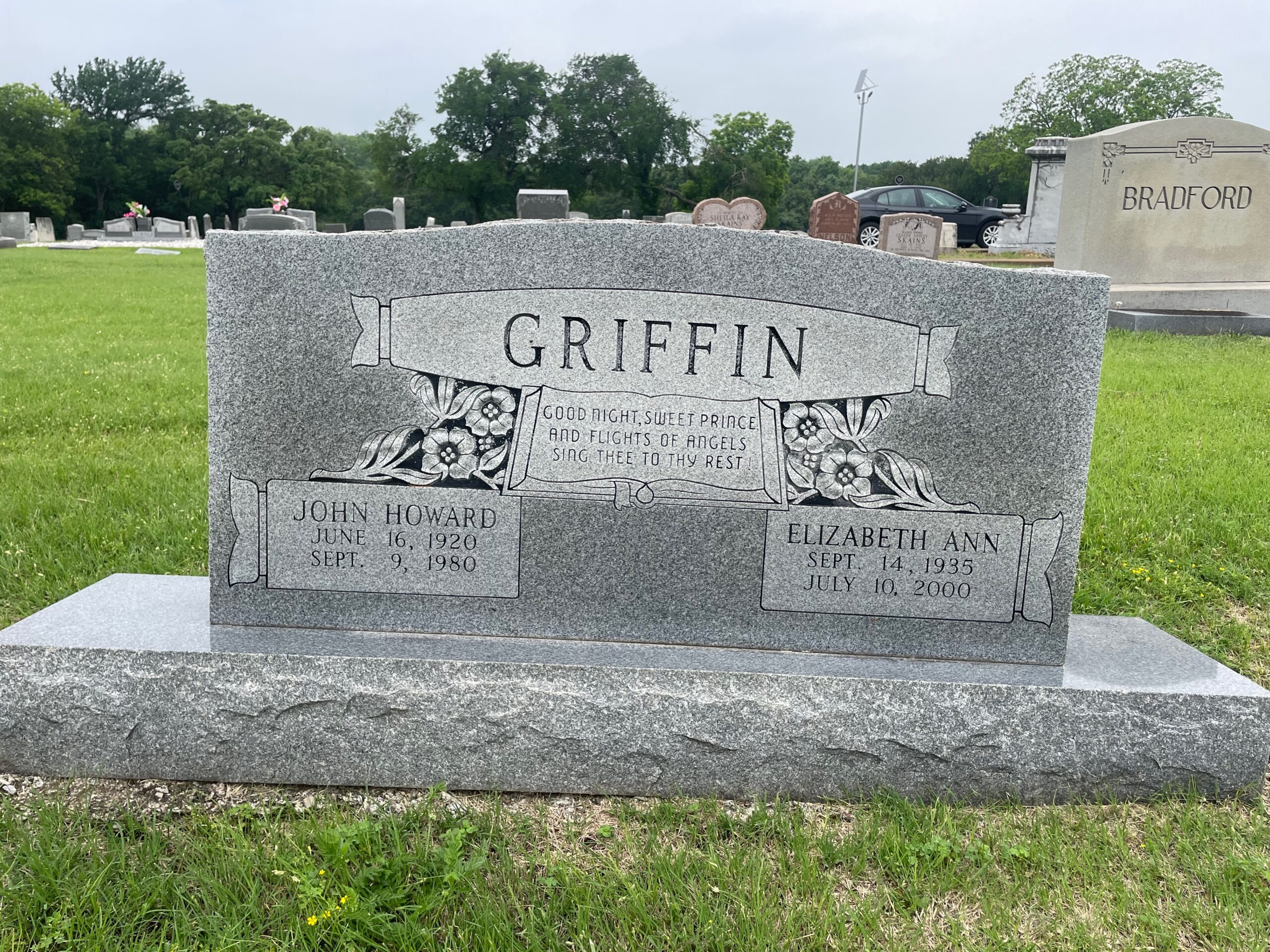
By This is the grave of John Howard Griffin.
Born in 1920 in Dallas, Texas, Griffin grew up in the liberal white southern relatively well off class of the time. His mother was a concert pianist. He was a good student who spoke good French and he won a scholarship to go to college at the University of Poitiers in France. He studied language and literature there and then moved to the École de Médecine to study, well, medicine. But as you can see, this would have put Griffin there when the Germans invaded France in 1940. Griffin did not immediately go home. Instead, he fought the Nazis as part of the French Resistance, which had about 1,000 times as many claim they were involved in 1946 than actually were involved in 1941. Specifically, Griffin was involved in helping Jews escape. There was a group of Austrian Jews who had made it to Saint Nazaire, where he was working on the docks as a medic. He helped smuggle them aboard a ship and get them to safety.
Speaking of safety, Griffin returned to the U.S., where joining the actual military to fight Nazis was a lot safer than working in the Resistance, though that’s not why he returned home. He joined the Army Air Forces upon his return and was stationed in the South Pacific. He also was the lone soldier stationed on the small island of Nuni in the Solomons, where he engaged in an early anthropological study of the people to pass the time. He was a long ways from the front lines here, but hey, he was assigned there and he was doing his job. He also had problems with one of the biggest killer of American soldiers in the Pacific. No, I’m not talking about war here, I’m talking about malaria. He had a bout of malaria that set in his spine and he couldn’t walk for awhile. Yikes. Oh, also, while he was there, he married a Polynesian woman who he left when he got to go back to the U.S. Now that’s a classic imperialist move right there.
Now, in 1946, Griffin lost his sight. Probably. He was blind until 1957. This was from the long-term effects of being near a Japanese bomb. However, some 2024 studies in French of this incident suggest that he might have faked the blindness. I don’t read French, so I can’t evaluate the claim. But people have questioned this for a long time. The main reason–why did he suddenly regain his sight in 1957 without any explanation? And it’s not like he just could see some light again or shadowy figures, he could see like anyone else. So this is a really weird situation.
Griffin was certainly an unusual person, no question about that. The blindness, whatever that meant here, did not stop him from living a successful life. After leaving his Polynesian wife behind so he could look back on his exotic sex fondly while not being hemmed in by what it would mean to bring a woman from the Solomon Islands back to Texas as his wife, Griffin married a good white woman and had a couple of kids with her. She was also a student of his, because of course she was. He started writing as well, beginning with a 1952 novel called The Devil Rides Outside, about a composer who goes to a French monastery to study Gregorian chants. He had spent enough time in France that this probably was something he could reasonably pull off. He wrote a lot about his blindness. Then he wrote a novel about a man lost in the Solomon Islands for a year, something he did know. He also became a professional photographer.
Griffin’s interest in amateur anthropology influenced what we know him for today–and if you don’t know the name, you definitely remember his famous 1961 book Black Like Me. I read this in school–5th grade? Maybe? As an aside, I am always amazed and maybe a little skeptical by people’s claims that they remember learning this or that in high school or even younger. Why would you remember this, outside of something being super memorable? I certainly don’t remember much in ways of specifics from my school days. But I do remember Black Like Me, although that guess about 5th grade could be off by 3 or 4 years for all I remember. It does seem more appropriate for something like 8th or 9th grade. Anyway, whatever about remembering stuff like this, who really cares when you read or learned something.
Black Like Me is such a strange project to me. For a white man to decided to “become black” and then walk around asking questions in 1959 in the American South is a choice that feels more suicidal than anything else to me. When I visited this grave–and I had not thought about Griffin for years before this–my first question was, how did he pull this off? Turns out he saw a dermatologist in New Orleans who was intrigued by the idea and given methoxsalen while tanning all day, which darkened his skin a bit. He then used makeup so, yeah, there was some blackface involved. I wonder how many people he was really fooling here. However, given America’s weird one-drop rule of racial characteristics, plenty of very light-skinned people were considered black and subject to the laws of segregation. So he pulled it off.
Griffin then spent six weeks traveling around the South as a black man, accompanied by a photographer. Black Like Me was a big hit when it came out. For a certain kind of white, hearing about race from another white just meant more than what black people were saying all the time. These were mostly liberals, since race haters didn’t care what he had to say. One of the things that he couldn’t believe and neither could his white readers is how many whites approached him to ask about sexual life. I’m not sure why this would have been surprising except for this one thing–whites, even liberal ones, simply didn’t ask a lot of questions about what race relations were really like. It’s like walking around today knowing ICE is bad but we mostly don’t ask too many questions and just go along our way. That’s not true of all of course, but most people would rather just not know, even if they hate ICE.
Griffin’s book led him to be super hated by southern whites. In fact, he took his family to Mexico for several months. He was hanged in effigy in his hometown of Mansfield, Texas. In 1964, KKK members caught up to him and beat him. He spent his later years in Fort Worth, where he lectured about race relations sometimes. He had become friends with Thomas Merton in 1962 so he started a project writing about the famed Trappist monk. But he didn’t finish it. Griffin developed Type 2 Diabetes. Treatments weren’t great at this time. So it killed him in 1980. He was 60. His friends finished the Merton book for him and that got published in 1983.
John Howard Griffin is buried in Mansfield Cemetery, Mansfield, Texas.
If you would like this series to visit other authors about race in American life, you can donate to cover the required expenses here. Alex Haley is in Henning, Tennessee and Harper Lee is in Monroeville, Alabama. Previous posts in this series are archived here and here.