
Erik Visits an American Grave, Part 2,174
 By
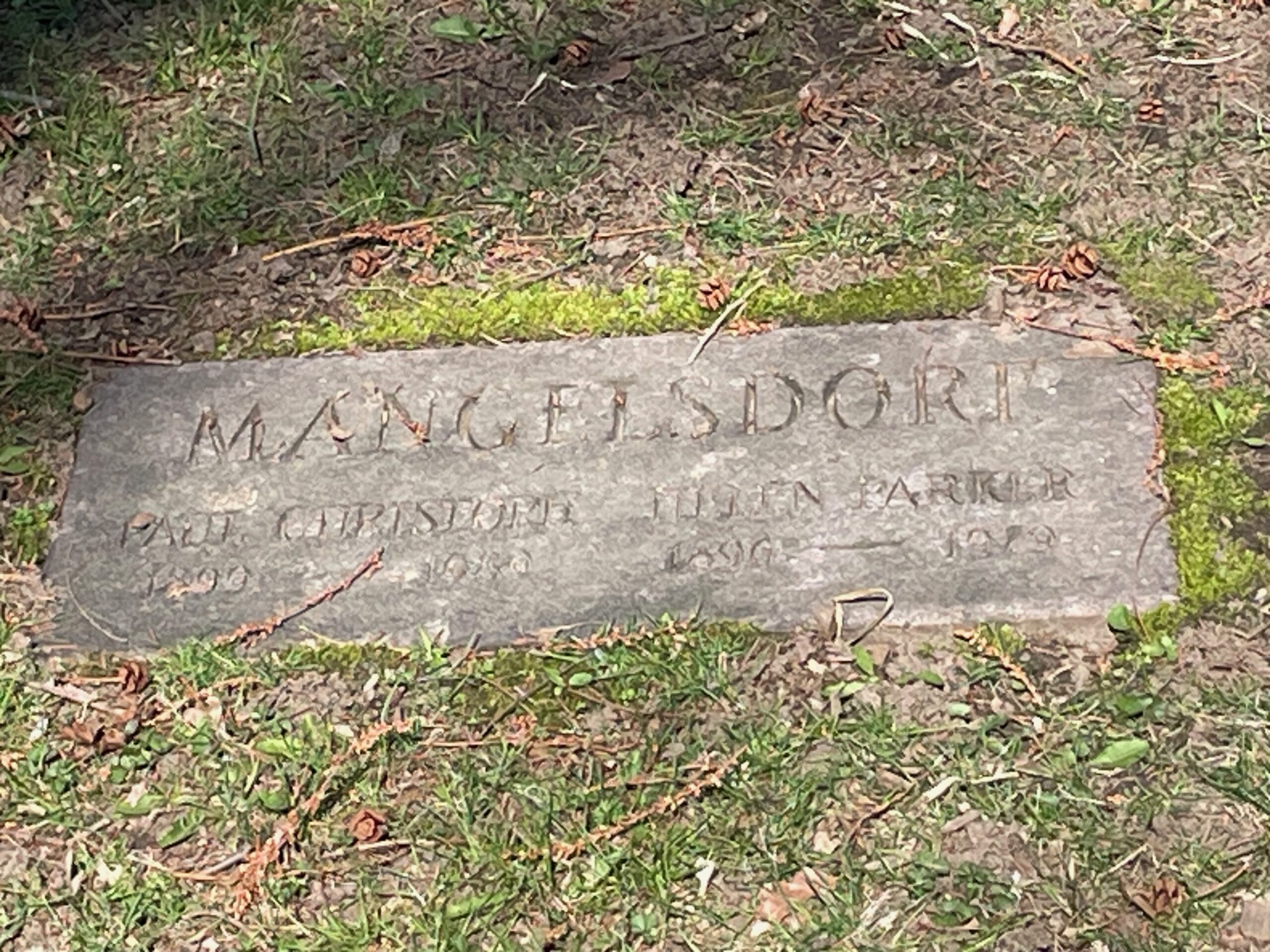
By This is the grave of Paul Mangelsdorf.
Born in 1899 in Atchison, Kansas, Mangelsdorf grew up in a German immigrant family. His father ran a seed store. The young’un was pretty smart. He was also very Kansas. So his future would combine these things in a way that someone who grew up in, say, the Lower East Side probably wouldn’t. He went to Kansas State, graduated in 1921, and then went to Harvard for a PhD. His specialty was plant genetics, particularly corn. As I said, very Kansas. He completed that in 1925 and took a job at the Texas Agricultural Experiment Station, which later became connected to Texas A&M.
Corn was Mangelsdorf’s obsession, particularly its genetic makeup, history, and breeding potential. Two things happened in 1940. Mangelsdorf returned to Harvard as a professor in economic botany, which is a field that connects plants and humans and has some anthropology in it. He also was elected the American Academy of Arts and Sciences. He would remain at Harvard until his retirement and continue his work on corn. He was director of the botancial museum there from 1945 to 1967.
Then in 1941, the Rockefeller Foundation hired Mangelsdorf as an consultant to work on its agricultural program. This became central to the Green Revolution. In 1943, the Foundation started the International Maize and Wheat Improvement Center, working with the Mexican government. Norman Borlaug, who would later win the Nobel Prize for his work on agricultural hybrids, is the most famous figure involved in this, but Mangelsdorf was right there too.
Like a lot of these folks, Mangelsdorf was active in getting wealthy from his research as well. I don’t have any problem with patenting all this I guess, except that I wonder what impact these patents have on farmers trying to make a better life for themselves. But the Green Revolution and the rise of contemporary corporate agribusiness was deeply connected and we all know the power of Big Ag today when it comes to seeds and hybrids and GMOs and all of that, which completely puts individual farmers behind the 8-ball as the courts routinely back up Big Ag in its aggressive profit seeking. But he made a bunch of money on his corn patents. At least some of that went to fund the Paul C. Mangelsdorf Professorship in Natural Science at Harvard, so you could do worse with money than endow chairs. Still, and especially given the likelihood LGM readers have interest in deep dives on corn scientists is probably not that great, thinking about the implications of all this modern ag science might be a place to have some discussion.
Now, Mangelsdorf was hardly right about everything. No scientist ever is. This is getting a bit deep for my knowledge of corn, which mostly revolves around eating it, but he had a theory that the modern origins of it were “tripartite,” by which he thought it was a combination of two original plants, one from South America and one in North America. But in fact, that was later disproven by George Beadle, the Nobel Prize winning scientist who discovered that corn was definitively came from teosinte, domesticated by indigenous people in what is today Mexico.
Now, I ran across Mangelsdorf in Helen Anne Curry’s excellent book Endangered Maize: Industrial Agriculture and the Crisis of Extinction, which makes the point that narratives of extinction in crop breeds are deeply connected to beliefs in extinction of indigenous people, which could fit into developmentalist narratives very easily. Mangelsdorf became aware of the rapid decline of corn diversity in Mexico while he was still in Texas and he immediately became involved in the issue, urging the U.S. Department of Agriculture to get involved in seed collection programs. At that time though, around 1940, it wasn’t going to do that kind of thing. He was already personally collecting seeds from all over the place, as he was investigating his deeply held question about the origin of the plant. So this sort of thing is what he was up to in his early years with Rockefeller. He spent a lot of time in Mexico with his team collecting samples. Of course all the labor to collect those samples was actually done by indigenous people themselves, but Mangelsdorf was totally uninterested in them and barely acknowledged their existence.
Mangelsdorf had a lot of the big awards that come to scientists like him. He was president of the American Society of Naturalists in 1951, the Genetics Society of America in 1955, and the Society for Economic Botany in 1962.
After Mangelsdorf retired, he moved to North Carolina, He got a research position at the University of North Carolina, which I think was probably mostly an affiliation and a lab. He stayed there and remained pretty active until close to his death, which came in 1989. He was 90 years old.
Paul Mangelsdorf is buried in Mount Auburn Cemetery, Cambridge, Massachusetts.
If you would like this series to visit other presidents of the Genetics Society of America (and I’m sure there’s nothing problematic with the early leaders of this group!), you can donate to cover the required expenses here. Clarence Oliver, who worked on human genetics and was president in 1958, is in Austin, Texas and so is John Patterson, president in 1954. Previous posts in this series are archived here and here.