
Erik Visits a (Non) American Grave, Part 2,213
 By
By This is the grave of Horatio Nelson.
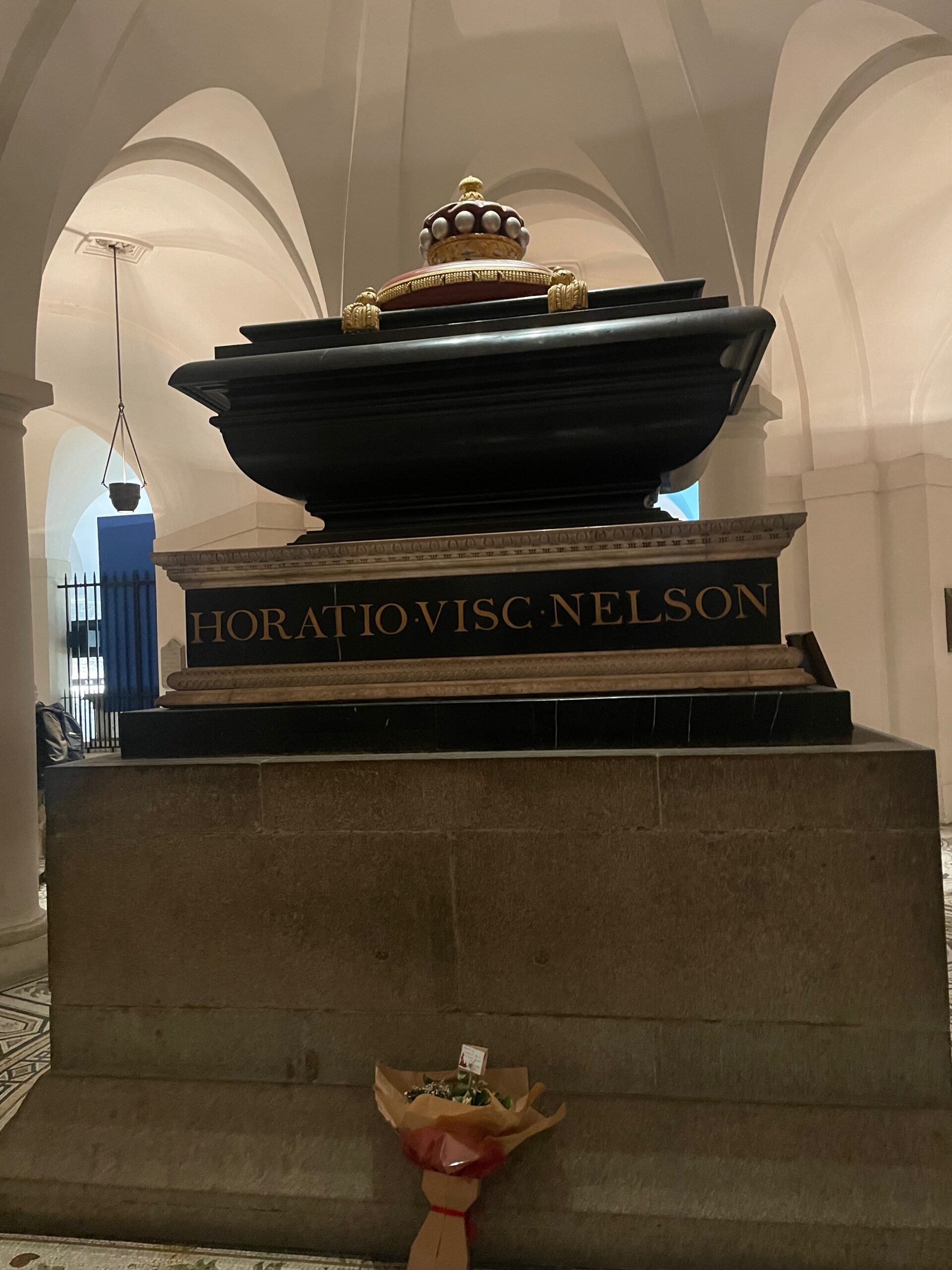
Born in 1758 in Burnham Thorpe, Norfolk, England, Nelson was in what we might call the upper middle class. He didn’t come from huge money, but the family had connections. This led him into the Navy thanks to his uncle, Maurice Suckling (can you imagine that as your last name?), who had developed a career in the Navy himself and had some pull. He took the young boy with him in 1770 as part of the Falklands campaign, where Spain, France, and England all wanted control over these uninhabited islands (can we again discuss how Argentina’s nationalist claims to the “Malvinas” are not backed up with anything but “they are close and we want them”?). The kid was only 12. And in fact, Suckling wasn’t real sure Nelson was Navy material. Turns out…the kid was indeed Navy material.
Nelson did very well for himself. He served under various commanders and they saw the teenager has having a ton of potential. In fact, by 1778, Nelson was commanding smaller vessels, remarkable for his age. He was in the fight against the American colonists attempt for independence, though on the seas, that was really a fight against the French. But the 1780s were kind of rough for him. The Navy wasn’t active enough. Peace held and that was just what a man like Nelson didn’t want. The Navy downsized. Nelson went on half pay and in the reserves. He needed more money than this. He also had a crew to look for–they were totally unemployed and he spent a lot of time trying to find work for his men.
Luckily for a man like Nelson, the French decided to have a revolution, kill their king, and annex what is today Belgium. War was back. Nelson was so happy! Killin’ is such a solid career move. He led a bunch of actions in the Mediterranean in the early 1790s.
Now…we all know by this point in the grave series that the details of military campaigns are more boring for me than the details of the latest scientific papers about dentistry. I just don’t care. So I’m going to do a fairly cursory overview of all this and you all–who get very excited about the Master and Commander series and love to imagine yourselves controlling militaries across the globe in your games and such–can expand, clarify, correct, whatnot in comments.
Nelson led an assault on Cadiz in 1797 (cool town, but much of the old history is gone so it’s not as cool as some other Spanish cities, though I did have an excellent lunch there). Then at Santa Cruz de Tenerife, he took a musket ball to the arm and lost it. He was back to command within 30 minutes of the amputation. Jeepers. He returned to England after that, in severe pain for a long time. A ligature in the amputation had gotten infected. Ow. It finally came out on his own.
Nelson then returned to command, leading the British Navy in the Battle of the Nile, which more or less ended a lot of Napoleon’s ambitions in the Middle East when his navy lost. Nelson was hit again in this battle, but with just small piece of shrapnel in his head. He initially thought he was going to die but he did not. It was at this point that he reached Hero status, thanks to the people of Naples glad they would not have to deal with the French navy anymore. However, Naples itself was soon overwhelmed by war and Nelson personally ensured that hundreds of Jacobins were executed in the aftermath. Then came the Siege of Malta and a reputation for insubordination, since he still had superior officers that he didn’t much respect and tended to ignore.
Nelson was promoted to vice-admiral in 1801 and then fought the Danes in the Battle of Copenhagen, which led to a draw. He then became commander of the British fleet in the Baltic. But he returned to England soon after over fears that Napoleon would try to invade. His health wasn’t super either and he basically took the next two years off after the French leader didn’t pull the trigger. But in 1803, he was given command of the British fleet in the Mediterranean and the ship HMS Victory. And this of course would make him one of the legends of the British navy and navies around the world.
Even I know that the Battle of Trafalgar is a critical moment in military history. Though were I to have guessed, I would have thought it much later in the Napoleonic Wars than in 1805, since, you know, I really had no idea since I don’t care about such things. All the descriptions of the battle I read online are basically the kind of over-excited prose that marks so much military history. But of course Nelson’s ships faced off against the French and Spanish. He only had 27 ships, versus the 33 commanded by the French commander. These boats would just shoot at each other from close range, the whole thing is kind of nuts if you think about it, though what isn’t insane about war? Nelson himself was hit by a musket ball that shot him through the spine. There was no way he was going to survive something like that, not in 1805. He died about three hours later.
Horatio Nelson was 47 years old.
But for Nelson this isn’t really the complete end of the story. That’s because Trafalgar was an overwhelming victory for the British. Despite losing Nelson and several other important officers, the British took 22 of the French and Spanish ships while losing not a single one of their own. So Nelson was a huge hero. He was laid in state for three days upon his return (I assume not an open casket at this point, good god) and many thousands of people attended, far more than anyone expected. He was the hero of the war at this point. The Prince of Wales was going to attend the funeral personally until King George III (perhaps in a moment or lucidity or maybe it was his top advisers) reminded the future George IV that the royal family was not supposed to attend the public funerals of commoners.
Horatio Nelson is buried in St. Paul’s Cathedral, London, England. But there’s a story here too. See, this sarcophagus had been sitting around for a long, long time waiting for the right person. It was initially constructed for Cardinal Wolsey all the way back in the early 16th century, but when he died out of favor with King Henry VIII, he didn’t get it. Then it was supposed to be part of Henry’s own tomb, but that didn’t happen either. So nearly three centuries later, it went to Nelson.
Again, feel free to expose my ignorance of all this stuff in comments.
If you would like this series to visit American naval heroes, you can donate to cover the required expenses here. Chester Nimitz is in San Bruno, California and John Paul Jones is in Annapolis, Maryland. Previous posts in this series are archived here and here.