
Erik Visits a (Latin) American Grave, Part 2,195
 By
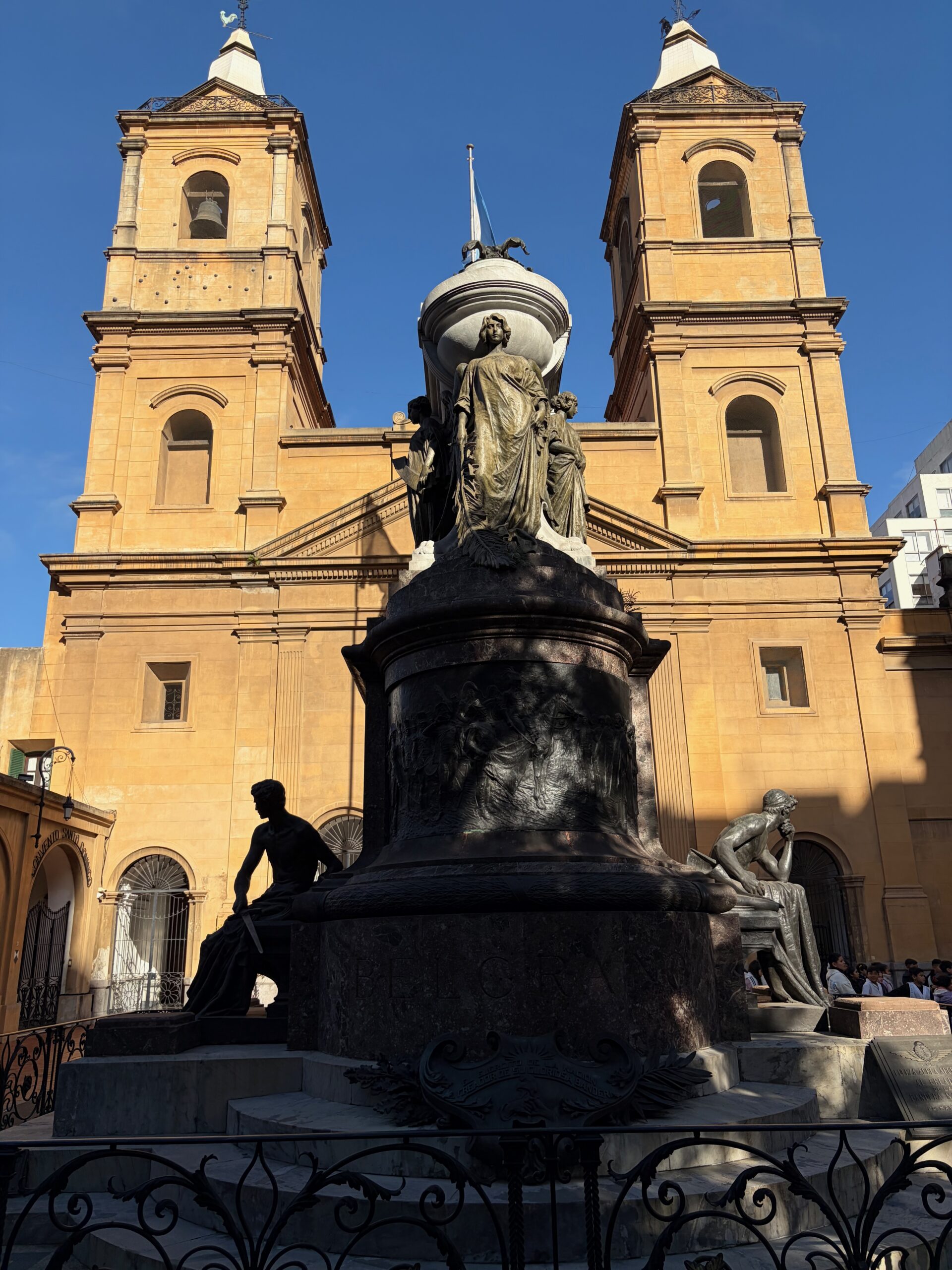
By This is the grave of Manuel Belgrano.

Born in Buenos Aires in 1770, Manuel José Joaquín del Corazón de Jesús Belgrano had a really long name. As per usual when you give you kids such long, pretentious names, the Belgranos had money. His father was Italian, a merchant who had a contract with the Spanish king to work in the Americas. His mother came from the second wealthiest family in the city. The family had eight sons who survived. The family wanted Manuel to take over the business, but he had no interest in that. So he went to good schools and then was sent to Europe in 1786 for higher education. This meant he was in Spain at the time of the French Revolution. He had interest in the forbidden texts of the Enlightenment there and read Rosseau, Voltaire, and other writers banned in Spain. They would influence him deeply.
The other thing that Belgrano picked up was the ideas of Adam Smith. Now, if you read The Wealth of Nations, it’s not nearly the right-wing text that modern capitalist fundamentalists make it out to be, especially if you have any context of what he was talking about. But of course they don’t read the Bible with any context either, or actually read at all. For Belgrano, Smith was a text of freedom, the idea that state control over how South Americans could gain wealth from nature began to see really problematic to him.
But it would be awhile before Belgrano could put these ideas into practice. His father expected to work toward the family interests and that meant tight connections with the state. So he returned to Buenos Aires in 1794 and became part of the new Commercial Consulate of Bueno Aires, a new institution that merchants created, working with the crown, to adjudicate their interests and eventually with greater control over customs. It was the kind of institution that could make the merchant class think they could run the Rio de la Plata themselves.
However, the leadership of the colony rejected many of these new ideas and the Spanish colonial government really did. Belgrano got discouraged. Now, the Spanish were really scared of what the American Revolution would unleash and they were quite right to feel that way. It wasn’t that they were scared of “democracy” per se; they hated that, but then so did many of the American founders. It’s that allowing the merchants and middling classes to see that self-government was possible without economic disaster would be really tempting for similar people in their own colonies. But the Spanish didn’t respond effectively, either by making it more appealing to stay with Spain or by, say, using political violence to crush resistance, which probably wouldn’t have worked either, but at least was some kind of response. No, the general reaction was just to refuse to admit that anything needed to change at all and put their heads in the sand while complaining about newfangled ideas coming out of the United States first, but then of course the horrors of France and Haiti. Well, no one said the Spanish crown had a useful response to anything at all by the early 19th century. So, unsurprisingly, when Belgrano found his ideas rejected, he became interested in self-government and kicking the Spanish out.
Belgrano was the secretary of the Commerce Consulate all the way from 1794 to 1810, so he plenty of time to work all this out. Meanwhile, Madrid was a mess, with Napoleon marching in and placing his own man on the throne. With the Spanish hopelessly occupied in Europe, the colonies began declaring independence one after another in 1810. In Argentina, this was the May Revolution. Belgrano supported this. But then what? It was one thing to get rid of the Spanish, but Argentine self-government proved much more difficult. The endless civil wars and deeply felt political conflict that has marked this nation for the next 200 years started immediately. Belgrano got real involved. He was part of the post-Spanish junta. In fact, he was named military commander for the invasion to stop Paraguay from declaring independence from Buenos Aires. Did Belgrano have the military experience to do this? No and it showed. Belgrano and his troops got their asses whipped, were forced to withdraw, and Paraguay moved toward full independence.
Belgrano came back to Buenos Aires in shame and there was talk of bringing charges against him, but that didn’t happen. The junta didn’t quite know what to do with him. But he did have one very strong thing to offer–Belgrano created the Argentine flag. This came about because the royalists and the revolutionaries were using the same colors and he wanted to unite the new nation with a new design. The Argentine flag is pretty nice too–I’ve always been a sucker for light blue. Few nations use that kind of blue. Flags are so boring–they are mostly just the same combination of a few different colors. The number of red, white, and blue flags are there show a real lack of design. At least the U.S. brought the stars and stripes idea into the world and with the stars in one corner, we really have a quite unique flag design rather than the big three stripes that define most nations. So it’s nice to see anything different at all, such as the Irish at least using orange or the Argentine light blue and white design. So at least for me, the flag is the most exciting part of this post.
Well, Belgrano continued with his work in the complicated internecine battles within the larger Argentine revolution. There were more military actions, coups, diplomatic trips to Europe. He did lead troops against royalists as the key Battle of Salta, which pretty much ended any Spanish threat to retake Buenos Aires. But he struggled in battles in what is today Bolivia. The new government in BA wanted to judge Belgrano for his failures, but they had sent Jose de San Martin to replace him and San Martin was not going to force Belgrano to do that. By this time, Belgrano was supportive of a new monarchy, seeing Argentina as ungovernable. Hard to argue with that point given its history.
But by the late 1810s, with the war still up in the air, Belgrano’s health was a disaster. It had been bad for at least five years. In 1820, he died of dropsy, which could have been caused by any number of factors. He was 50 years old. He had used his entire wealth to fund the war, so he had very little financial resources left.
Manuel Belgrano is buried in front of Iglesia Santo Domingo, Buenos Aires, Argentina. Initially, he was buried simply inside the church. But he was exhumed by the government in 1902 and placed in this over the top monument, part of the effort by Latin American governments to turn their founders into heroes with monuments that occurs from time to time.
If you would like this series to visit early American ambassadors to Argentina, you can donate to cover the required expenses here. The first two ambassadors–Caesar Rodney (nephew of the guy on the Delaware quarter) and John Murray Forbes–died on the job, as was common in this era where everyone dropped dead at any moment. They both are in Buenos Aires evidently. But for people who would see the United States again, Francis Baylies is in Taunton, Massachusetts and William Alexander Harris is in Louisiana, Missouri. Previous posts in this series are archived here and here.