
This Day in Labor History: June 27, 1993
 By
By 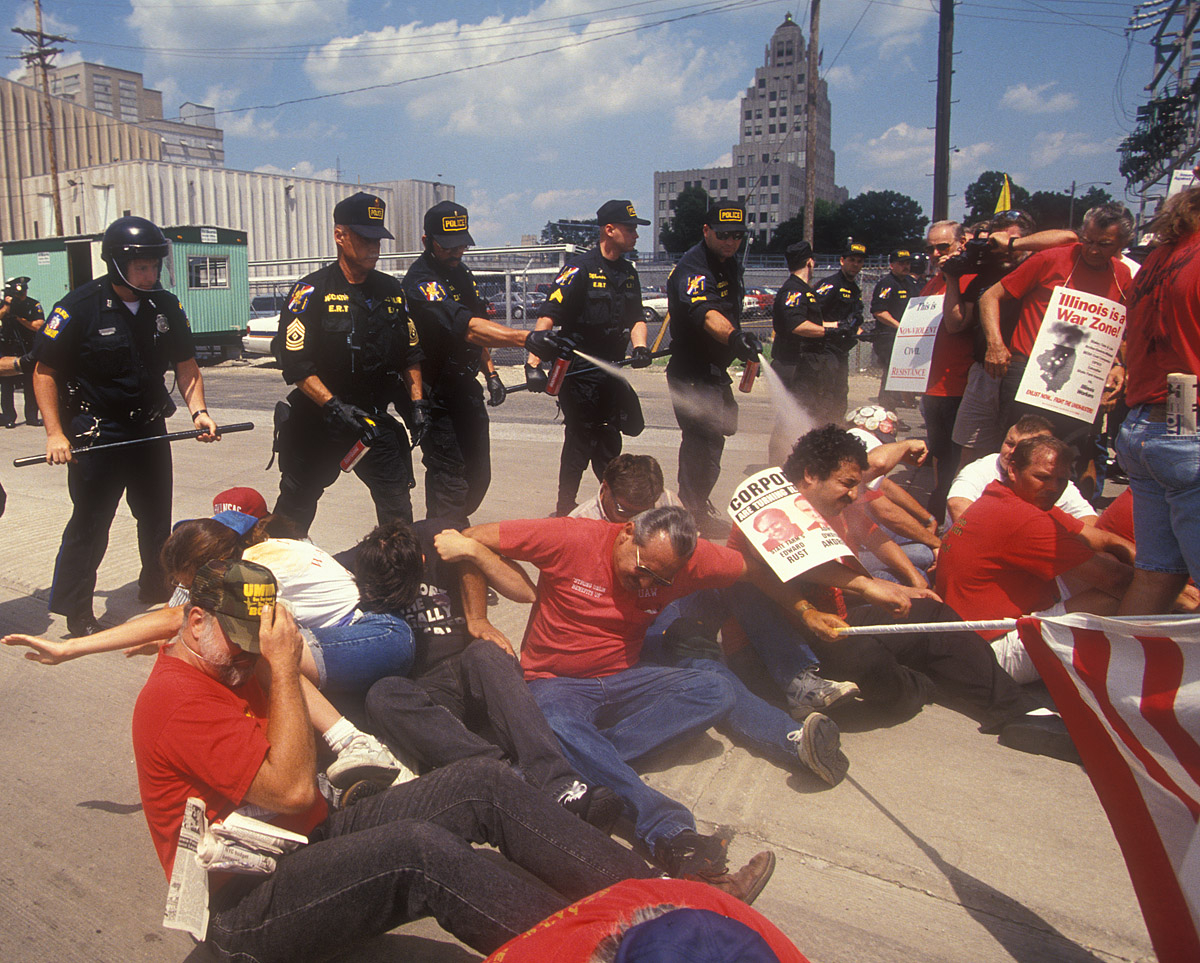
On June 27, 1993, the A.E. Staley Company in Decatur, Illinois chose to lock out its workers unionized with the Allied Industrial Workers of America in order to bust the union. This led to a two-year campaign to try and not only save these workers’ jobs and union contract, but to save American labor after a decade of concerted unionbusting by the government and employers. The Staley movement was one of the most important moments for American labor in the 1990s.
Unions showed a lot of pep in the 70s, with widespread public sector organizing, fights over union democracy, and a new militancy on the shopfloor. The 80s erased all of that. The big factory closures of the late 70s really started it–the promise of work disappeared. Then Reagan fired the air traffic controllers over their illegal strike in 1981. That disaster–arguably the most disastrous moment in American labor history–combined with the Reagan administration’s disdain for unions and the working class generally to give permission to corporate America to bust their own unions. Workplaces with long-standing union contracts found themselves embroiled in new labor wars as greedy employers decided to destroy the unions. Some of the prime examples of this are the Phelps-Dodge strike in the copper mines of Arizona in 1983, the Hormel strike in 1985-86 in Minnesota that Barbara Kopple captured for her superb but depressing film American Dream, and the Brown and Sharpe strike in Rhode Island that became the longest strike in American history. Plus millions of industrial jobs continued to disappear thanks to the bipartisan free trade mania of the era that would be codify a few years later with the North American Free Trade Agreement. There were occasional moments when unions had big victories in the 80s, notably in the Pittston strike in 1989. But unions came out of the 80s completely shellshocked, with almost no vision on how to approach the new reality, with organizing a thing of the past and political power diminished.
One of the companies that sought to take advantage of this new situation was A.E. Staley, which mostly produced industrial food out of its Decatur, Illinois plant–corn starch, frozen breakfast foods, plus cleaning supplies such as fabric softener and toilet bowl cleaner. Basically anything you could do with corn, which was a lot. It was a local company that had gone big and now was part of the kind of megacorporations that the 80s mergers phased created. In 1985, the company’s owners started pushing back hard on the good union contracts its workers had won. It was in the buying phase at this time and wanted to cut costs. It had merged with a company called Continental that year. The union took a loss on the new contract. Wages were frozen and working conditions got worse Then, in 1988, a British firm called Tate & Lyle bought it with the intention of spinning it off to SYSCO, the giant food conglomerate, though that last part failed to materialize.
This new regime had no interest in continuing with their unions. In 1991, the company hired a known unionbuster to be its labor relations director. OSHA–already a shell of what it was intended to be–was ordered to be ignored by management. The company started firing workers for any reason it wanted, throwing away the just cause clause of the union contract. In response, the union went to a “work to rule” plan. This is when you do exactly what is said in the contract and not one thing more, slowing everything way way down. The company was furious. Production fell upwards of 50% thanks to workers taking power on the job.
So the company decided to shut its doors until the workers gave up. That’s the lockout–an employer strike. The employer was happy to lose money until it could regain power, which is one of the key takeaways from labor history. It’s about the power over workers much more than it is about the money the workers want.
The workers tried everything to fight this. They hired the corporate campaigner Ray Rogers–if you’ve seen American Dream, he’s in there too–at the outrageous salary of $28,000 a month to help them place pressure on Tate & Lyle’s holdings across the nation and world. This was the era where labor organizers and activists really wanted to believe that you could win power for workers in one part of a conglomerate by making a big stink at shareholders meetings and other public events at other parts of the conglomerate. Mostly it didn’t work, but since people love the idea of consumer activism, it had a lot of legs.
A lot of what the Staley workers ended up doing was borrowed from the United Farm Workers’ grape boycott--send organizers and activists across the country to raise awareness. Since Tate & Lyle was the world’s largest sugar conglomerate, there was potential in the strategy. Workers went here and there and there were plenty of solidarity campaigns around the country.
But the other side of this–and this is what labor activists today really focus on–is that it, like the UFCW battle in the Minnesota Hormel plant–a challenge to union leadership and the AFL-CIO offices that really had no answer to anything at all in this era. Now, the workers really didn’t have a realistic shot at victory here. Tate & Lyle did not give a shit. The workers fought–they really did. It was the ultimate David & Goliath campaign. But even when John Sweeney took over the AFL-CIO and promised big changes and a new commitment to organizing–which was in fact positive but hardly the revolutionary changes required to transform the labor movement–he had no real way to help Staley workers because they simply had no power. When you read discussions of the lockout and its aftermath, the level of bitterness toward centralized union leadership just drips from the page, but also a lot of that is ideology. It’s pretty easy to say that union leadership sucks because you have no evidence that your ideas would have done any better. A lot of labor writing is like this.
In any case, Tate & Lyle finally did win. In December 1995, workers decided, by a narrow margin, to accept the company’s horrible offer and return to work. Only some were hired back. Decatur continued its decline from a center of American industry. The American working class continued to lose power to corporate scum. The American labor movement continued to not have any answers. Not much has changed since.
This is the 607th post in this series. Previous posts are archived here.