
The Fall of Skywalker feat. Yours Truly as Kathleen Kennedy
 By
By 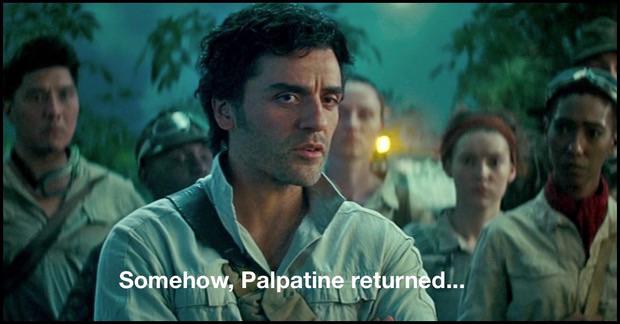
I’ve mentioned the podcast Going Rogue on this blog before, in rather glowing terms, but to repeat myself: hosted by Tansy Gardam, Going Rogue is a research-based podcast about the inner workings of the American film industry, and specifically how blockbusters are made, from the pitch and script stage, to production, to post production and marketing. More specifically, how things can go wrong in any of those stages. The podcast’s first topic was, as the title indicates, 2017’s Rogue One: A Star Wars Story, a film that—as Gardam discusses—had a lot of potential in the script and concept phase, and still came out the gate with much to recommend it, but is nevertheless kind of a mess overall (though it did give us Andor in the end, so all’s well that ends well there).
It was only natural to follow up a discussion of one ill-fated Star Wars movie with another, and the second season of Going Rogue was thus about Solo (2018), a film with far fewer strong points than Rogue One, and which proved fodder for an equally excellent discussion of Hollywood’s foibles as a whole, and the fundamental problems with the Disney Star Wars experiment in particular. (Also, listening to this season, known as Going Solo, allows one to avoid the shocked response of “but it’s not a comedy!” that some people have had to Project Hail Mary; despite the conventional wisdom, the problem with the beleaguered Solo production was not that Phil Lord and Chris Miller were trying to make a Lego movie in the Star Wars universe.)
The obvious next step for Going Rogue would have been to complete the “Star Wars clusterfucks” trilogy with a discussion of 2019’s The Rise of Skywalker, but you could sense Gardam’s reticence to be pigeonholed that way. In the last few years, she has produced seasons about 2007-2008 writer’s strike, about Zack Snyder’s film doulogy Rebel Moon, and—because Going Rogue is a podcast about blockbusters, not just blockbusters that go wrong—about projects that work despite seeming like soulless cash grabs on paper, such as the Pirates of the Caribbean trilogy. But throughout all these excellent discussions, The Rise of Skywalker has loomed like a giant question mark, and starting last week, Going Rogue has launched into a new season, titled The Fall of Skywalker, discussing the film that may (depending on how well The Mandalorian and Grogu does) have killed the entire concept of new Star Wars movies for a generation.
I knew about the subject of the new season of Going Rogue well ahead of most people, because back at the beginning of the year, Gardam approached me with a request. Rather than read out blocks of text from various movers and shakers in the Disney Star Wars project herself, she invited different people to voice them. Which is why, if you listen to The Fall of Skywalker—which you should—you will hear my dulcet tones in the role of the most hated woman in fandom, Lucasfilm’s former president Kathleen Kennedy.
One of the problems with talking about the Star Wars sequel trilogy is that, having become a rallying cry for the far right (and, in many ways, a precursor to how they have sought to influence culture and politics in general in the last decade) it is impossible to talk about these films’ flaws without feeling like you’re ceding ground to literal Nazis. There are issues with how Rey is introduced in The Force Awakens, but it’s impossible to discuss them in light of the firehose of misogyny that greeted the character as soon as the film dropped. There are problems with The Last Jedi, but far too much of the outrage surrounding it is little more than open racism against John Boyega, Kelly Marie Tran, and their excellent characters. And it is impossible to take seriously the vitriol that has been directed against Kennedy, one of the most experienced and successful producers in Hollywood, whom the fandom has been determined to cast as a brainless neophyte whose only idea is “white woman with brown hair”. But nevertheless, as I listened to The Fall of Skywalker and started placing the segments I had recorded a few weeks earlier in context, I had to conclude that Kennedy had seriously screwed up.
The first episode of The Fall of Skywalker discusses Duel of the Fates, the draft script written by Colin Trevorrow (who was supposed to direct the movie that eventually became The Rise of Skywalker) and Derek Connolly, which was posted online in 2020, long after Trevorrow was removed from the project and replaced, as director and screenwriter, by J.J. Abrams. I agree with Gardam that the script, as described, has problems, but nevertheless it is shocking how much more interesting and compelling it sounds than the film we got. That impression is bolstered by the second episode, which discusses Abrams’s entry to the project, and his development, along with co-writer Chris Terrio, of the script that ended up being filmed. As Abrams and Terrio bounce from idea to idea, location to location, and set-piece to set-piece, it’s obvious that they never had a coherent notion of the story they wanted to tell with the final installment of the sequel trilogy. It’s startling to consider that Kennedy, and other people in the Disney and Lucasfilm hierarchy, did not grasp this as a fatal problem, and preferred Abrams’s overcooked mess to Trevorrow’s script, which for all its issues, is clearly trying to tie the entire trilogy together with a statement about what Star Wars is.
This is not a new observation, of course, but one of the things The Fall of Skywalker really drives home is that the key failure of the sequel trilogy was not the fact that Lucasfilm did not have an overall story locked down before The Force Awakens started shooting, but that nobody, from Kennedy on down, ever came up with a reason for these movies to exist. The original trilogy was a story about defeating fascism. The prequel trilogy, about how fascism took over in the first place. The sequels, in contrast, don’t really seem to be about anything beyond “let’s make more Star Wars“. The Force Awakens introduces some incredibly promising characters, but storywise its biggest idea is “what if we erased all the progress made at the end of the original trilogy, and then refused to sit with the sadness and horror of that?” (Gardam is being very insightful when she points out that in hindsight, the movie feels more like the pilot of a TV series than a trilogy opener.) The Last Jedi is genuinely thoughtful and provocative about the project of Star Wars as a whole, but does not move the story of the trilogy one jot. That Trevorrow was able to craft anything resembling a conclusion to this shapeless mess is much to his credit, and it is once again mind-boggling that Lucasfilm’s response was to toss that out, and instead use a script that did not seem to have any idea why it, or the movies preceding it, even existed.
Going Rogue: The Fall of Skywalker can be found where all podcasts are found (and in addition, Gardam has a Patreon where subscribers get the regular podcast episodes as well as bonus material about recent movies, and, last year, the second season of Andor). The first two episodes are excellent and have, as you can see, already occasioned a lot of thoughts about this project, and why Hollywood seems to be struggling to make IP-based movies that work, rather than ones that feel like work. The rest of the season will, I’m sure, be no less engaging. Listen for intelligent, informative discussion of how the Hollywood sausage gets made, of if you’d like to hear me try to justify decisions that, in context, seem really hard to justify.
(Did I deliberately pick May the Fourth to recommend a podcast about modern Star Wars‘s failing? Well, no. I’ve been planning to write this post for a week. But life has been particularly life-y lately, so it wasn’t until today that I actually had time to do that. And I think it’s appropriate, on a day that is all about the Disney machine bigging up its latest and upcoming IP extrusions, to remember how badly they’ve failed in stewarding the franchise over the last decade.)