
Erik Visits an American Grave, Part 2,130
 By
By This is the grave of Elisha Bartlett.

Born in 1804 in Smithfield, Rhode Island, Bartlett was well enough to get a good education, including at New York schools. He grew up as a Quaker. He was particularly interested in medicine. This was still a grim field at the time. Medical knowledge hadn’t honestly changed all that much in centuries. But of course people wanted to do better and Bartlett was one of them. He would become a leader in American medical knowledge during his lifetime, as limited as that still might have been. He studied at a variety of medical schools and became a professor at Berkshire Medical College in Pittsfield, Massachusetts in 1832. For awhile, he made his home in Lowell, Massachusetts and even became the mayor of Lowell for a couple of terms in the 1830s, as a Whig. In fact, he was the first mayor of Lowell.
Bartlett traveled around a lot during his career, being based at many colleges. I don’t think that was crazy common at this time. His career sounds like the hotshot professor today who bounces around out of wanderlust and a desire for ever more money and prestige (this sounds like a pain to me and totally not worth it). He went to Transylvania University, then a quite elite school in Kentucky. He was the University of Maryland, University of Louisville, Vermont Medical College, the University of the City of New York, and finally the College of Physicians and Surgeons in New York. Maybe that was the point in the end, getting to New York, already the central city of the United States.
Well, following some guy’s academic career is not very interesting. But his medical career is somewhat more interesting. He became particularly interested in typhoid fever. He started researching the issue. He was already writing a lot. In 1842, The history, diagnosis, and treatment of typhoid and of typhus fever, with an essay on the diagnosis of bilious remittent and of yellow fever. This book was widely read and relatively popular for a book of this kind. It’s kind of hard to describe what a guy like this did. Some of this is that what he did was really obscure and the medicine not particularly successful. But he was a pretty popular guy. Here’s the first page of an obituary I found online:
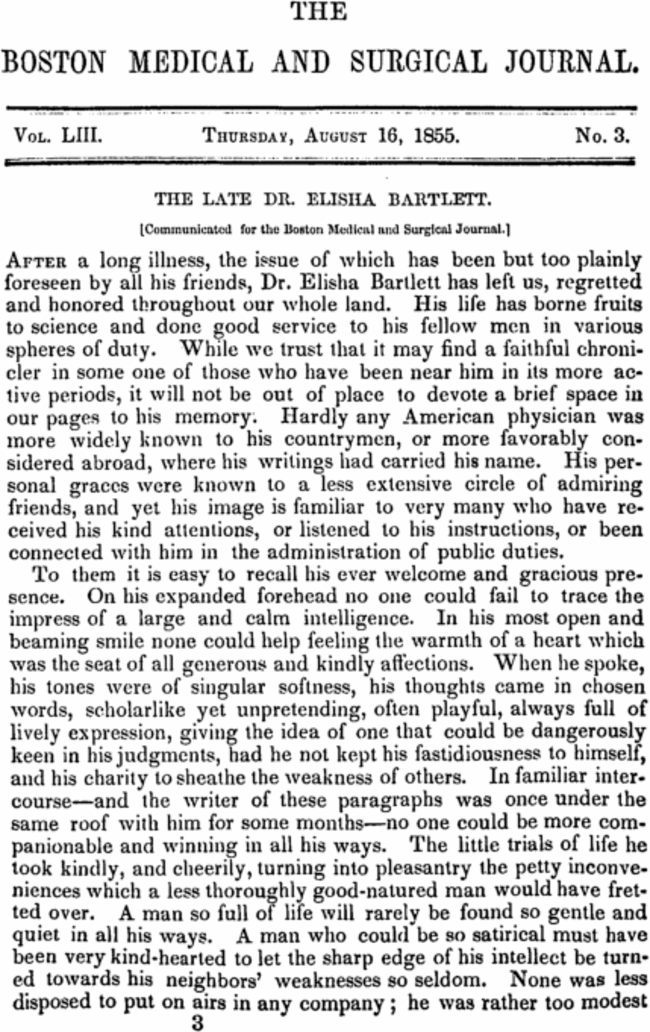
I like the forehead bit, good to see some early eugenics get in there.
When contemporary scholars mention Bartlett–and they do more than you think–a lot of it has to do with him encouraging other medical practitioners to spend time in Europe, especially France, if they could. He had done this at some point and by the 1820s, was writing that doctors should do this if possible, when he published an 1828 article in an American journal about a modern Paris hospital. What he noticed is the kind of thing that didn’t really get implemented until around the Civil War, which is the idea that hospitals should think about where to place patients and maybe not just put them all in a giant ward that helped no one. Bartlett returned to Paris in 1845 to learn more as well, this time as a senior medical doctor.
After the typhoid book, Bartlett decided to take on the medical establishment in America. A lot of medicine at this time had to do with doctors’ theories of the human body. This was not good. Bartlett published a long essay, really a book, in 1844 that attacked this and said that doctors needed to be scientists and work off of observation and experiment, not theory. He talked about things such as sample size in an era before statistical analysis really existed. He urged doctors to have proof that a patience even had a disease when they claimed to be able to cure said disease publicly. He was skeptical about the common knowledge medically perfect unproblematic at all practice of bleeding patients, saying that maybe we needed evidence that this actually worked. I don’t know if no one had ever questioned bleeding before–I’m going to assume they had and the fact that he was so influenced by French doctors suggests there were advances being made over there–but the ubiquity of this well into the nineteenth century is pretty amazing given its utter quackery.
Interestingly, Bartlett was also skeptical that the medical profession would ever figure out how to solve most diseases. Now, he was wrong about that. In the decades after he wrote his influential texts, the medical world would advance by leaps and bounds. But what’s notable here is his humility. Rather than make the kind of outlandish claims for bullshit cures that his colleagues did, he simply said that nature was mysterious and humans aren’t really that bright, and disease will remain with us. And honestly, who doesn’t want the medical profession to have a lot of humility? Among the diseases he did not believe curable included the Bubonic plague, cholera, typhoid, and spotted fever. He also criticized the overprescription of drugs, which at this point were also super rudimentary of course. Reviews to this book were highly mixed. Some were impressed by the humility, others were super defensive about his attacks on the field.
Bartlett died in 1855, at the age of 50. Not sure why. Bartlett is a highly obscure figure, yes, but it’s important to consider those largely forgotten in the development of medicine and other fields, especially when the internet’s least important and now unquestionably longest series is well over 2,000 posts.
Elisha Bartlett is buried in Slatersville Cemetery, North Smithfield, Rhode Island.
If you would like this series to visit other figures from 19th century American medicine–and what a bunch of luminaries that is!–you can donate to cover the required expenses here. John Curwen is in Bryn Mawr, Pennsylvania and Henry Pickering Walcott is in Cambridge, Massachusetts. Previous posts in this series are archived here and here.