
Erik Visits an American Grave, Part 2,131
 By
By This is the grave of Homer Cummings.
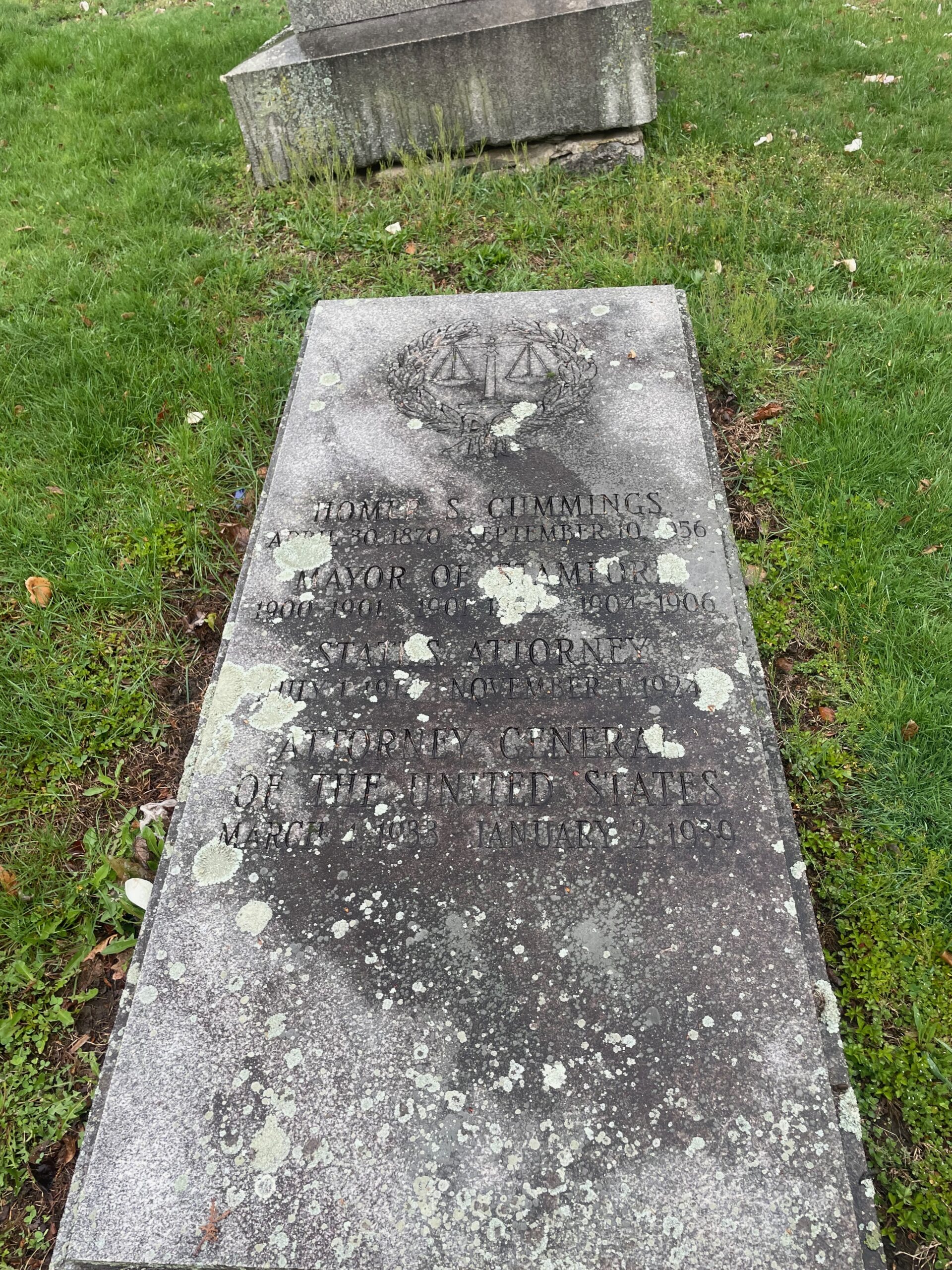
Born in Chicago in 1870, Cummings was pretty well off, went to some fancy private school in Buffalo, and then it was off to Yale and then Yale Law, where he finished in 1893. He passed the bar soon after. He started a practice in Stamford, Connecticut and then formed a partnership with another rising young lawyer named Charles Lockwood and their firm became a leader in Connecticut law.
One thing that made Cummings different than your usual Connecticut rich guy is that he was a committed Democrat with a Populist streak. He was an active supporter of William Jennings Bryan in 1896, who horrified most of wealthy New England. He became a big Progressive too and he was an excellent public speaker. He was nominated for Connecticut Secretary of State. He didn’t win that race, but he did do well enough. He then became mayor of Stamford, which had enough immigrants that a Democrat could defeat the Old Yankee Republicans. He became a frequent Democratic nominee for statewide elections, but that was so hard. It was like winning as a Democrat in today’s Texas. You can nominate great candidates, but the forces are so hard against you. He ran close races on multiple occasions–Congress in 1902, Senate in 1910, Senate again in 1916. He came close all three times. He never could win.
So Cummings had a good national profile and a good local standing, even if he couldn’t win statewide. He was also an effective, decent, humane lawyer and for this he became famous. In 1924, a priest was killed in Bridgeport. Cummings was state attorney for Fairfield County at this time. A guy named Harold Israel was charged in the murder. The media picked up on it and assumed he was guilty and it was a clownshow all the way. He was a World War I veteran fallen on hard times, an itinerant homeless man, and, given the name, I assume was Jewish. Cummings refused to play along. He believed the confession was coerced under torture through not allowing Israel to sleep, which is what happened. The man looked like the killer and he even had an illegal gun. In fact, he was already arrested for that gun when the cops tried to pin the killing on him. Cummings found experts who undermined the entire case. Cummings dropped the case entirely in 1924.
Cummings really risked his career here. Bill Clinton sure wouldn’t have done it, as he flew back to Arkansas to have Ricky Ray Rector murdered by his state so he could look tough for the voters. Cummnings was a nationally prominent Democrat, under consideration for high position the next time they took office. Connecticut leaders were furious at him for making them look soft on crime. This was the era of Sacco and Vanzetti after all. But Cummings felt he had to do the right thing and that law enforcement needed to protect the innocent as much as prosecute the guilty. This whole thing was made into a movie in 1947 called Boomerang, directed by Elia Kazan with Dana Andrews playing the Cummings character. The names were changed but it was filmed in Stamford.
Cummings was already kind of on the outs with a lot of Democrats leaders anyway. He tried to get the Democratic Party to compromise over KKK provisions and was very uncomfortable with Al Smith, being one of the only leading northeastern Democrats to prefer William Gibbs McAdoo. But John Davis, who was awful, was the nominee in that bad year for Democrats. After this, he mostly just stuck to the law for the next several years.
In 1933, Franklin Delano Roosevelt had enough respect for Cummings to find himself something in his new administration. Initially, it was to be governor-general of the Philippines, with the big house in Manila and everything. Kind of a secondary job, but an important one within the limited American colonial empire. But then, a mere two days before FDR took office, his attorney general nominee, Thomas Walsh, died. Needing a very quick turnaround here, he promoted Cummings.
Cummings proved a very active AG and a big ally of FDR in the fights with the courts. He gave Roosevelt the legal reasoning that allowed for the bank holiday. When the Supreme Court did its “we are the protectors of the Great Gilded Age” and threw everything out the government passed as unconstitutional, Cummings pushed for court expansion. Cummings did the prep work on the court expansion plan that Roosevelt announced in 1937. Of course, it was something of a political disaster to FDR as it solidified opposition to the New Deal among conservative southern Democrats who would thereafter work with Republicans to limit any more major changes. But it also put the necessary pressure on the old hacks to resign and allow the 20th century to exist. Of course, Cummings’ ideas need reconsideration today.
Cummings was also an ally of the FBI and its young energetic director J. Edgar Hoover. This was before Hoover had become a full-on monster, though that was already very much in the evil man. But Cummings expanded definitions of federal crimes, tried to make Alcatraz a model prison (whoops!), and built support for the Lindbergh Laws around kidnapping. Hoover played Cummings pretty well to increase funding, raise fears of Japanese subversives spying on the U.S. that laid the groundwork for the World War II American concentration camps, and all the other stuff that the Director wanted. Cummings also wanted firearms restrictions, but our old friends, the National Rifle Association, not yet the extremist far-right organization it would become but bad enough, lobbied successfully against any meaningful gun restriction legislation.
One thing that Cummings did that might or might not be a good thing is solidify the relationship between the AG office and the White House. In the past, these had remained pretty separate, but Cummings’ involvement in specific policy debates, pushing New Deal legislation, and using the power of his office to pressure the courts definitely had an impact. Cummings himself lobbied Congress for his desired policy choices and bills. He really led FDR down the road of greater interference with the other branches of government, doing so before the president understood just how obstructionist they would be. Of course today, with Trump using the AG office as his personal prosecutorial team, this has gone nuclear. I don’t want to blame Cummings for Trump of course, but it’s important to note the choices made in the past that created the present.
Cummings stayed as AG for six years, which is today the 4th longest run of anyone in the history of the office. He retired in 1939. He stayed in Washington for most of the rest of his life, practicing law and making a lot more money than he made in Connecticut. He moved back to Stamford late in life. He died in 1956, at the age of 86.
Homer Cummings is buried in Woodland Cemetery, Stamford, Connecticut.
If you would like this series to visit other occupiers of the Attorney General position, you can donate to cover the required expenses here. May I live long enough to visit Pam Bondi’s grave. William Mitchell, who held the position under Hoover, is in Saint Paul, Minnesota. Frank Murphy, who held it after Cummings, is in Harbor Beach, Michigan. Previous posts in this series are archived here and here.