
Erik Visits a (Non) American Grave, Part 2,145
 By
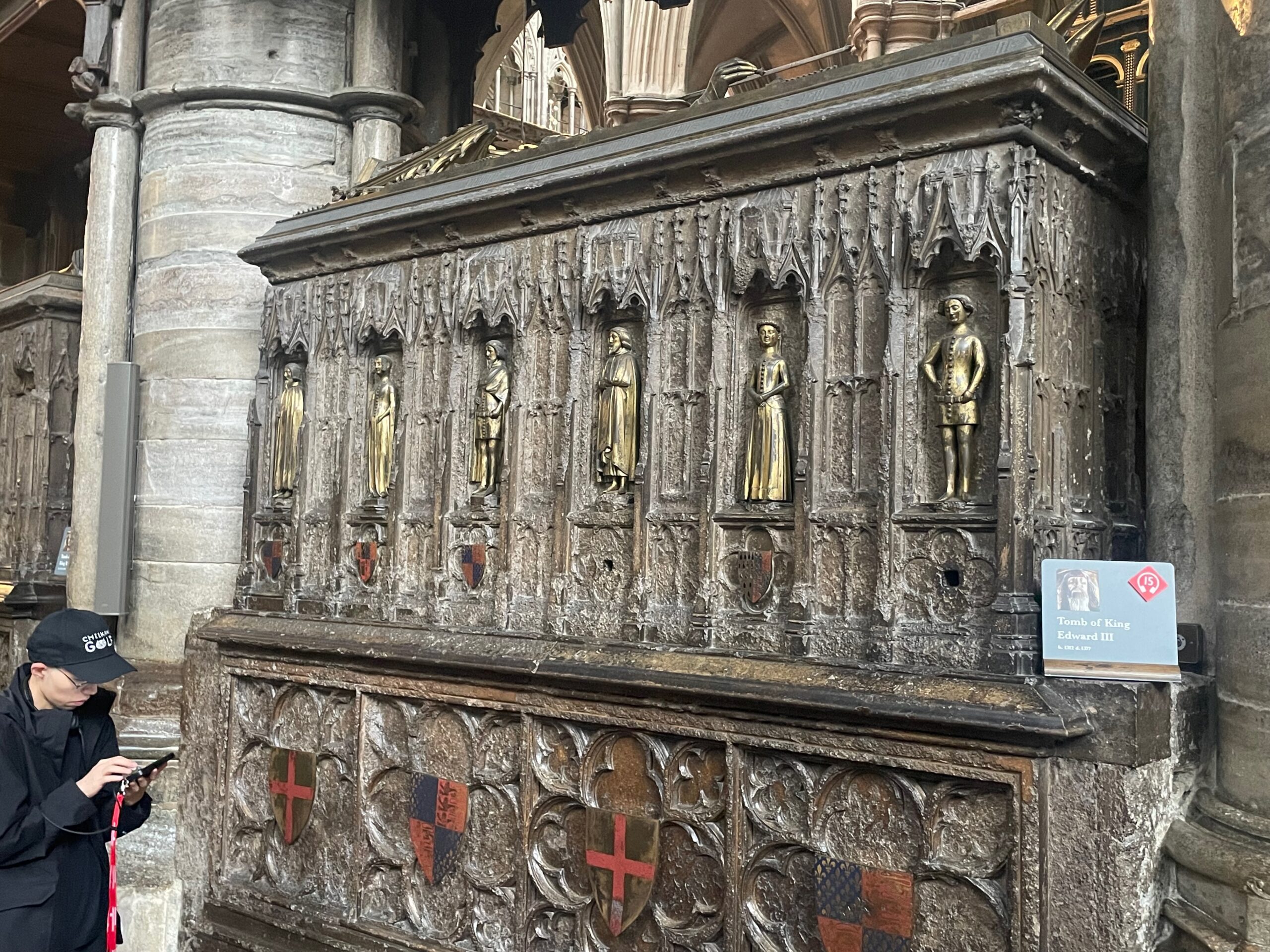
By This is the grave of King Edward III.
Born in 1312 in Windsor Castle in London, Edward was the son of King Edward II, a disastrous king of England. Turns out that succession by birth leads to weirdos becoming king, who knew. But sometimes it can go the other way and for the most part, that’s the story of Edward III. His mother was a schemer bar none. She knew Edward II was a disaster. She had a lover, Roger Mortimer, that she met while in France. He had a led a rebellion in 1322 and barely escaped with his life. They decided to overthrow Edward II, place Edward III on the throne, and then rule themselves through him. It worked too, for a bit, in 1327. Since he was only 14, he needed a regent and gee I wonder who that would be? Moritmer thought of himself as king, immediately invaded Scotland, lost major battles, and alienated most of the nobles by acting like he was king. Meanwhile, the young Edward was getting impatient and proved to me much stronger than his father. He also worried, for good reason, that Mortimer was planning his own death to get himself officially installed on the throne. In 1330, Edward and a group of trusted men went to Moritmer’s castle at Nottingham, took him, and had him executed.
After that, no one was going to mess with Edward’s control over the crown. He moved fast and he moved smart. The country’s mobility was a mess, with infighting, diminishing numbers due to marriages that failed to have children, divided over the political crises of the 1310s and 1320s. So he created a whole bunch of new nobles and gave them to people he knew were loyal to him, including the men who had helped him kill Mortimer.
Edward was now pretty drunk with power. He was king and he thought he was the king of kings. Now, he was pretty good at military operations and made England a legitimate European power for the first time. He started by invading Scotland in 1333, basically forcing the Scots into full-fledged war by placing Berwick under siege and over the next couple of years, forced the Scots to cede a large amount of its southern territory, which given the climatic conditions, was the land that was relatively decent for growing food.
The French got involved to help the Scots, but this made everything quite complicated and infuriated Edward. See, in 1328, King Charles IV of France died without an obvious male heir. In fact, his closest male relative was….Edward III of England. But the French had no intention of allowing Edward to be their king. So it went to his cousin Philip VI. Well, Edward thought he good and damn well should just take over France since he was the rightful heir and all. This led to the Hundred Years War. It looked pretty good for Edward early on. The cities in what is today Belgium all expressed their fealty in 1340. Because the Low Countries and northern France were pretty dependent on English wool, he had some advantages. Then he had a big win at the Battle of Crecy in 1346, with Philip VI wounded and then the Siege of Calais shortly after. This battle also made the longbow popular as the English used it effectively. Then in 1356, Edward’s son, the crown prince known as the Edward the Black Prince, led English forces to another major victory in the Battle of Poitiers.
But when Edward led forces against Paris, a giant hailstorm killed over 1,000 of his troops. I assume this was actually a tornado or something like that, which usually includes gigantic hail storms that are like ice bombs too. In any case, this was as close to Edward got. Of course, these big campaigns cost a ton of money and so this war might have been called the Hundred Years War, but it was extremely sporadic, in part because the English kept having to go home and raise money for more fighting.
Of course the Black Death messed a lot of this up too. The armies had to take a lot of time off with everyone dying and such. Workers demanded more money and the King and Parliament, showing the usual wealthy contempt for workers, attempted to tie labor in place and ensure they received as close to nothing as possible. Edward and family somehow managed to escape the plague. Edward didn’t care that much about all the dead people, but it did delay resuming war with France until the mid 1350s and that was horrible.
Edward, being a king and all, also had a gigantic ego. He thought he could heal people through touching them. I guess it probably wasn’t worse than anything else that passed for medicine in the 14th century. But still. Opinions on Edward the person differ. He seems to have been both a general kind of populist, giving away a lot of funds and hosting meals for the poor, while also being a complete sicko who liked to torture and punish people. So he’s like Donald Trump I guess, except, oh wait, Trump’s populism is entirely fake and he doesn’t do shit for his supporters except increase the cost of their food while they smile and like it.
Now, other than the wars, Edward was a complete schmuck. He had no interest in domestic governance at all, so he completely handed over power in this realm to William Wykeham, who became very powerful in the 1360s, though Parliament forced him out in 1371. Like most of these rich people, Edward’s health got bad as he aged, though given the state of medicine at the time, no one was really healthy ever by modern standards. He let his sons handle most everything after about 1360. John of Gaunt, his 4th son, took over a lot of Wykeham’s power after the latter was forced out. Also, by the time Edward died, most of the big gains made in France were lost and he lived long enough to know this and it was pretty much just down to Calais by 1375. After 1375, Edward was just a shell of himself. He had a serious abscess in 1376 and then had a stroke in 1377 that killed him. His son Edward died in 1376, so his successor was his grandson, Richard II.
But whatever you want to say about Edward III, he absolutely expanded England’s power. The mere idea of ruling for a half-century was so unbelievably unlikely given the health issues of the time–not to mention that men like Edward liked to be in battle–that it alone would make him remarkable. Unlike most kings, he wasn’t abjectly horrible with the job. He managed the personalities and power dynamics necessary to prevent serious attempts to kill him over internal struggles. So when you look at some of these things in context, he’s a pretty successful king by the standards of this era.
Grant you, I know next to nothing about the 14th century, so feel free to correct any misconceptions in comments.
Edward III is buried in Westminster Abbey, London, England.
If you would like this series to visit some American Edwards, you can donate to cover the required expenses here. Edward Baker is in San Francisco and Edward Stettinius is in Locust Valley, New York. Previous posts in this series are archived here and here.