
Erik Visits an American Grave, Part 2,121
 By
By This is the grave of Frank Sprague.
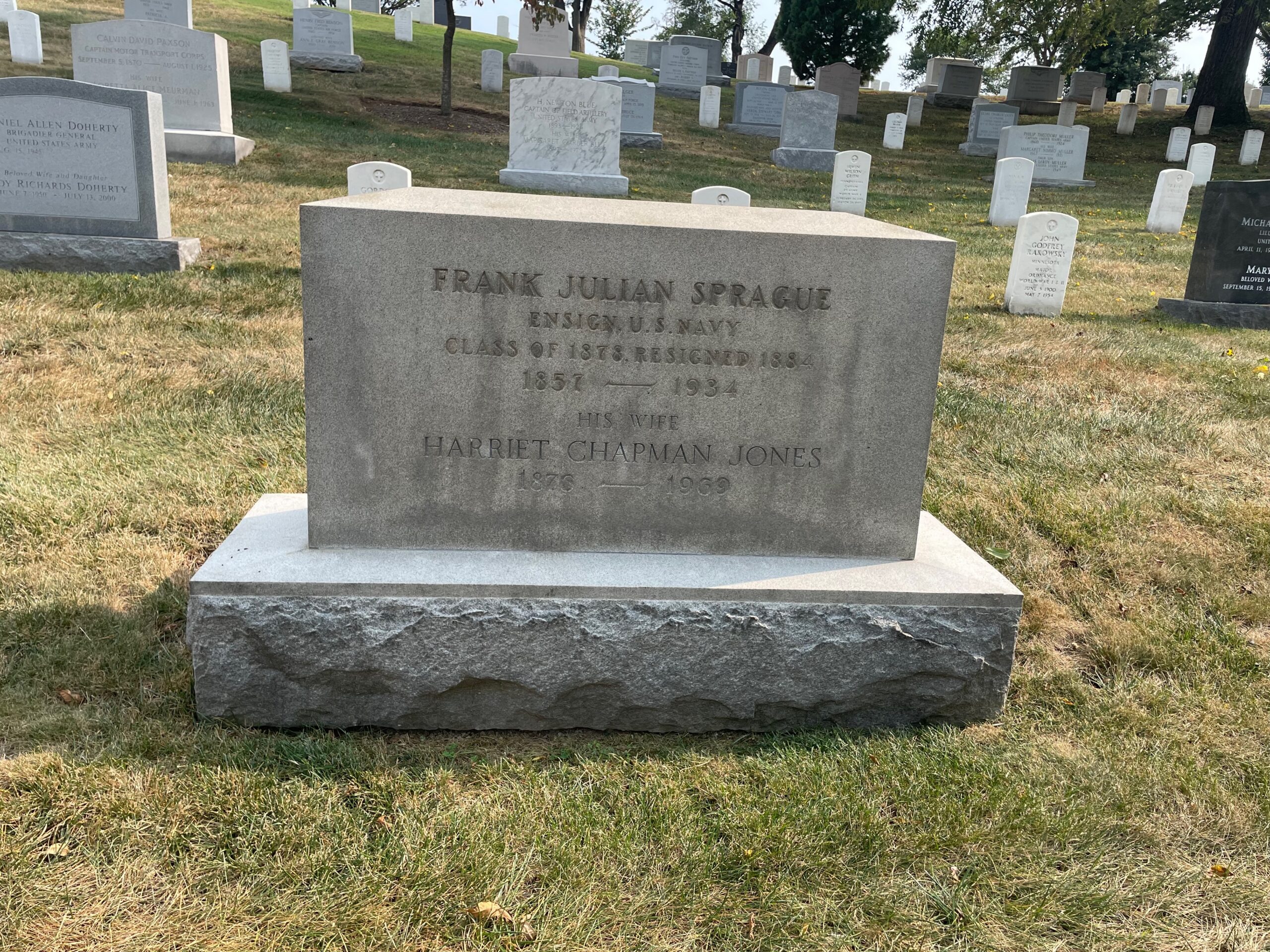
Born in 1857 in Milford, Connecticut, Sprague grew up in North Adams, Massachusetts. He got a good education. He wanted to go to West Point. But for reasons that I don’t understand and I don’t think he understood either, he ended up by accident taking the Naval Academy test. He did great on it, so Annapolis it was. He did very well there and graduated high in his class in 1878. He was commissioned as an ensign.
Now, Sprague was a tinkerer in that great age of tinkerers. And so he started figuring things out to help the Navy. While docked in Newport, Rhode Island in 1881, he created the inverted dynamo to generate power. While on a different ship heading to Europe, he created the first electric call-bell system on a ship. While in Europe, he studied a lot of the advancements in electricity taking place and was already seen as an expert, to the point he was on the prize committed at the Royal Albert Hall in 1882 for a contest around gas engines and dynamos.
So in 1883, Sprague decided naturally that he could make a lot more money in the private sector than he could in the Navy. Thomas Edison hired him. But they did not get along. Edison just wanted to make money–his one true obsession. Sprague didn’t mind that of course, but he wanted to work on his own projects. Edison put him on making the light bulb work better. Sprague didn’t care about that. He wanted to work on motors. He did good work for Edison, but left the next year to start his own company.
The Sprague Electric Railway & Motor Company is not known today but was a really important company of the era. Basically, Sprague and his company invented the motors of the electrical age. His electrical motor that created something called regenerative braking that sends power back into the motor was almost instantly a hit, acknowledged by Edison, who no doubt wish he had made the money on it. Sprague also figured out to make streetcars a real thing though moving electricity through the lines to the machine. Of course he built on earlier inventions here, but he perfected the system where you have the streetcar connected to the line. It was his technology that created the possibility for subways running on electrical lines and when Boston opened its subway line based on Sprague’s ideas in 1897, it was a big deal.
Sprague still worked with Edison on many things and Edison produced a lot of his inventions. So eventually Edison just bought him out. At this point, Sprague started working on a new problem–the electric elevator. He founded a new company in 1892 to perfect this technology and create this key invention for the modern world, one that is used a lot more today than his streetcar technology. He then took his elevator technology and applied it to trains, allowing for multi-unit systems of rail operation. It was his technology that created the Chicago elevated train system, so yeah, I’d say that’s a big deal.
Then Sprague designed the system that allowed for the creation of Grand Central Station in New York with its complicated rail technology. This included being part of the design for the third rail system used in New York, though he was not the only person involved in that. Then, during World War I, Sprague was on the Naval Consulting Board. He created more elevator technology in the 20s, creating a way to run a local and an express elevator in the same shaft, which sped up service a lot and is often used in hotels today.
In short, Sprague created a whole lot of the technologies that shaped the contemporary world. I fully admit to having at best a shaky understanding of any of this, so feel free to correct me in comments. But dude seems pretty important to me!
Sprague died in 1934, at the age of 77. He worked til just about the last day of his life. According to his son, he worked literally all the time.
Frank Sprague is buried on the confiscated lands of the traitor Lee, Arlington National Cemetery, Arlington, Virginia.
In 1903, Sprague won the Elliott Cresson Medal from the Franklin Institute, which was given out “for a discovery in the Arts and Sciences, or for the invention or improvement of some useful machine, or for a new process or combination of materials in manufactures, or for ingenuity skill or perfection in workmanship.” If you would like this series to visit other Cresson Medal winners–an award that continued until 1997, you can donate to cover the required expenses here. James Mapes Dodge is in Hillside, New Jersey and L.D. Lovekin is in Ardmore, Pennsylvania. Previous posts in this series are archived here and here.