
Erik Visits an American Grave, Part 2,120
 By
By This is the grave of Wayne Morse.
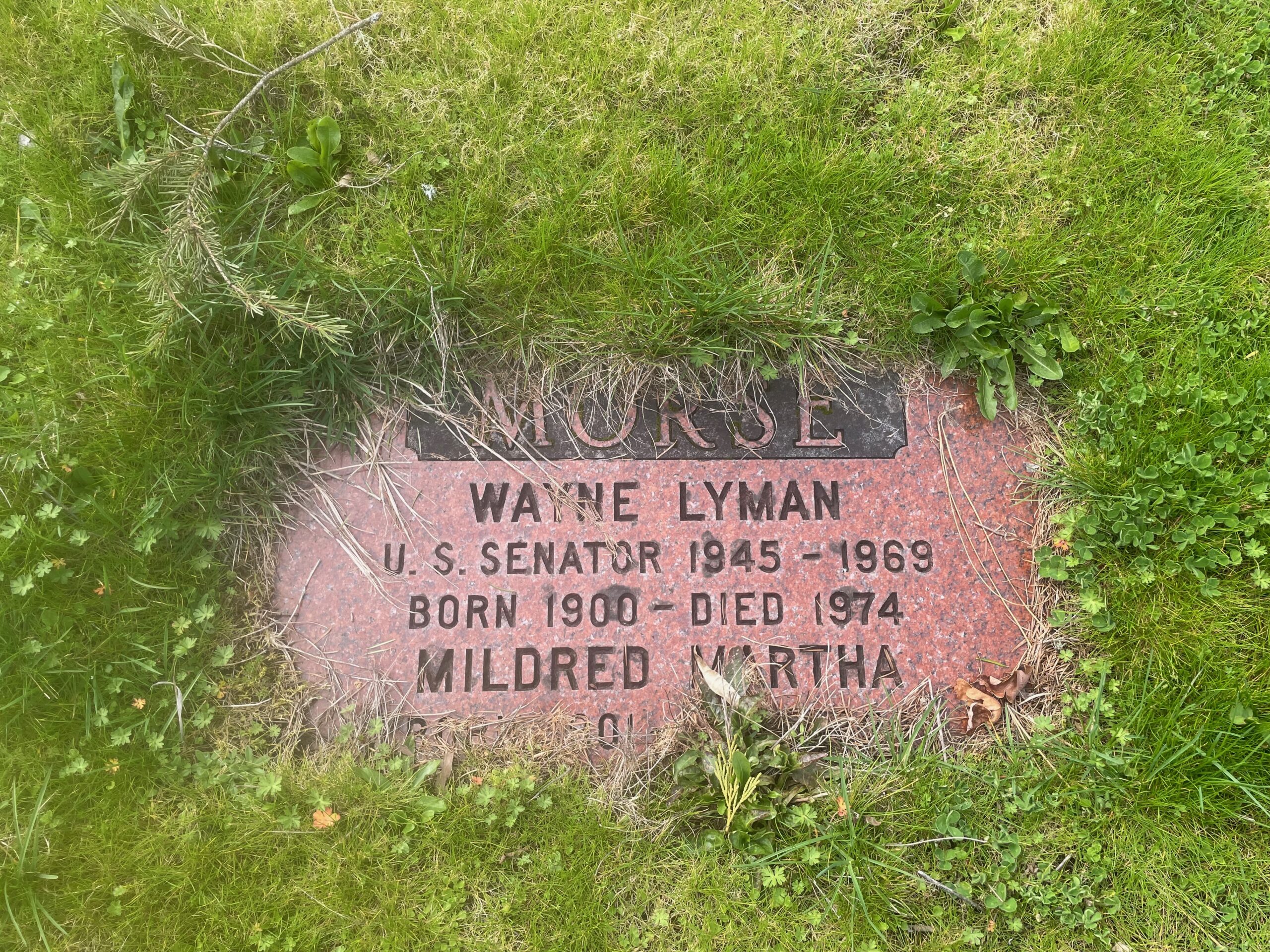
Born in Madison, Wisconsin in 1900, Morse mostly grew up on his parents farms. They were Progressives, big fans of Robert LaFollette. Morse and his siblings were told to have strong opinions, backed up with evidence, and to hold them on principle against all that opposed them. That’s certainly something Morse came to understand. His parents lived about 25 miles outside of Madison, but Morse would ride horses into school there. He graduated in 1918 and went to the University of Wisconsin, finishing there in 1923. He then got a master’s degree in speech the next year. At that time, a master’s degree was plenty to teach college, so he and his wife Mildred moved to Minneapolis so he could teach at the University of Minnesota. He mostly taught in the law school and while he was there, he decided to get a law degree himself. He got the degree and passed the bar in 1928.
The next year, Morse took a job in the law school at the University of Oregon. He moved out there and bought a farm south of town, replicating the life he lived back in Wisconsin as much as possible. In 1931, he was named dean, the youngest law school dean in the country. He became an important New Deal figure, the kind of expert valued on both sides of the aisle at that time so long as your politics fit into a broader centrist framework. Morse was technically a Republican, but a LaFollette follower had higher principles than party loyalty. So he started doing work at the state level, such as on the Oregon Crime Commission. But that soon became federal work with the rise of the New Deal. The Department of Labor named him an arbiter on marine labor issues, which meant the longshoremen, at the moment when those workers were organizing. He chaired the Railway Emergency Board in 1941. He was named to the National War Labor Board that mediated the many struggles between employers and unions during the war. He was an alternate member of the National Defense Mediation Board for awhile too, but I don’t think he ever really had much to do there.
All of this made Morse have big political ambitions. And if there’s one thing you can say about Wayne Morse, it’s that he had extremely high regard for himself. Few senators were more personally disliked by just about every other senator from both parties than Morse. His personal popularity among other politicians was at about the same level as Ted Cruz and I am not exaggerating. People really hated this guy. But we are getting ahead of ourselves here. Morse decided to run for the Republican nomination for Senate in 1944. No point starting lower than the Senate! There was an incumbent named Rufus Holman, a former Klansman (not many Republicans were in the KKK!) who was an isolationist and opposed entry into World War II. That gave Morse the path and he beat him in the primary. Morse wasn’t a stupid man. He appealed to the largely right-wing population of Oregon by lambasting FDR in the general election. Then he got elected and proved to support most of the New Deal, if not in fact, in generalities.
Morse became an internationalist who was more than happy to take on Robert Taft’s positions in the Senate. Being a junior senator meant nothing to him. He was a big personality and didn’t care what you thought of him. He was brought up on LaFollette after all and had been taught to take the principles and fight for them no matter the odds. There really wasn’t that much of a place for a guy like Morse in the postwar Republican Party though. He knew this too. He won reelection in 1950 as a Republican, but loathed Joe McCarthy and everything he stood for. So he became an independent in 1952 and then a Democrat in 1955.
Now we might see this as the kind of journey we would like to see from a Republican, coming over from the dark side. But with Morse, it was always about himself first and as such, he annoyed everyone. I can’t overstate this–people fucking loathed Wayne Morse. He worked hard to get Richard Neuberger elected as a Democrat to the Senate in 1954, which was cool, Neuberger would have been a really good senator had he not died of a stroke in 1960. And then Morse himself had to face a furious Republican Party, who nominated Eisenhower’s vile former Secretary of the Interior Douglas McKay to defeat the apostate. And he beat McKay, who really sucked, back. But then he and Neuberger started fighting. See, Morse was dean of the law school and Neuberger was his student. Neuberger had been accusing of cheating. Morse defended him and then told him to find a different school. Neuberger refused to leave, said he had done nothing wrong. Morse then failed him. in his class. He could never get past this and treated Neuberger like his lapdog. Neuberger got sick of it. So they refused to even speak to each other after Neuberger’s election.
And sure, Morse was a principled man. He not only famously voted against anything to do with the Vietnam War, which was a brave stance at the time, but he had his hobbyhorses and would ride them. He was the only non-southerner to vote against the Civil Rights Act of 1957 because he thought it was a sham bill. He personally stopped Clare Boothe Luce’s nomination as ambassador to Brazil because she had become such a right wing hack. And he gets all the credit for opposing the Gulf of Tonkin Resolution when every other damn senator but one was happy to go all in on the disaster that would come in Vietnam. He was unsparing about the war too, joining antiwar marches with Coretta Scott King in 1965, for example. That made him controversial at home, to say the least.
Maybe Morse could have survived all this politically, but he was such an asshole personally. No one trusted him. It was all about him. So he had switched to the Democrats. But then he worked to get Mark Hatfeld elected to the Senate as a Republican, based on Hatfield’s opposition to the war, as opposed to the Democrat Robert Duncan. So his own party hated him. Morse was also old and getting pretty low-energy. In 1968, a young energetic moderate Republican named Bob Packwood took on Morse. It was a close race, but Packwood defeated him and started his own fascinating career in the Senate, which was taken down thirty years later by him being a womanizer, though that made him no different than Ted Kennedy or Chris Dodd or a lot of other senators of that era.
Morse was furious that he lost. He ran again in 1972. He won the Democratic nomination too–by this time, his opposition to Vietnam was much more broadly held by Democrats. But this time he had to run against Hatfield and since the Republican was also anti-war, he didn’t have the platform to defeat him. But Morse still wanted a rematch against Packwood. He would win the Democratic primary in 1974, but got sick and died of kidney failure during the campaign. It evidently came on out of nowhere. He was 73 years old.
Wayne Morse is buried in Rest-Haven Memorial Park, Eugene, Oregon. Many thanks to the LGM reader who had found this incredibly difficult to spot grave and sent me an email to help me locate it when I complained about this awhile back.
If you would like this series to visit other senators elected in 1944, you can donate to cover the required expenses here. Alben Barkley is in Paducah, Kentucky and John Overton is in Pineville, Louisiana. Previous posts in this series are archived here and here.