
Erik Visits an American Grave, Part 2,110
 By
By This is the grave of Robert Barnwell Rhett.
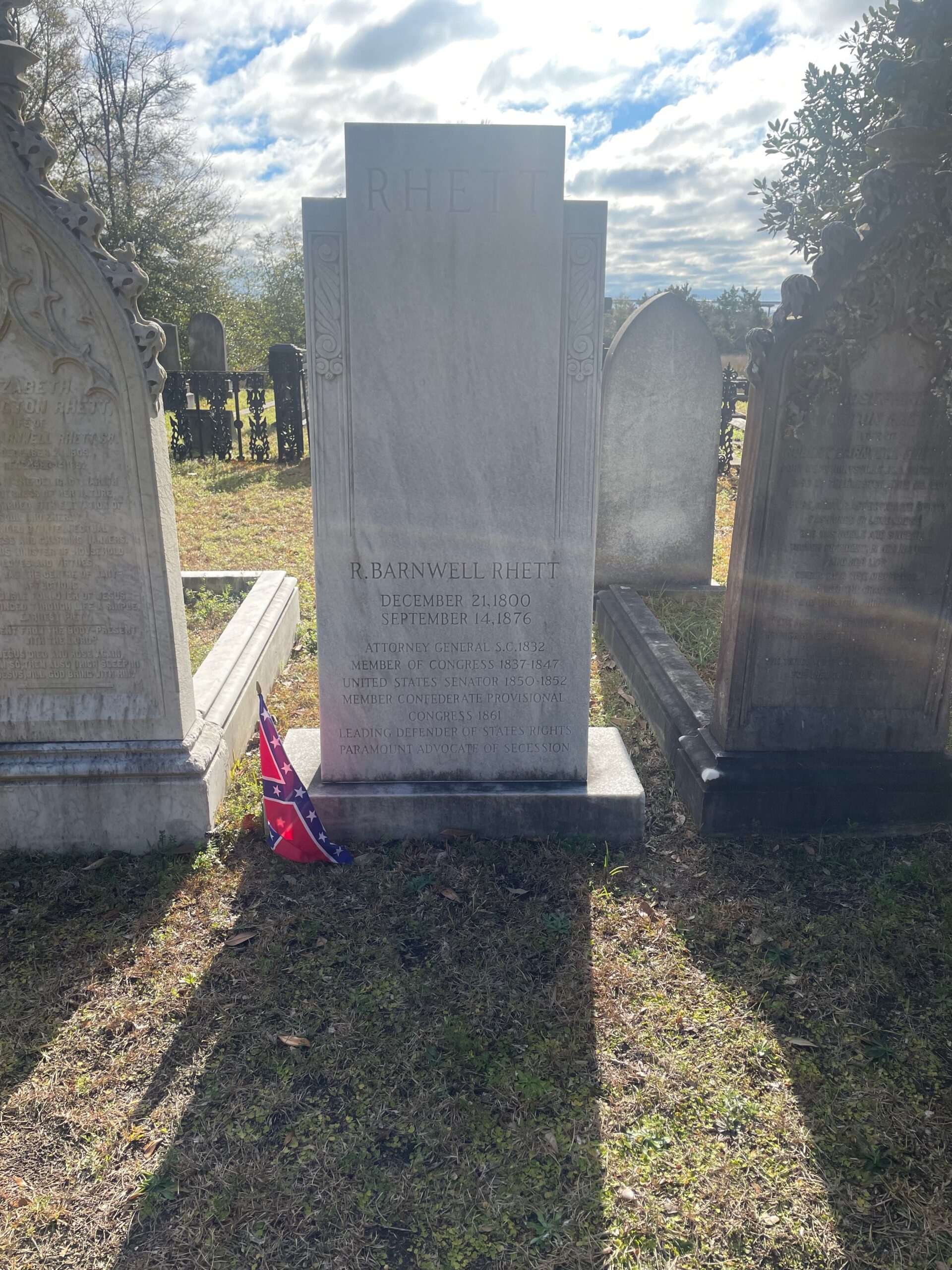
Born in 1800 in Beaufort, South Carolina, Robert Barnwell Smith grew up in the plantation elite of South Carolina and boy howdy would he represent their scumbag interests all the way. He was related to a lot of the Revolutionary era South Carolina leaders. Their interests weren’t really that different than the rest of the nation at that time, but after 1800, with the rise of the cotton gin and the great wealth generated in South Carolina, that sure changed. Smith was headed into politics from a young age. He first won election to the South Carolina legislature in 1826 and stayed there until 1832. This was the moment when the state started becoming a hive of massive extremism in ways that even the rest of the South could not imagine at that time. Sure, the rest of the South might have opposed high tariffs, but talking about secession? That seems insane. That’s because it was insane.
Smith would push these ideas from the time he was young. He loved slavery. Absolutely loved it. He thought slavery was the destiny of the races, with whites naturally leading, and he thought that northern whites were stupid for not seeing this. He and people like him were the masters of the world and he intended to keep it that way. He was elected in 1832 as the state’s attorney general, running on a platform of extreme pro-slavery and nullification and that made him popular. He remained in the position until 1837.
Also, Smith changed his name to Rhett in 1838. William Rhett was an ancestor of his who was an early leader of South Carolina and who had gotten famous fighting pirates and I think was a big time slaver. Smith thought this name change was romantic and would give him additional cred, evidently, and so Robert Barnwell Rhett it became when the man was 38 years old. Seems weird to me. He was pretty fucking weird though.
Anyway, Rhett thought most of the South Carolina elite were not committed enough to slavery and secession. So in 1844. he was part of the Bluffton Movement, which was a group of extremists in South Carolina. The nation had not listened to the South bitching about tariffs and in 1842, passed another one that was not favorable to South Carolina’s interests. Rhett left this movement to stand up for another round of nullification and to threaten again to leave the union. Now, this was too early for secession and so Rhett’s real goal here was to reform the union, even if secession might be the only option. But still, this was pure extremism. It was too much for John C. Calhoun, who was still the real power in the state’s politics. He put a stop to it. But the groundwork was being laid for future actions. Rhett’s favorite newspaper, the Charleston Mercury, wrote of two great evils–the tariff and abolitionism, and stated they were “cohesive, cooperative, concurrent, kindred and co-essential atrocities.” OK then.
Rhett was pleased with the presidency of James Polk, who stole half of Mexico to expand slavery. But he thought the Compromise of 1850 was a sellout to the abolitionist north. Like everything else, only southern extremism was the answer. He convened the Nashville Convention in 1850 to unite the South in secession. The South was not quite ready for this, but he saw the progress. Meanwhile, Calhoun died. Who did South Carolina select to replace him? Yep, Rhett. Calhoun was too conciliatory anyway. But then Rhett thought the rest of the South Carolina leadership a bunch of cowards. In 1852, the legislature decided it would not push for secession right away. In response, Rhett resigned from the Senate rather than represent such a bunch of cucks.
So Rhett went home to his Charleston Mercury and spewed propaganda and pushed extremist ideas and candidates fo the next eight years. By the time the nation elected Abraham Lincoln in 1860, he was ready to rock and roll and his influence had just grown and grown. He was elected to the Confederate legislature in 1861 and remained there for the war. Like far right extremists in our government today, they all hated each other back then too and Rhett loathed Jefferson Davis.
A lot of this is that Davis, like much of the rest of the Confederate leadership, did not believe in slavery as much as Rhett. Just committing treason in defense of slavery was not enough for this man. Oh no, anyone believed in that. No, see, what was necessary was reopening the transatlantic slave trade. That became Rhett’s top priority. He ranted and raved about this at the Confederate founding convention and was infuriated that the Confederate Constitution did not solve this affront to the white race. He also believed that Confederate states should also be able to secede from the Confederacy. Give him credit, I guess. He actually believed this shit, unlike a lot of the Confederate leaders, who only talked about secession as a tool but in fact were totally authoritarian in fact. Rhett believed it.
But I want to be clear–no one and I mean no one did more to father secession than Robert Barnwell Rhett, very much including Calhoun or Davis.
Another reason Rhett hated Davis is that the Confederate president tried to create a functional nation (and let’s not really give Davis credit here, he was terrible as Confederate president even if you take out the reasons why this fake nation existed). So when Davis issued an order that the government confiscate saltpeter supplies, Rhett lost his shit. TYRANNY, he cried. HOW DARE BIG GOVERNMENT LIBERALS LIKE JEFFERSON DAVIS TRAMMEL UPON ON OUR CONSTITUTIONAL RIGHTS.
The other thing that happened to Rhett during the war is that he lost all his money, which was of course largely invested in humans. I think a lot of his plantation land was near the Atlantic coast and very quickly, the Union army took this land over and freed the slaves, de facto if not de jure.
After the war, Rhett left South Carolina for Louisiana. At least Rhett had the late life he deserved. He had serious skin cancer problems, which led to noted disfigurement that seems to have disgusted most of the people who saw him. I can’t imagine a more appropriate fate. It eventually killed him, in 1876. He was 75 years old.
In conclusion, Robert Barnwell Rhett is the worst politician ever from the worst state in American history. Burn in hell.
Also, can you help me out here–how did that Confederate flag up on Rhett’s grave end up broken and under my muddy shoes? It’s a real mystery.

If you would like this series to visit other secessionist scum, you can donate to cover the required expenses here. If I haven’t earned support for this series today, I don’t know what I can do. William Yancey is in Montgomery, Alabama and Louis Wigfall is in Galveston, Texas. Previous posts in this series are archived here and here.