
Sports fandom and the paradoxes of consumer capitalism
 By
By 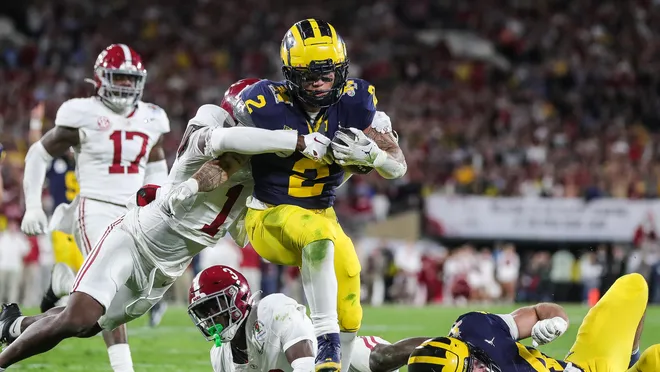
David Dayen hasan essay on the ongoing furious monetization of sports fandom. When he interviewed me for the piece — LGM commenter Victor Matheson, an expert on the economics of sports, was also interviewed and quoted — I took a it was the best of times/the worst of times perspective. Dayen makes a nod to the former, but not surprisingly emphasizes the latter:
In some ways, it’s never been a better time to be a sports fan. You can wake up on Saturday where I live in Los Angeles and binge on college football from 9:00 in the morning until late into the night. Though I’m over 2,200 miles from Ann Arbor, all the games of my alma mater Michigan Wolverines are televised nationally. And I can go online for vast volumes of high-quality statistical analysis, insider information, and even trash talk with fellow fans on social media. I can build large quantities of my life around sports and never lack for action. This grows fan interest, deepens emotional attachment, and helps make sports an unsurpassed phenomenon.
This is all very true, but the risk here, as so often the case when it comes to contemporary consumer capitalism, is that the unbridled lust for maximizing short term profits at the expense of long term considerations risks killing the golden goose:
NFL games are now spread across 11 different networks, and varying estimates put the annual cost for access between $750 and $900. If you want to see games for all four major sports, New York Times commentator Joon Lee estimated that at $2,634 a year. And that’s a moving target, because streamers keep raising prices.
Most sports fans don’t enjoy tracking which streaming apps bought which contracts when they want to catch the game. But league executives demonstrably don’t care. When NBA commissioner Adam Silver was asked about its record $76 billion media contract that hived off many games onto Amazon and Peacock, he responded that basketball is “a highlight-based sport,” so fans could always go to TikTok or Instagram to find the best plays for free. The implication was clear: The rich get a courtside seat, everyone else gets a highlight reel. . . .
Others see profit-making opportunities in the RSN implosion by building direct-to-consumer streaming apps. Dallas-area teams use Victory+; Texas Rangers fans must pay $100 a year for access. Altitude+ costs $20 a month for Denver Nuggets fans. The YES app, for New York Yankees, Brooklyn Nets, and New York Liberty games, is $24.99 a month; Boston sports on NESN 360 is $29.99 a month.
Sports bundles like the Hulu + Live TV streaming service, a skinny sports bundle from YouTube TV, and a long-rumored sports tie-up between ESPN and Fox promise a one-stop shop. But none of them offer what fans already had: access to every available game, in one place, for one price. “I said a while ago that the way forward for media companies was to make the product worse and charge more for it,” Creutz joked. “That’s what happened.”
A related problem is that TV contracts drive everything in sports these days. Campos, who grew up in Michigan, recalled seeing the famous college football 10-10 tie between Michigan and Ohio State in 1973. The game lasted two hours and 20 minutes. The average college game now is around three and a half hours. “If you go to Michigan Stadium in November, it’s just oppressive, sitting in the stands with those TV timeouts,” Campos said. “We the long-suffering in-person fans have to be mortified so the plutocrats can make the money machine go brr.”
Again, it’s complicated: In many ways it’s a golden age for sports fans, assuming you have a whole lot of disposable income and the leisure to spend it. Based on secondary market prices and travel costs, Indiana football fans — a species that came into existence about 18 months ago — probably paid something like an average of $5,000 per person just to attend last month’s championship game. A trip to the semifinals ten days earlier was nearly as expensive.
If this reminds you of anything else that’s not exactly surprising:
Television dictates when teams play as well. To accommodate prime-time doubleheaders, NBA playoff games sometimes start as late as 10:45 p.m. on the East Coast. Michigan State played a conference football game last year at USC in Los Angeles that started at 11 p.m. Eastern time. That’s an artifact of television-driven realignment, which blew up the Pac-12 and put Stanford and Cal Berkeley into the Atlantic Coast Conference. (To clarify, they reside on the Pacific Coast.) This has upended traditional rivalries and turned unfamiliar matchups into conference games. TV demands also lead to punishing NBA schedules with numerous back-to-back games, which have been blamed for a significant uptick in injuries. Long seasons provide networks and streamers with more inventory but punish players and exhaust fans.
“Why are we doing this?” Campos said. “It’s Cory Doctorow’s concept of enshittification applied to everything.”