
Erik Visits an American Grave, Part 2,051
 By
By This is the grave of Red Faber.
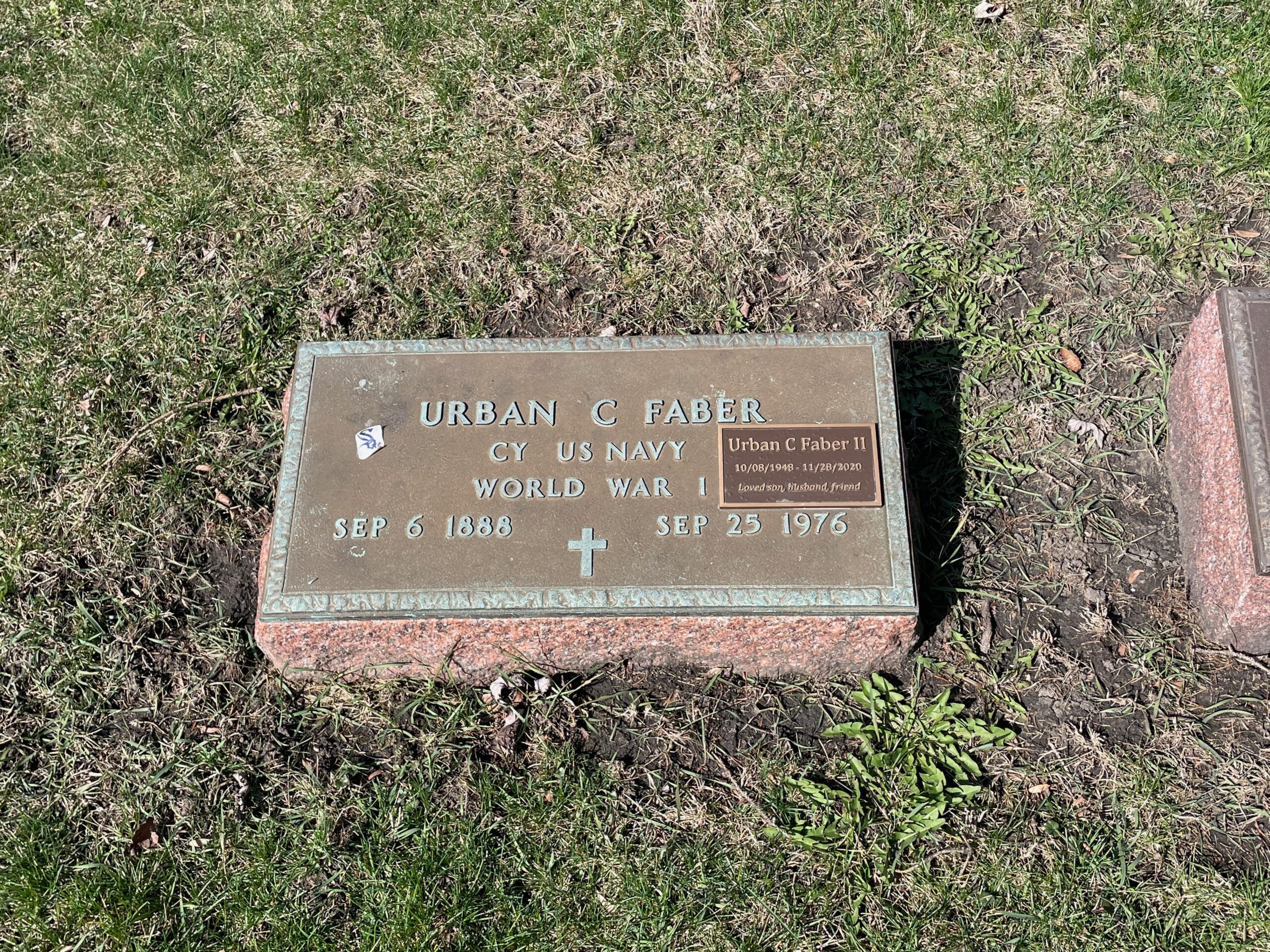
Born in rural Iowa, outside of the town of Cascade, in 1888, Urban “Red” Faber grew up in an upwardly mobile family. His father, an immigrant from Luxembourg, started as a farmer but then became a bartender and ran the town hotel and became a pretty well off guy. He sent Faber to the best schools in the area, private academies in Iowa and Wisconsin intended to send kids to college. But his son had different ideas. He wanted to play baseball. He did go to St. Joseph’s College for a year, where he was an outstanding ballplayer. So Pants Rowland convinced him to drop out of school and sign with the Dubuque Miners, a Class B team. Can’t imagine his father was real thrilled.
Well, Faber skyrocketed through the minors based on his golden arm. He moved through the minors between 1909 and 1913. In 1914, he made the Chicago White Sox. He would pitch there for the next 20 seasons. In truth, Faber was a solid pitcher with two astounding seasons, so his overall impact is probably overrated. But he was that solid guy almost immediately. He was OK his first year, holding his own. By 1915, he started 32 games and pitched in 50, went 24-14 with a 2.55 ERA and was worth 4.3 WAR using the Baseball Reference stat. That would be a pretty normal season for him during his career. He was a 2-4 win pitcher almost every year for a very, very long time.
Faber left the White Sox in 1918 to serve in the Navy during World War I. He was back for the infamous 1919 team, but he was sick. Quite possibly he had and survived the so-called Spanish Flu, which should be called the Kansas Flu since it started in a gross U.S. military encampment in that state. He had lost a bunch of weight and tried to play but was terrible so they shut him down. What that meant is that he was not around the team during the infamous Black Sox World Series.
Faber was back in 1920. Now, that year, baseball banned Faber’s key pitch, the spitball. But 17 active pitchers were grandfathered in and allowed to throw the pitch until they retired. Faber was one of them. It was pretty unfair to hitters, but you know pitchers have been doctoring balls forever and that was nothing new then and it isn’t new now. It so happened that this gave Faber a huge advantage. He had a very solid year in 1920, worth 5.7 WAR off a 23-13 record and a 2.99 ERA, tossing a mere 319 innings. But 1921 and 1922, he was absolutely dominant on some very bad White Sox teams. 1921 was truly astounding. He was worth 11.4 WAR after going 25-15 with a 2.48 ERA, starting 39 games and leading the league in complete games (32!!!!!), ERA, ERA+, WHIP, and hits/9 innings. The next year, he was nearly as good, worth 9.6 WAR, again leading the league in ERA, complete games, innings pitched (a mere 352), and WHIP.
Beginning in 1923, Faber went back to being merely a good pitcher. For the next 11 years, he would be worth between 1.2 and 3.5 WAR a year, with one exception in 1927 when he was hurt. Not great, but useful. He finally retired after the 1933 season. By then he was pitching almost exclusively in relief, at the age of 44, and was still a completely functional guy to have around. He had thrown a one-hitter in 1929, at the age of 40.
After retirement, Faber coached with the White Sox for a few years, sold cars and real estate, that sort of thing. He did highway surveying until almost the end of his life. There was tragedy too. His son (buried here too) broke his back in a swimming accident at the age of 14 and so required lifelong care, though he managed to live a quite long life. He also was a good egg it seems. He started an organization called Baseball Anonymous that was a lifeline for retired players who had fallen on hard times and needed financial assistance. The Veterans Committee elected Faber to the Hall of Fame in 1964, one of many rather dubious selections they’ve made over the years. But whatever, good for him.
Faber smoked himself into the grave, with his last decade dominated by heart attacks and lung issues. He died in 1976, at the age of 88.
Red Faber is buried in Acacia Park Cemetery, Norwood Park, Illinois.
According to Baseball Reference’s JAWS stat, Faber is the 68th best pitcher of all time. For modern context, that puts him between Chuck Finley and Johan Santana, in other words, a very good pitcher but really not a HOF guy. If you would like this series to visit other similar quality pitchers, you can donate to cover the required expenses here. Tony Mullane, who pitched mostly for the Reds in the 1880s and 1890s and is ranked 62nd all time, is in Alsip, Illinois. Faber’s old teammate on the Black Sox, the banned Eddie Cicotte, is 69th all time and is in Livonia, Michigan. Previous posts in this series are archived here and here.