
Roberts Court Republicans use shadow docket to refuse to allow its precedents to be applied because it would be an electoral disadvantage for the Republican Party
 By
By 
And in doing so shows its typical unbridled contempt for federal judges who try to apply rules other than “Trump wins”:
Notably, in assessing “irreparable harm” that Texas would face, the court also stated, “The District Court improperly inserted itself into an active primary campaign, causing much confusion and upsetting the delicate federal-state balance in elections.”
This is, however, a function of the timing of the Texas legislature’s action — not the challengers or three-judge district court (whose 2-1 opinion was authored by U.S. District Judge Jeffrey V. Brown, a Trump appointee and former Texas Supreme Court justice) — and it’s astounding to see an unsigned Supreme Court order accusing a lower court of such a “improper[]” act in this fashion.
[…]
But on Thursday, Kagan continued, “this Court reverses that judgment based on its perusal, over a holiday weekend, of a cold paper record. We are a higher court than the District Court, but we are not a better one when it comes to making such a fact-based decision.”
Noting that the Supreme Court’s order “disrespects the work of a District Court that did everything one could ask to carry out its charge” and “disserves the millions of Texans whom the District Court found were assigned to their new districts based on their race,” Kagan went on to detail the district court’s actual trial work and legal conclusions regarding the racial gerrymandering claim that is all but ignored by the Supreme Court’s order.
“You would never guess it from the majority’s order, but under this Court’s precedents, a district court’s factfinding about electoral districting—’most notably, as to whether racial considerations predominated in drawing district lines’—is reversible ‘only for clear error,’” Kagan wrote.
Steve Vladeck’s book devotes a chapter to the use of the shadow docket in election cases. This body of non-law is extremely partisan even by shadow docket standards, but particularly farical is its application of the so-called Purcell principle, which forbids lower courts from altering election rules too close to elections irrespective of any deprivation of constitutional rights. What does “too close” mean? It, ah, depends. As Kagan’s dissent notes, this case illustrates how farcical this “rule” (named or unnamed) is in practice:

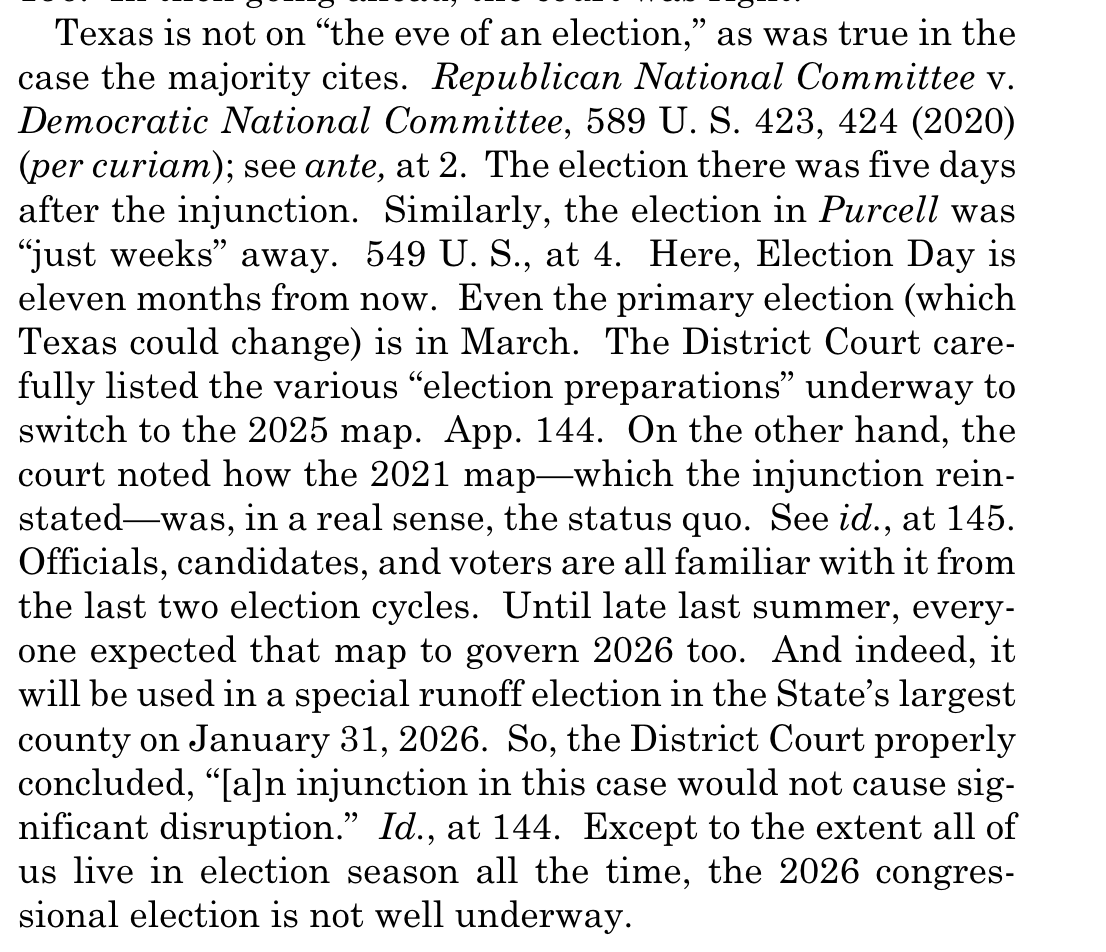
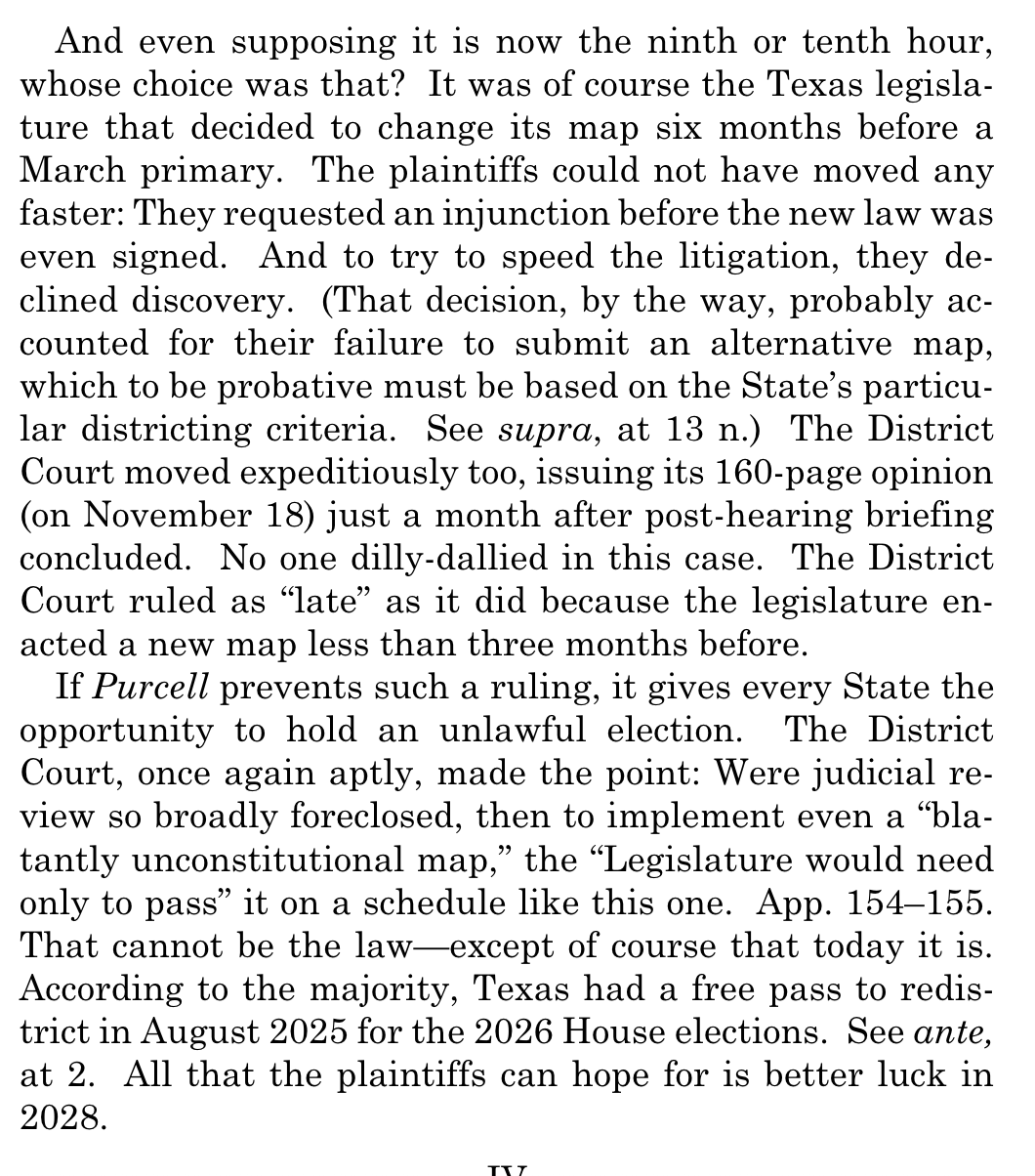
The principle is “it is always too close to the next election to intervene in a way that would advantage Democrats and it is never too close to the election to intervene in a way that would help Republicans.” And variations on this rule are the only thing guiding any of the Court’s shadow docket orders.