
Erik Visits an American Grave, Part 2,046
 By
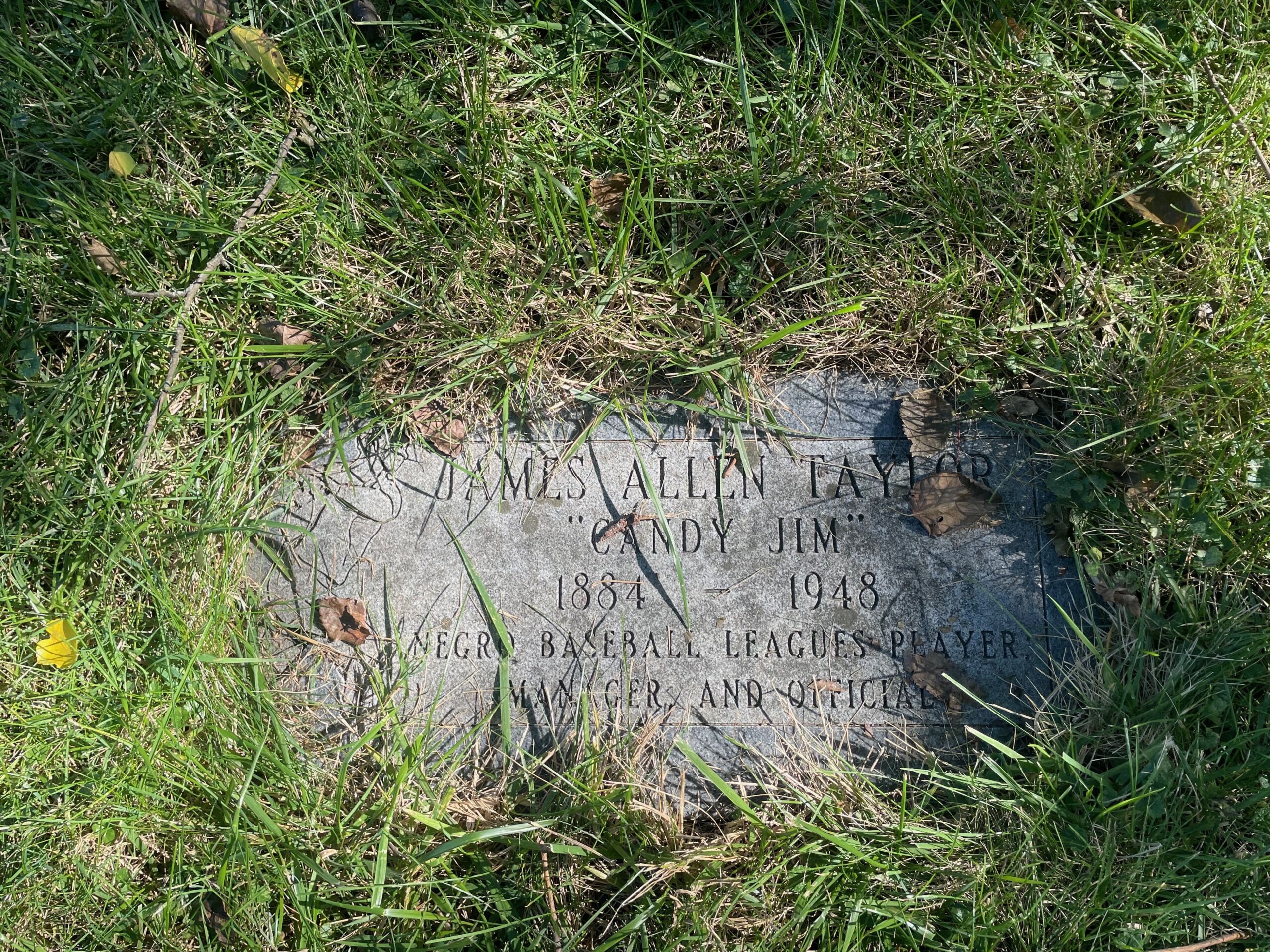
By This is the grave of Candy Jim Taylor.
Born in Anderson, South Carolina in 1884, James Taylor, better known as Candy Jim, played baseball. So did his brothers. This athletic family hoped to find a future that was not that of most of the Black working class of the late 19th century South. Baseball was about as good of an option as existed. Taylor was pretty good and started playing professionally in 1901, playing as a catcher on the local team. By 1904, he was with the Birmingham Giants, playing third base.
Now, we know very little about Taylor’s early life, like we know very little about most of the Negro League players at this time. We don’t have anything that even closely lists the statistics for all the teams he played for over these years. Baseball Reference, which is about as comprehensive as it gets, has nothing for him before 1920, merely his 20th year playing. What we know is that he played in Birmingham for several years and then went north. He started managing teams while also playing by the early 1910s. In 1916, he managed the Indianapolis ABC’s to the Black World Championship. When he registered for the draft in World War I, he listed his occupation as laborer and no doubt he was doing plenty of that kind of work when there weren’t games to be played. He played all over the place. No one really played for any of these teams for very long. Many of them went out of business. The seasons might be short and you’d join a barmstorming team. It beat real work, whatever the circumstances.
It wasn’t until the start of the National Negro League in 1920 that we have anything like real numbers on Taylor. By this time, he was 36 years old, so certainly his best days had passed. But he was still worth 3.2 WAR using the Baseball Reference stat in 1923, which is pretty solid for his age and the shorter season than MLB. He also was in his heyday as a manager. He managed teams all over the place, never staying more than a couple of years in any given place. Given the economics of the Negro Leagues, this isn’t surprising. In 1925, he led the St. Louis Stars to the World Series, where they lost in 7 games to the Kansas City Monarchs. They did however win in 1928, defeating the Chicago American Giants. In 1943, Taylor started managing the legendary Homestead Grays. They won the title both that year and in 1944. Somewhat amusingly, Taylor would insert himself into a game or two every season until 1942, when he was a mere 58 years old. He went 3-5 in 1934, which must have been exciting for a 50 year old man.
Taylor had no interest in retiring from managing. But his heart did not have an interest in him continuing. He had a heart attack in 1948, just as he was about to start the season for the Baltimore Elite Giants. He died at the age of 64. Perhaps there’s something appropriate about a lifer dying right after Jackie Robinson’s ascension to the majors spelled the end of the Negro Leagues. Taylor is considered the winningest manager in Negro Leagues history, with around 900 wins.
For years, Taylor’s grave was unmarked. Baseball fanatics paid for a marker in 2004 and that’s what I saw, in Burr Oak Cemetery, Alsip, Illinois.
If you would like this series to visit other managers of the Negro Leagues, you can donate to cover the required expenses here. Vic. Harris is in Newhall, California and Oscar Charleston is in Indianapolis. Previous posts in this series are archived here and here.