Subscribe via RSS Feed

Author Page for Erik Loomis

rss feed

Visit Erik Loomis's Website

7 Billion

[ 41 ] October 31, 2011 | Erik Loomis

As the world’s population reaches 7 billion sometime today, it’s worth remembering that while overpopulation is an important environmental issue that needs addressing, it is a vastly lesser problem that the consumption of the planet’s resources by the wealthy. I don’t know if there’s any kind of conversion mechanism on the internet, but the purchase of an SUV, the heated backyard swimming pool, and the transatlantic flight each cause tremendously more damage to the climate and to resource depletion than that family of 12 in Chad or Bangladesh. Westerners bemoaning population growth are usually shifting blame from their own responsibilities and blaming poor and brown people for our environmental crisis.

Reagan–Our Pro-Apartheid President

[ 56 ] October 29, 2011 | Erik Loomis

The death of Howard Wolpe, the congressman from Michigan who sponsored bills in the 80s to impose sanctions on the apartheid regime in South Africa should remind us that Ronald Reagan, who vetoed the bill twice, was for all intents and purposes pro-apartheid. As of course was Dick Cheney, who voted against the bill as a congressman from Wyoming.

Our New Robot Overlords Need Pets Too

[ 1 ] October 29, 2011 | Erik Loomis

Someone is trying to get in good with our robot overloads by developing robot cats they can pet.

Linkocity

[ 16 ] October 27, 2011 | Erik Loomis

Too many worthy stories today, too little time to write them up.

If humans playing football suffer concussions, why don’t woodpeckers?


Oliver Stone directing a film about Robert Moses based on Caro’s The Power Broker sounds very unpromising
.

The drought in the Southwest affects all of us because 70% of our winter vegetables come from northern Mexico. Very high food prices will occur this winter. And the poor will eat less.

Will Valles Caldera become the next national park? Would that status ruin this beautiful area? Turns out that trying to run federal land for profit doesn’t work real well. Who could have guessed?

Colin on the Henry Louis Gates documentary on race in Brazil

General Strike

[ 73 ] October 27, 2011 | Erik Loomis

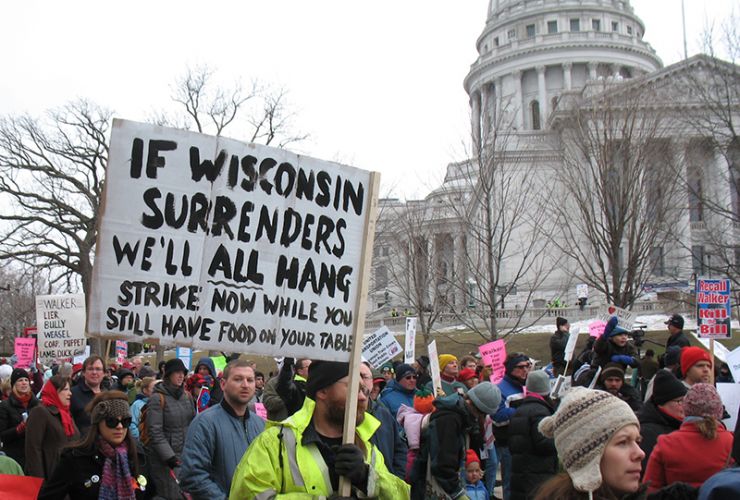
Yesterday, Occupy Oakland approved a motion for a general strike, to be called for November 2.

I’m curious to see where this goes. General strikes have always had trouble gaining traction in American history. The most successful was in Seattle in 1919 and it only lasted a few days. The last general strike was also in Oakland, in 1946. I have little no doubt that knowledge of Oakland’s radical past helped influence this decision; the same public history exhibit at Occupy Oakland that mentioned the absurd myth of the Chinese peacefully living in America for hundreds of years before Columbus also taught about the 1946 general strike.

In these cases, the general strike was a work-based action, called by radical unionists who had spent years organizing people. So it’s obviously a very different scenario than Occupy Oakland. I think a very important factor in its success will be the response of Bay Area and national labor organizations. Labor and OWS have approached each other with wary caution, with OWS rightfully worried about being co-opted by the AFL-CIO. If labor actively supports the general strike, it could go a long ways in building important trust between the two groups. The legality of such a measure in union contracts is not often clear. Taft-Hartley outlawed sympathy strikes. On the other hand, it may be in the interests of unions to challenge Taft-Hartley and force the capitalists to show their hand in their drive to crush labor and take America back to the Gilded Age.

If labor doesn’t take the general strike seriously, I think it leads to 2 problems. The first is that the protestors alone cannot create an effective general strike because they are not working, in a traditional sense of the word. They are protesting on October 27 and they will be protesting on November 2. The second is that it would undermine any faith that labor is going to back the movement in a serious way.

I guess I’m a bit skeptical about the general strike because I’m not sure anyone knows what it will accomplish. But OWS has surprised people for a month now. I certainly see no downside to this strategy and I encourage organized labor in the Bay Area to take next Tuesday off and join the protestors.

Oh Mittens

[ 22 ] October 27, 2011 | Erik Loomis

Why on earth would Mitt Romney wade into the SB-5 fight in Ohio? John Kasich’s union-busting bill is extremely unpopular and is about to go down to a crushing defeat. Given Obama’s somewhat surprising resiliency in the southern and western states he won (and also Arizona where recent polls show him doing pretty well against any Republican), the best Republican hope for victory in 2012 is to peel off the Rust Belt. Indiana seems pretty sure for Republicans whereas I’d bet dollars to donuts that the successful auto industry bailout pretty much guarantees Michigan for Obama. That leaves Minnesota, Wisconsin, Iowa, Ohio, and Pennsylvania as vital states for Republicans. Yet Romney flip-flops over whether to support a bill that may well have doomed Republicans in Ohio in 2012? Why would he do this? It’s not like this is a key issue that Americans are clamoring to know about. It’s not as if the other Republicans contenders have weighed in. What is the possible gain Romney gets here? Making the Ohio Republican primary voter happy? A lovely tea party with classy Ohio Republican elected officials like Mean Jean Schmidt and Josh Mandel?

An absolutely stupid move that really hurts Romney in a key battleground state.

Kyle Leighton has more on why this matters.

Early Jazz, Looney Tunes, and Cultural Rebellion

[ 92 ] October 26, 2011 | Erik Loomis

I’ve been making it through the many Looney Tunes collections over the past couple of years. Last night, I watched “I Love to Singa” for the first time in a very long time:

This play on The Jazz Singer is fantastic from the modern perspective not only for the art of the cartoon, but to remember how revolutionary and threatening jazz was for a lot of people. A decade ago, I was sitting in on a job talk for a Gilded Age/Progressive Era historian. This was one of those searches that had 400 candidates, of which 50 would have been awesome. Anyway, this guy worked on southern music and talked about the reactions to ragtime, which unleashed a furious response in the white community of fears that these beats would turn our good young white women into the sexual conquests of black men. In other words, a response that would repeat itself in one form or another with jazz, rock and roll, the music of the counterculture, and of course, hip-hop.

Never mind that the jazz used in Looney Tunes was an extremely white form of it, whether here or in so many other cartoons. This is your Benny Goodman/Andrews Sisters 1940s version of jazz. When black musicians are portrayed, they are caricatures, which of course was common for any racial minorities in these cartoons (not to mention that most of the major characters use speech impediments as defining characteristics). The music is still great and satirized real cultural fear of older Americans. That the very people who enjoyed this whitened jazz would flip out over rock and roll is hardly lost on the modern viewer.

“I Love to Singa” is perhaps best known today thanks to a direct reference to another form of cultural innovation that freaked out conservative parents:

God, that’s funny.

While I love the well-known characters of Looney Tunes, there’s something great about the cartoons that don’t push those narratives because they can be completely anarchic and creative. This isn’t only when they bring jazz into the equation, but especially when they do. Take “Katnip Kollege” for instance:

I also adore the many cartoons that reference stars of the day. As someone who sees W.C. Fields as a guide to growing older, I can’t get enough of those references. But I’ll leave these cartoons for another post.

This Day in Labor History: October 26, 1676

[ 29 ] October 26, 2011 | Erik Loomis

On this date in 1676, Nathaniel Bacon, the leader of the movement known as Bacon’s Rebellion, died of dysentery. This effectively ended the rebellion, an event that helped entrench slavery as the labor system of the American South.

The first African slaves arrived in Jamestown in 1619, but through the 1640s, it’s unclear whether they were held in what would become chattel slavery. There is evidence of slaves being freed and becoming landowners. In any case, African slaves were a small part of the early Virginia labor force. This wasn’t because tobacco planters didn’t want to buy slaves. Rather, they couldn’t afford them. Tobacco was a far less valuable product than sugar and thus even the richest Virginia planters were barely middling compared to the sugar barons of the Caribbean who could buy slaves and be so wealthy as to not care whether they lived or died.

But there were other labor options for the planters. Thousands of poor English, both men and women, were willing to become indentured servants in Virginia. Conditions in England in the early and mid 17th century were not good. Food riots were common. Work was scarce. Political strife, including the Puritan Revolution, did not help. Virginia offered these people hope. If you signed a contract for 5-7 years, you would get land of your own at the end of it. But that doesn’t mean things in Virginia were great. Mass death defined the Chesapeake colonies in the 17th century. People died of malaria, dysentery and other diseases at astronomical rates. Essentially, these were cold weather people moving to a subtropical swamp while wearing wool clothing, not understanding how to access clean water, and without immunity to mosquito-borne illness. People quickly realized what was happening and would time their arrival to Virginia in November and December, so they could develop as much immunity as possible before the pestilence of late summer and early fall would wipe most of them out.

Even if they did survive, and they usually didn’t, they faced other problems. You might indenture yourself to a quality man, but you might not. Your status as an English person granted you some rights, but enforcing those rights on the remote plantations was nearly impossible. Perhaps the worst offenses came with men taking advantage of their female servants. Most contracts for women included a clause where pregnancy would result in additional time on your contract. Masters sometimes raped their female servants, got them pregnant, and thus the woman would have to stay there longer.

If these indentured servants did survive long enough to get their own land, they had limited options. The fertile bottomland along the rivers was already purchased by the early plantation owners. That left two choices. You could buy land farther inland, but that meant you had to pay for the transportation costs to get your tobacco to the ships that docked at the big plantations, and had to pay the big owners for the privilege of using his dock. Or you could move farther west. But out there were Indians less than thrilled to see continued English expansion into their lands.

By 1676, the farmers who had chosen to move west were demanding that the leaders of Virginia raise a military expedition to force the Indians out. But the government in Jamestown, led by Governor William Berkeley thought these people, most of whom were former indentured servants, were a bunch of yokels and ignored them.

Nathaniel Bacon was a man who could straddle the divide between the rich and poor. Bacon was a newcomer to the colony and bought land in the west, but he was also well-heeled. His wife was friends with Berkeley’s wife. Bacon brought an impressive 1800 pounds of capital with him. Berkeley nominated him to the colonial council immediately. Yet Bacon was also sympathetic to the problems of his poorer neighbors. Moreover, he wanted to kill some Indians. Berkeley opposed this, wanting the friendship of Indians and worried about these poor people out there causing trouble.

In truth, there’s little positive to say about Bacon’s Rebellion. They murdered a bunch of Indians, captured Jamestown, murdered some more Indians, and then burned Jamestown to the ground. Then Bacon, like most everyone else, died of a horrible disease.

The real importance of the revolt is not in its accomplishments, such as they were. Its that, according to Edmund Morgan’s brilliant American Slavery, American Freedom: The Ordeal of Colonial Virginia, it turned the tide away from indentured white labor who had the inconvenience of eventually becoming free and causing problems toward permanently enslaved African labor. There were several structural factors that contributed to this, including improving conditions in England, knowledge of the horrible treatment of indentured servants in Virginia, and lower prices for African slaves. And while there’s no evidence of a meeting or something where Virginia landowners made this decision, after 1676, the number of African slaves increased rapidly with numbers of white indentured laborers falling equally dramatically.

Moreover, Virginia increased the institutionalization of permanent slavery. Some of the groundwork had already been laid. In 1662, Virginia declared the status of slave children depended on their mothers, allowing white men to rape slaves and then own their own children. In 1667, it ruled that baptism did not free a slave and in 1669, decided that death of a slave by a master was not a felony. By 1700, at least half the labor force in Virginia was enslaved.

As the 18th century began, new laws were passed to suppress runaways with maximum brutality including dismembering and murder and for the state compensation to a master if a slave was killed while being hunted down. In 1691, Virginia cracked down on miscegenation, reacting against a number of mixed-race marriages. To use their words they acted “for prevention of that abominable mixture and spurious issue which hereafter may encrease in this dominion, as well by negroes, mulattoes, and Indians intermarrying with English, or other white women, as by their unlawfull accompanying with one another.” Free white women who had an illegitimate child by a black person was fined or forced to five years of forced labor while the child, although technically free, had to serve the first 30 years of its life as indentured labor. This move to an explicitly race-based labor system was a strategy by 18th century Virgina elites who found it convenient to build white solidarity against blacks as a way to overcome the serious class divisions that had led to Bacon’s Rebellion. The creation of despised black labor meant the rising in social status of even the poorest whites, creating an increasingly comfortable political stability for the colony’s wealthy leaders that continued until the American Revolution.

So while Bacon’s Rebellion is only something of a labor incident, its impact upon American labor and racial history is enormous.

Morgan’s American Slavery, American Freedom goes into all of this in much more detail and I highly recommend it.

Previous editions of this series have included the Bisbee Deportation on 1917 and the Pittston coal strike of 1989.

If you are looking to save on designer boys trench coat and leather jackets coats then join us today. We have stylish variety of leather car coat, mens leather motorcycle jackets and discount motorcycle gear review designed by our top designers.

A Marriage I Would Not Go Through With

[ 80 ] October 26, 2011 | Erik Loomis

Seriously?

When Taylor Branch and his wife, Christy, exchanged vows in 1978, Branch had to do more than promise to remain faithful through sickness and health: he also had to give up football.

Branch had been a standout high school football player in Atlanta before turning down a scholarship to play at Georgia Tech, but his wife was not a fan. She wanted him to refrain from playing, watching, cheering — everything — and in exchange, she pledged to learn to love baseball. Branch complied and kept his distance.

Really? I love football, sure. And I certainly love Taylor Branch’s books. But that’s not the point. Should anyone go into a marriage when the partner bans the person from enjoying something they love? Isn’t part of a marriage embracing what your partner loves, even though you totally don’t understand it? In my case, this would me more or less accepting my wife’s enjoyment of Sex and the City and being Irish.

Still, whatever works for you. But if my partner told me I had to give up silent movies or martinis or staying up til 2 a.m. on the east coast to watch random Pac-12 football games, I don’t know. Instead, she just wisely makes fun of me and goes to bed.

Newsreel as Plot Device

[ 30 ] October 25, 2011 | Erik Loomis

With the World Series off tonight, I watched Three on a Match, the 1932 film starring Joan Blondell, Ann Dvorak, Bette Davis, and Humphrey Bogart. It’s not great, despite the cast. Joan Blondell is massively underrated with some of the greatest eyes in Hollywood history, but Davis is underused and Bogart was still in his early typecast as thug phase. And seriously, what is with child acting in the 30s and 40s? The average kid in a movie at this time makes Culkin in Home Alone look like Nicholson at his peak powers. I really wanted someone to kill the little monster. Still, if you like stories about rich women becoming dope fiends and ending up in the gutter, it might be your kind of movie.

The film also provides the single least flattering introduction to a character I have ever seen, the head of the gangsters, seen below.

The Hays Code was worthwhile just if it got rid of scenes like that.

But I’m not writing this post to promote the film. Rather, I’m interested in why so many films from the 30s used what were essentially newsreels to advance the plot. It’s the classic, let’s put the year up on the screen, then show some footage from that year to set our story in place and time. And that’s fine except so often, this device was used to get the audience to remember all the way back to last year. Even at the beginning of the movie, I was laughing at this, as the 3 girls are in grade school in 1919. 13 years ago, so long. Who can remember that far back?

And then they kept using the device over and over until we got to 1931–the year before the film was made! The filmmakers needed to remind the audience of the major news events of the last year. The Japanese invaded Manchuria! Businessmen were optimistic the Depression would end soon! Did the audience really needed to be reminded of what had happened mere months before? I can imagine this today, a giant “2010″ on the screen, with images of John Boehner celebrating becoming Speaker and the Gulf oil spill. You know, to remind the youth of the distant past or something.

I’m just curious as to what point this is supposed to serve, other than to kill time. It’s not like any of it was at all relevant to the movie. The gangsters weren’t even bootleggers.

The most important cute leather jackets you’ll ever own is the cheap trench coats. Our hooded bomber jacket is generally less expensive than waterproof motorcycle gloves and cheap motorcycle clothing.

Scioscia!

[ 74 ] October 25, 2011 | Erik Loomis

The resounding success of Mike Napoli after years of Mike Scioscia trying his best not to use him and them dumping him for nothing has finally put a dent into the idea that Scioscia is a brilliant manager. Scioscia finally spoke about it today and used a classic line:

“Mike had to work on stuff that didn’t come naturally to him, more so than other catchers who maybe do it more naturally.”

This is as opposed to Scioscia’s crush on Jeff Mathis, who of course has nothing to work on. Certainly not hitting, not with his career 50 OPS+. And while I don’t doubt Mathis is better on defense and probably handles a pitching staff better, his career success throwing out basestealers is 24%, while Napoli’s is 25%.

The real issue here of course is that Scioscia believes a catcher should be just like he was. Scrappy, all about handling a staff, etc. And when confronted with the best hitting catcher since Mike Piazza, well, Scioscia couldn’t see the value.

Outstanding girls quilted jacket and finest draped leather jacket are always very demanded in cool weather. Beside affordable and leather jackets coats are also highly appreciated by the bikers along with latest motorcycle riding pants. Biker also appreciate women’s motorcycle apparel.

Moore and Stewart

[ 142 ] October 25, 2011 | Erik Loomis

One doesn’t usually look to Pop Matters for political essays, but this piece praising Michael Moore and lambasting Jon Stewart is interesting.

Michael Moore is one of the few heroes of contemporary American culture. He is a true patriot, a serious populist, and a clever provocateur, dedicated to striking politicians, jabbing corporate elites, and encouraging the American public into summoning the courage necessary to create a country of egalitarian love, benevolent community, and universal justice. The amazingly simple messages of his films – don’t outsource manufacturing plants because it will destroy American towns, don’t allow people to buy guns without precautionary measures, don’t deny people health care for seemingly arbitrary reasons to increase corporate profit, don’t go to war for specious reasons – have, in just a few years, gone from controversial to dully prescient and obviously correct

….

It’s impossible to understand the hatred of Moore from the cocktail party and faculty lounge scene of the liberal establishment without also understanding the same politically impotent group’s love for Jon Stewart. Understanding the juxtaposition of Moore andStewart reveals the true depths of the failure and soullessness of modern American liberalism.

….

Michael Moore is a populist and Jon Stewart is an elitist. The blind liberal embrace of the superficial smugness of Stewart and detachment from the heroism of Moore is the most powerful and convincing illustration of the suicidal tendencies, moral bankruptcy, and spiritual decay of the American left.

Well then. It’s obviously meant to be a provocative essay and while I wanted to toss it out the window, I actually have a hard time doing so. Stewart is brilliant and generally remains so. He allowed me to stay sane during the Bush years. But he’s obviously not a movement leader. He’s a satirist. When he leaves that role, things get shaky. The Rally to Restore Sanity never did make any sense; not surprisingly, it also made no difference.

That hardly means one is an elitist to enjoy his show. The piece John Oliver did on the Occupy Wall Street was fantastic. I think one has to be able to laugh at the movement one is involved in.

Or maybe not. If we are leaving an age where young people are super ironic and unable to commit to a cause, that’s probably a good thing. I’ve bemoaned that very irony many times. Sincere belief in a cause may open one up to a bit of teasing, but that’s a small price to pay for making change.

On the other hand, I still have trouble seeing Michael Moore as heroic and I don’t think that makes me “a member of the faculty lounge scene of the liberal establishment” to say so, even if that describes me pretty well (though I generally disdain anything reeking of a faculty lounge). Moore may be a “true populist,” but that’s not necessarily a good thing. Moore may be right on many issues, but he’s also a provocateur and not much more. He’s an extreme egoist, has committed his life and art to promoting himself as much as any cause, and gets attacked not for his causes or his weight but because too often his actions themselves, as well as the level of analysis in his films and books, are indeed kind of embarrassing for the hard-thinking liberal. If saying that makes me insufficiently worshipful of leading lefties, so be it.

Jon Stewart might not provide any kind of leadership for lefty activists, but Michael Moore isn’t too much. We need better leaders. Occupy Wall Street is hopefully creating those leaders. May they be more serious than Moore.

After the best availability for italian leather jackets and long leather coat, you can shop the latest double breasted trench coat and motorcycle jackets by our handpicked global community of motorcycle gear.

  • Switch to our mobile site