
Erik Visits an American Grave, Part 2,211
 By
By This is the grave of John Bartlett.
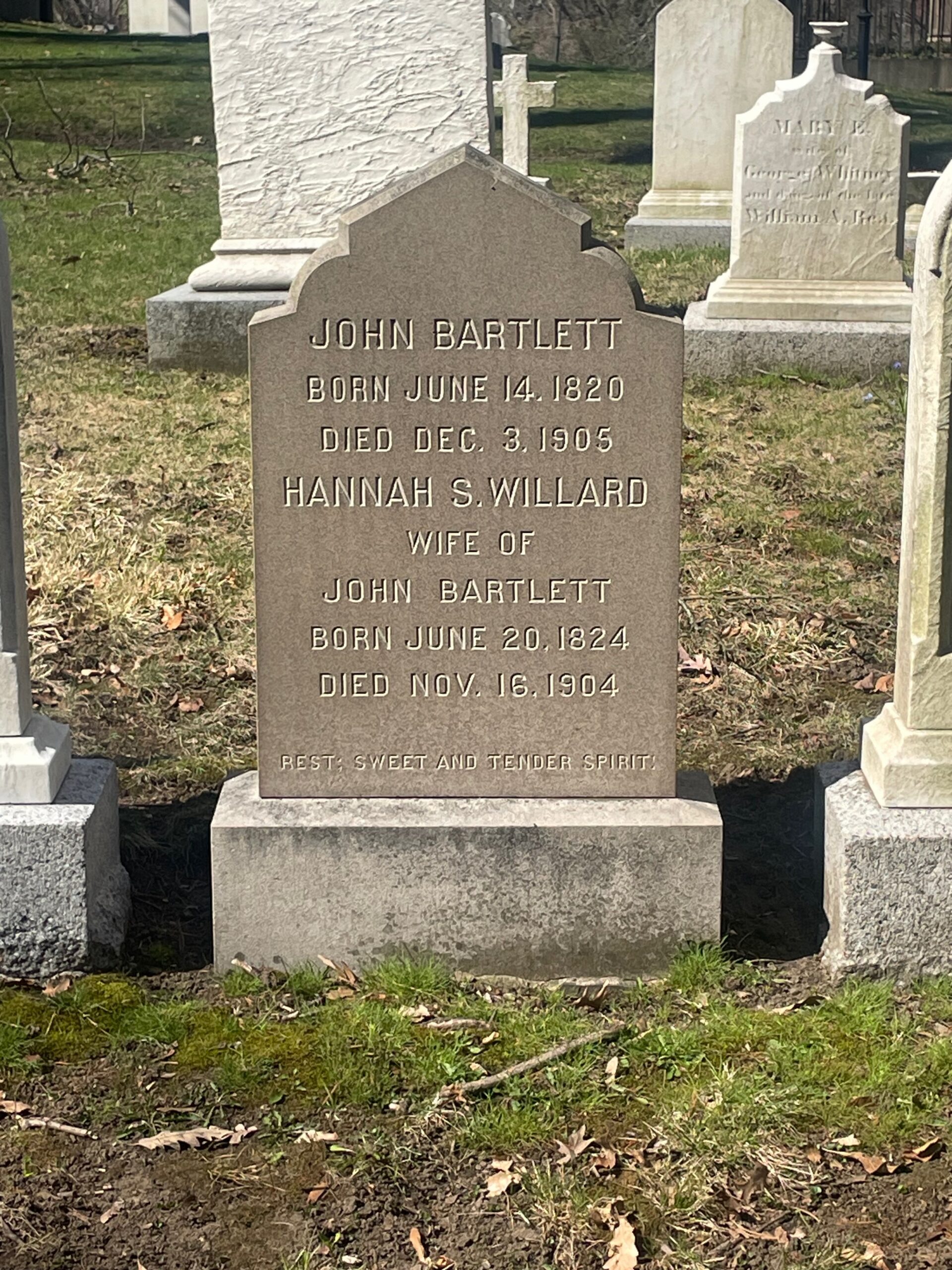
Born in Plymouth, Massachusetts in 1820, Bartlett became the ultimate striver and the prophet of striving. He didn’t have a lot of money, but he wanted to be taken seriously. When he finished school at age 16, he moved to Cambridge. He wanted to be around Harvard, though there was no way he was going to have the resources to attend Harvard. So he got a job in the Harvard bookstore. He was a smart guy, no question about that. He was a voracious reader and could remember much of what he did read. He was good at business. He owned that bookstore before he turned 30. It’s just that he was like a lot of working class kids with big brains and ambitions–he didn’t have the money in the class-bound society of the United States to train that brain in the halls of higher education.
This isn’t to say that the U.S. was more class bound than the European societies the birthed it, of course that’s not true. But it is to say that Americans love to tell bullshit stories about themselves that don’t stand up to the first bit of scrutiny (starting with “this is the greatest nation that has ever existed,” which always makes me assume one has never traveled) and one of the biggest myths is that the U.S. is a classless society, since everyone is “middle class.” What a load of garbage this is.
Anyway. Bartlett is a great representative of the kind of person who should have had better opportunities in a better society, but didn’t, and yet was so deeply ambitious that he managed to be pretty remarkable anyway. Bartlett probably had a photographic memory. He was also the kind of smart guy who thinks trivia is important. I reject the entire idea of something as “trivial;” there’s no knowledge that is actually useless. But at the same time, pointless facts for the sake of pointless facts in fact equals pointlessness. Around Cambridge, there became a game to see if you could stump John Bartlett on a trivia question. But what Bartlett was into was not really trivia so much as trying to be a self-taught person. He believed strongly in this and he believed others could do it.
So, in 1855, Bartlett decided to publish what became known as Bartlett’s Familiar Quotations. Behind this was the idea that famous people had said famous things and the educated American should know these things. And while I can’t say that I know a lot of this kind of thing or that I think remembering some famous quote by a president or witty writer is exactly important knowledge, I have a lot of respect for the thinking behind it. It’s at least a noble goal, something almost lost by the crude and stupid Americans of the 21st century.
Now, Bartlett didn’t entirely invent this idea. There was already a version of this in the UK, published by Isabella Rushton Preston in 1853 and titled Handbook of Familiar Quotations from English Authors. Bartlett freely admitted that he borrowed the idea. Most of the early edition of Bartlett’s book came from The Bible, Shakespeare, and British authors.
The book sold like hot cakes. It became one of those books for the American Striver, a type of person who was pretty common in American history and was almost a stereotype for an American during the 19th and early 20th century. The small town businessman needed to know a little Shakespeare. Maybe he didn’t have time to read his Bible, but if he could pull some quote from Psalms that he learned for Bartlett, he could communicate with the guy he was trying to lock down on the deal.
Bartlett briefly gave up the book business in order to serve the Union in the Civil War. He closed his shop in 1862 and became a paymaster in the Union Navy. He even was in the South for awhile. But in 1863, he took a job in Boston with Little, Brown, and Company. Founded in 1837, this was already one of the largest book publishing companies in the nation. They wanted Bartlett’s Familiar Quotations and they wanted Bartlett too. He became part of the company’s management and was named a senior partner in 1878. He stayed with them until 1889. He built up future editions of his best seller. I assume he worked on other projects too. He also wrote about fishing and chess, two of his hobbies. He also did a giant concordance of Shakespeare, which was a big deal in the early encyclopedia era that is no longer relevant to the world, but which sure was when he published this in 1894.
Bartlett sort of retired, but he kept working on his Familiar Quotations. There were nine editions published in his lifetime. The ninth came out in 1891. That seemed like it was going to be it for the project, but after his death, it was brought back, with the tenth edition published in 1914, when Nathan Haskell Dole took the project over.
Bartlett died in 1905. He was 85 years old.
John Bartlett is buried in Mount Auburn Cemetery, Cambridge, Massachusetts.
If you would like this series to visit other figures associated with Bartlett’s Familiar Quotations, you can donate to cover the required expenses here. A bit niche, but it’s hard to know how to categorize a guy like Bartlett. Nathan Haskell Dole is in Hartsdale, New York and Christopher Morley, who edited later editions, is in Greenvale, New York. Previous posts in this series are archived here and here.