
Erik Visits an American Grave, Part 2,200
 By
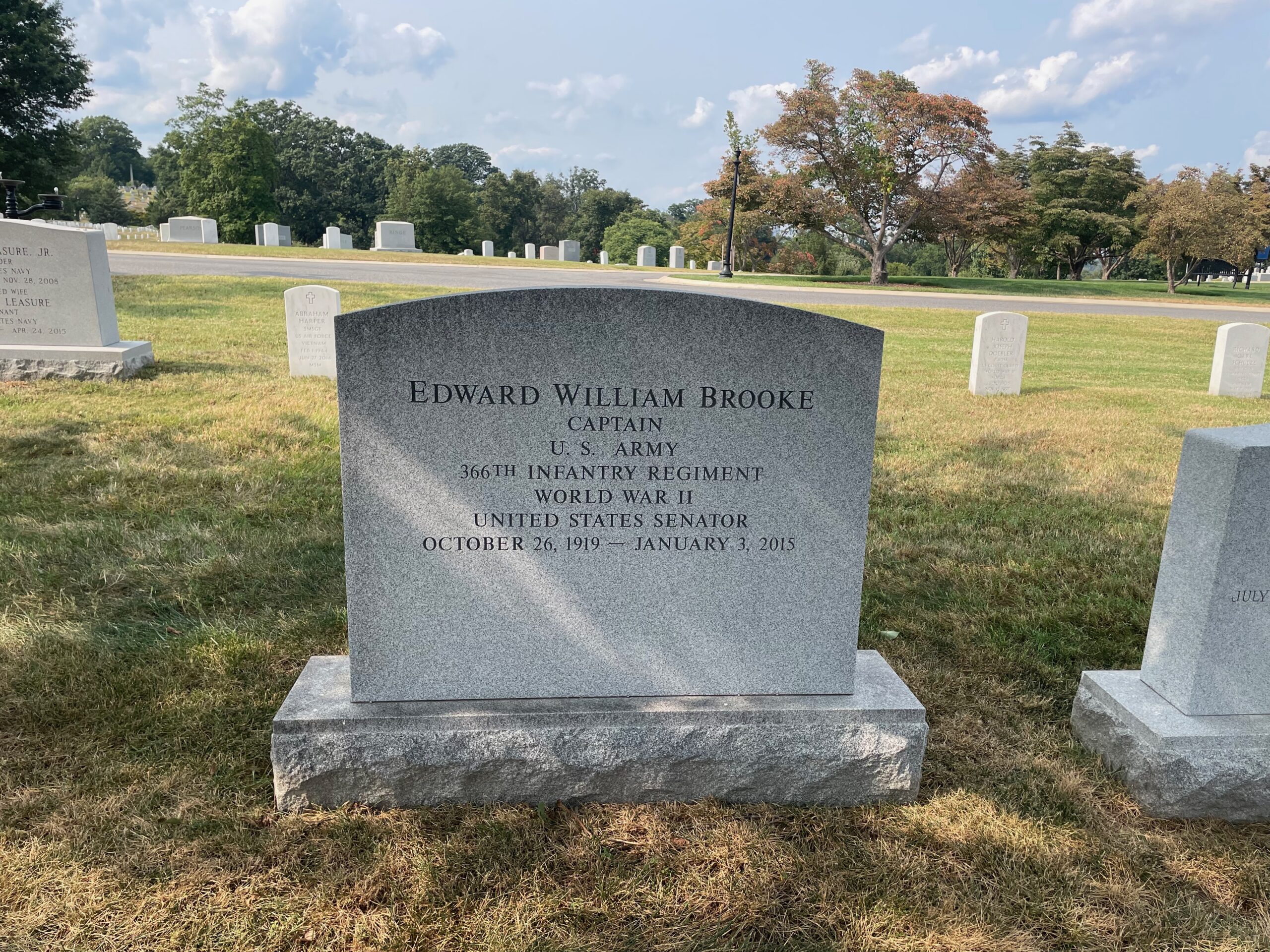
By This is the grave of Ed Brooke.
Born in 1919 in Washington, D.C., Edward Brooke grew up in what passed for the black upper class of the era, though it was really middle class by white standards. His father was a lawyer who worked for the Department of Veterans Affairs. Even after the segregation of the federal government (which I will state again was not just Woodrow Wilson, but which every president had set up since William McKinley and Wilson just codified what McKinley, Roosevelt, and Taft had already moved toward), there were opportunities in it for the black community. Brooke grew up almost completely separate from whites. It was segregated, but also his parents didn’t want their kids around many whites and who can blame them. So he went to Dunbar High and then Howard University. He majored in political science. We will try to forgive him.
Brooke was in the military during World War II, commissioned as a second lieutenant and eventually making captain. He was in the 366th Infantry, like everything else, a segregated unit. He spoke some Italian and was sent to Italy. He was quite light skinned and so went undercover to cross enemy lines and communicate with Italian partisans. No desk job there! He got a lot of medals for that. He then went to get his law degree at Boston University, finishing there and passing the bar in 1948.
Before he went into the military, Brooke said he had never thought much about race. Dealing with racist white superiors changed that and it infuriated him. Also, he fell in love in Italy and married a woman named Remigia Ferrari-Scacco. He wondered why an Italy that had just until recently been controlled by fascists was less racist than the United States. This is a question a lot of Americans could use considering.
Brooke decided to run for a seat in the Massachusetts legislature in 1950. This was an unusual move for a black person to make in New England. Obviously there wasn’t the legal segregation of the South, but it was still not something that was expected. He won and a pioneering career was born.
Brooke’s politics were a combination of the old belief within black communities that the Republican Party was still the Party of Lincoln and a genuine conservatism, especially on economics. So while Brooke found himself increasingly out of the mainstream of what the Republican Party would become–i.e., taking over the mantle of the White Man’s Party from the Democrats–it would take him a long time to be that uncomfortable with the party as a whole.
Brooke was a good, competent guy. His position was that his race shouldn’t matter and that his work should speak for himself. And that did work pretty well for him. He was chair of the Boston Finance Commission for a few years and then, in 1962, ran for Massachusetts’ attorney general. No black person had ever been elected to the AG position in any state before. Massachusetts voters, pleased by his competence and for the most part not sad to have the opportunity to engage in a pioneering choice, voted him in.
In 1966, Brooke decided to run for the Senate. The Democratic candidate was former governor Endicott Peabody. Brooke blew him out. He served two terms as the kind of liberal Republican that New Englanders loved–and nostalgically still do and which may yet again elect Susan Collins in Maine, not to mention Phil Scott as Vermont governor–who was very good on civil rights and very orthodox on free market economics. He was a Nelson Rockefeller guy all the way in who he hoped would be the party’s presidential candidate. He was at first skeptical about the Vietnam War, but then came around to it, unfortunately but not surprisingly. He was a good fighter against housing discrimination and helped write the Civil Rights Act of 1968. Brooke thought that bill too weak and routinely proposed stronger legislation.
Brooke became the first black senator to win two terms when he won again in 1972, this time defeating the Democratic candidate, a lawyer named John Droney. In his second term, Brooke was notable for being the first Republican to demand Richard Nixon’s resignation over Watergate. He deserves credit for that, for sure. No sitting Republican senator has ever demanded Donald Trump’s resignations over his many, many, many crimes worse than Watergate. He continued to vote for conservative Republican policies on financial matters, but within reason. He did believe that at least when it came to race, bootstrap politics couldn’t always work. But he was certainly no friend of the labor movement or the liberal agenda to expand government programs to ensure greater equality of opportunity. But he was also good on gender equality issues. One of his major policy achievements was the Equal Credit Opportunity Act, which ensured married women could get credit cards in their own name.
In 1978, Brooke wanted a third term. But this time he faced a fast rising Democrat named Paul Tsongas. It wasn’t even close, Tsongas beat him by 10 points. Why? Not for great reasons. Brooke was a big abortion advocate so the Catholic Church turned on him hard and convinced many of the enormous numbers of Catholic voters in the state to vote for Tsongas. Note that this was also the same time as the busing issue was roiling Boston. Again, let’s not pretend racism is some southern problem. Tsongas was fine, more or less, and given the impending partisanship of the Senate, any Democrat was by this time basically better than any Republican (with the exception of Joe Lieberman), but the issues here weren’t great.
Amazingly, Brooke was the longest serving black senator in American history until Tim Scott’s reelection for a third term in 2024. Now’s that’s depressing. Both the fact and who holds that honor.
After his defeat, Brooke went into Beltway lobbying land and made a lot of money. But he also headed the National Low Income Housing Coalition for awhile and that was good work. There was an investigation into him by the Department of Housing and Urban Development in 1992 over accusations that he was influencing the government for his friends, but nothing much came of it. Later in life, he moved away from the Republican Party entirely. In 2008, he expressed his support for Barack Obama’s presidential run.
Brooke died in 2015, at the age of 95. He probably would rather be dead than to see what has happened to the Republican Party since the rise of Donald Trump.
Edward Brooke is buried in the confiscated lands of the traitor Lee, Arlington National Cemetery, Arlington, Virginia.
If you would like this series to visit other black senators, you can donate to cover the required expenses here. Hiram Revels is in Holly Springs, Mississippi and Blanche Bruce is in Washington, D.C. Previous posts in this series are archived here and here.