
Erik Visits an American Grave, Part 2,202
 By
By This is the grave of Reginald Heber Smith.
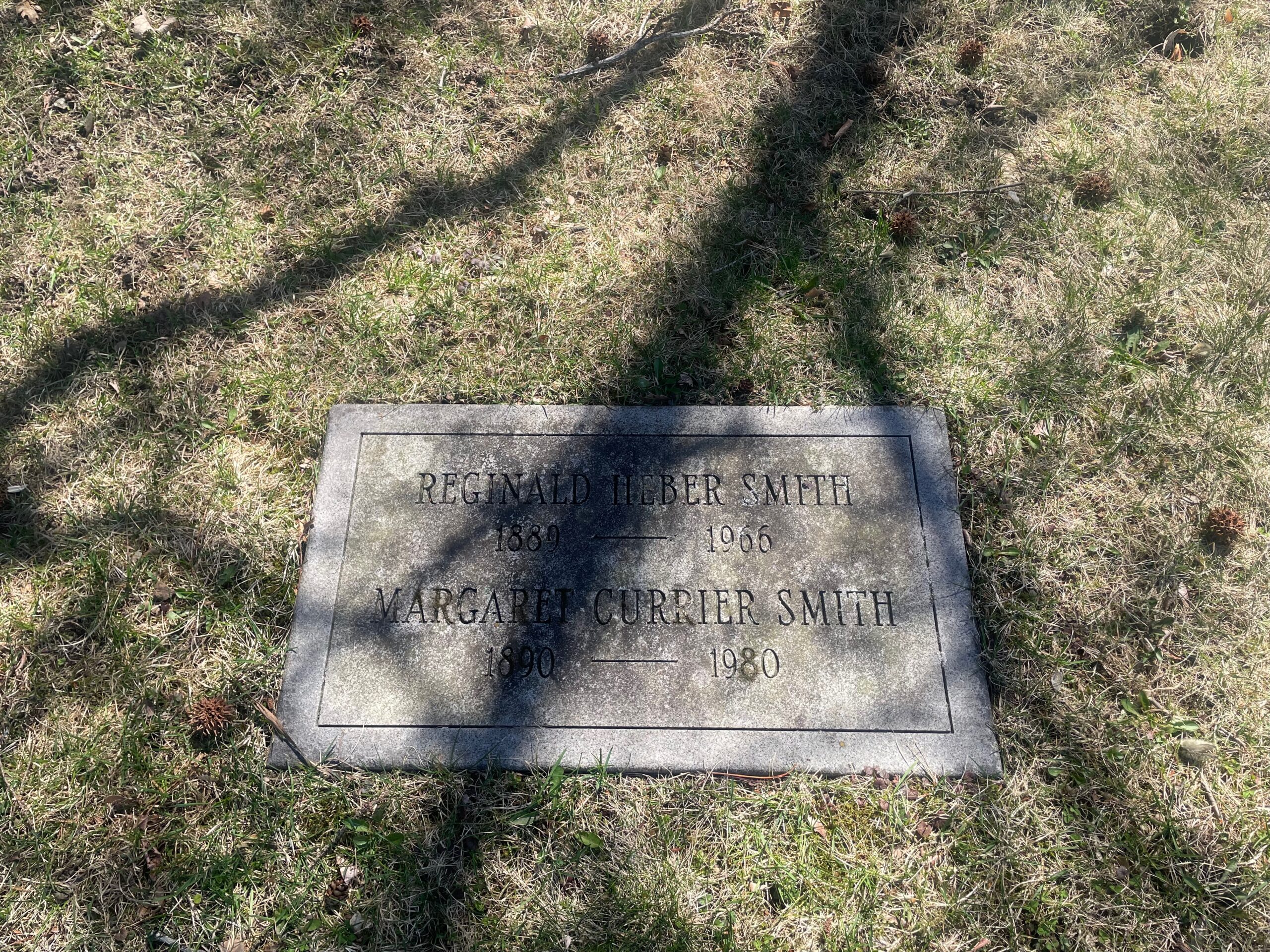
Born in 1889 in Fall River, Massachusetts, Smith grew up wealthy enough to go to Harvard. He graduated there in 1910 and then stayed on for a law degree, which he finished in 1914.
Smith was a Progressive and sympathetic to leftist causes. He realized that one major issue that the poor faced in creating conditions where they would have a fair chance for justice was the lack of legal representation. Hard to say that justice is blind when the rich could afford the best lawyers that existed and the poor couldn’t afford anything at all except hoping someone would take the case. Now, Smith did not invent the idea of legal aid, but he was one of the first really important people in this movement. In 1914, shortly after passing the bar, he became Chief Counsel at the Boston Legal Aid Society. Of course, he supported himself through lucrative law too and was a partner at Hale and Dorr basically forever, all the way from 1919 until 1956.
But Smith’s real passion was legal aid. In 1919, he published the key text of the legal aid movement. Justice and the Poor made the case that seems obvious to any liberal–unequal legal aid meant unequal outcomes and kept the poor down. Of course conservatives fundamentally knew this, even if they wouldn’t admit it if they thought of it, and they wanted to keep it that way. Given that so much legal work at this time around the poor was about the rich exploiting the poor, very much at work, but in things such as rent, inheritance, and every other part of the law, Smith’s larger point that the legal profession was a real problem and needed to reform its own ways. He wrote, “Without equal access to the law, the system not only robs the poor of their only protection, but places in the hands of their oppressors the most powerful and ruthless weapon ever invented.” Which is of course the point for the oppressors. Probably one of the most ridiculous myths in American history is that we have equality before the law. You know who doesn’t believe in that at all? The 6 Republicans on the Supreme Court.
Smith calling out the legal profession forced the American Bar Association to create the Special Committee on Legal Aid Work. This led to the growth of legal aid societies in most major cities by World War II. Of course it wasn’t much and most lawyers rolled their eyes at doing pro bono work for the poor. But in the 1960s and 1970s, in that era when there was reason to think that America could actually get better and people really fought for that (I wonder what’s that like and I will probably never know the answer) legal aid flourished as a couple of generations of liberal lawyers wanted to spend at least some of their time doing things like fighting for racial equality, housing rights, corporate accountability, and all the other social movements of that period.
Smith remained central to the legal aid movement for the rest of his life. He was on the Committee on Legal Aid Work from 1921 to 1936. The next year, in 1937, he and an ally named Edmund Ruffin Beckwith created the Conference on Consumer Finance Law. Smith also wasn’t just some gadfly. He was one of the nation’s most respected legal minds and he got the accolades that come with such honors. He was on the editorial board for the American Bar Association Journal from 1941 to 1954. He also served in a lot of other major positions within the American Bar Association.
But for most law firms, the legal aid stuff wasn’t Smith’s greatest invention. Nope. Because Reginald Heber Smith also invented the billable hour. So even for the most corporate hack right-wing lawyer, Smith should be a hero. Certainly he is for the accounting side of law firms. This article calls him “the man who pioneered the rationalization of the modern law firm.” This all was connected to the legal aid stuff. See, he was running an organization on a shoestring budget, as you can imagine. So he went to the Harvard Business School and approached a professor named William Morse Cole to create a system that would allow the Boston Legal Aid Society to function on a budget. Using all sorts of ideas of scientific management, Cole and Smith figured out how to get a lot more work done. This was in 1915 and within a year, the group had cleared 65% more cases than the previous year. Impressive.
Interestingly, Smith had to work hard on his fellow lawyers at Hale and Dorr to get them to accept his scientific management positions. He complained, “This simple plan had but one weakness which is that lawyers are individualists. They hate any system; and to keep a detailed record of time seemed to them about as bad as a slave system.” Well, I’m not sure that the billable hour turned out to be exactly like slavery to them in the end. The problem was that the lawyers themselves did not want to be accountable for their time. A lot of them didn’t actually work very much and they didn’t want anyone to know that. In this, they were dealing with the same ideas of controlling time that the working class was resisting in the more common use of scientific management, the ideas of Frederick Winslow Taylor and using stopwatches to time worker actions and the like. Who wants to see your time controlled? On the other hand, a smart law firm has managed this quite effectively to increase profits and many of those lawyers who opposed this on principle found themselves with more money.
Moreover, for Smith, the billable hour made legal services clear to clients and if they understood what they were paying for, they would be likely to pay for them more often. He worked this up all through the 20s and 30s and then in 1940 published Law Office Organization, a pamphlet laying it all out. It went through 11 editions by the early 90s. Evidently, what made this so successful is that by the 50s, lawyers’ salaries were falling behind other major professions such as doctors and so the justification for higher salary became something of a crisis. Of course today, the billable hour is a major problem, as law firms use it as a weapon against each other and against clients as a tool to maximize profits at the top. But there’s more than a few lawyers around here so you all can talk about this more fluently than I have.
I started this post because of the Legal Aid stuff and had no idea I was going to be exploring the history of the billable hour. Never know where things will lead in the grave series!
Smith died in 1966. He was 76 years old.
Reginald Heber Smith is buried in Mount Auburn Cemetery, Cambridge, Massachusetts.
If you would like this series visit other lawyers, you can donate to cover the required expenses here. F. William McCalpin, who was also a big Legal Aid guy in the late 20th century, is in St. Louis. Jewel Lafontant, the first woman and black American to serve as Solicitor General, is in Chicago. Previous posts in this series are archived here and here.