
Erik Visits an American Grave, Part 2,180
 By
By This is the grave of George Mackey.
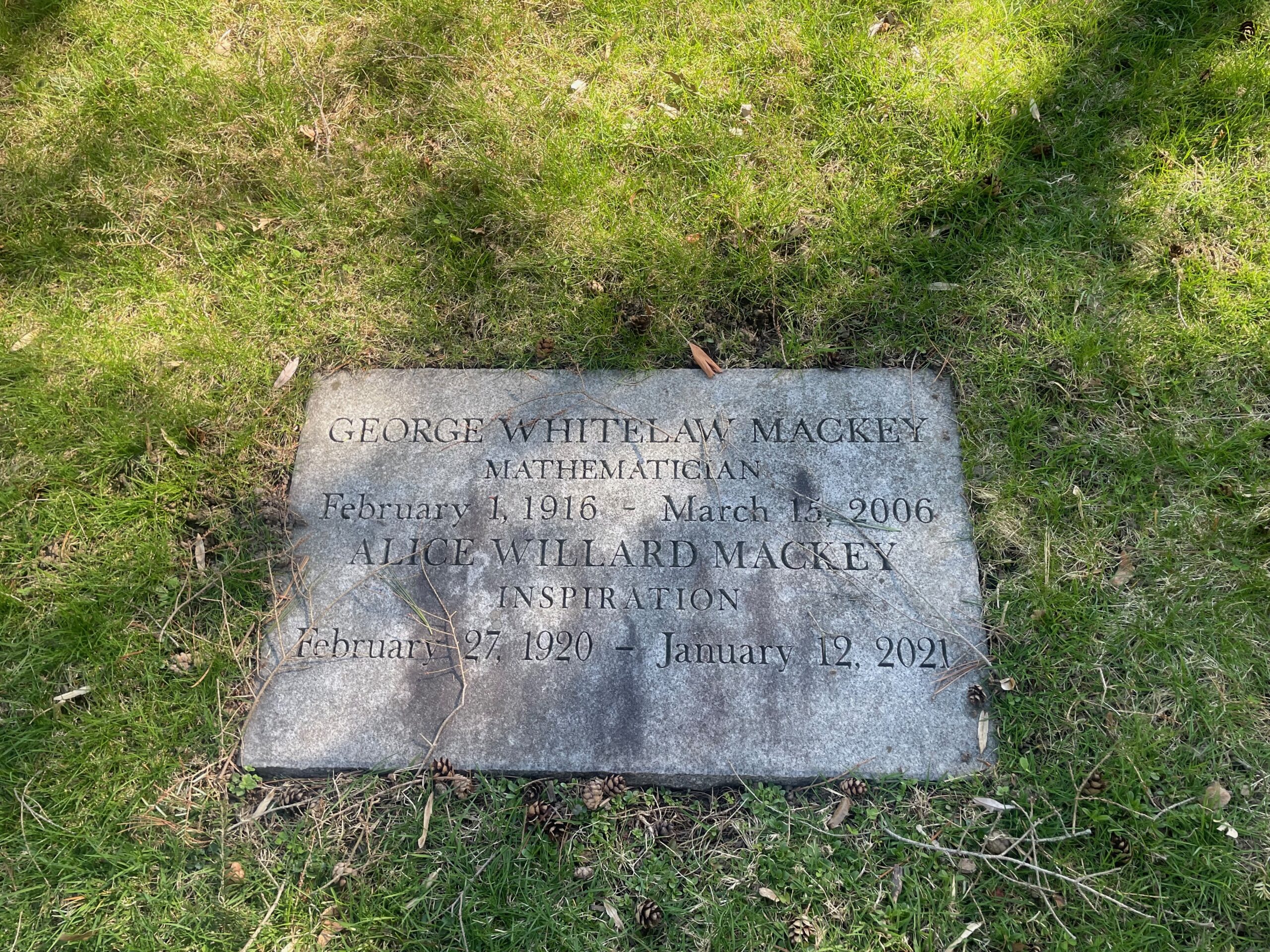
Oh dear….I was told there would be no math. Well, huh. OK, look, I really have zero ability to even describe what mathematicians do in even the most basic way possible. And this guy wasn’t even that famous, not famous enough to get a New York Times obituary. Though what mathematician really is? But, with this series at such a ridiculous length–and really, what in the entire history of the internet is like what I do here? Nothing. There is nothing at all even remotely like this. See, when I get committed to the bit, I’m really committed to the bit. Thus, when you get far enough into a series discussing Americans, you want to cover as much ground as you can in order to provide the most complete picture of this nation as possible. Now, it would be easy for me to say, nope, no math for me. But I don’t mind writing about things that I don’t really understand (obviously). I mean, it’s the internet, who cares, it’s not like it’s real life or matters in any way. So….I’m going to do the only thing I can think of to include a mathematician in this series, which might sound like the lamest thing possible, but which is the only way I can move forward here: I’m going to copy and paste Mackey’s Wikipedia page and then add a few bits that I can find to it from what obituaries and other material are out there.
Born in 1916 in St. Louis, Mackey grew up in Florida and then Texas, when his family settled in Houston in 1926. He went to Rice for college. His father thought there was only one valuable thing a man could do: business. Mackey didn’t want to do that. He had to convince his father that science was practical enough. So he first tried to chemical engineering. He evidently hated it. Then it was physics. But that didn’t stick either. So he went to Math, even though that’s no more directly applicable to society than history or math’s close cousin, philosophy. Good for him, stick it Dad. He ended up at Harvard for graduate work. That’s where he would teach too. And like any good human, he believed strongly in reading and his daughter noted how often he read English literature out loud to his family. No STEM moron was Mackey. That’s a well-rounded human. Colleagues later noted his shyness but his firmness and ethical center when things mattered. Sounds like a good colleague to me.
Mackey became known for his contributions to quantum logic, representation theory, and noncommutative geometry. You can see why I am doing this Wikipedia bit, I don’t know what quantum logic, representation theory, or noncommunatitive geometry even is. Actually, let’s use this as another side point–the only reason Math is included in STEM is for the acronym. None of the capitalists behind pushing the transformation of American higher ed into job production for the need of capital at this moment but most certainly not the future give a flying fuck about math, certainly not as mathematicians themselves practice it. In fact, they don’t care about science either. They care about technology and engineering. Math is basically numbers philosophy and these folks are operating on a completely different wavelength than the rest of us. That’s great! It may be beyond my understanding, but why do I need to understand what they do?
Mackey earned his B.A. at Rice University in 1938 and obtained his Ph.D. at Harvard University in 1942 under the direction of Marshall H. Stone.[1] He joined the Harvard University Mathematics Department in 1943, was appointed Landon T. Clay Professor of Mathematics and Theoretical Science in 1969 and remained there until he retired in 1985.
Earlier in his career Mackey did significant work in the duality theory of locally convex spaces, which provided tools for subsequent work in this area, including Alexander Grothendieck‘s work on topological tensor products.
Mackey was one of the pioneer workers in the intersection of quantum logic, the theory of infinite-dimensional unitary representations of groups, the theory of operator algebras and noncommutative geometry. A central role in Mackey’s work, both in the theory of group representations and in mathematical physics, was played by the concepts of system of imprimitivity and induced representations. This idea led naturally to an analysis of the representation theory of semi-direct products in terms of ergodic actions of groups and in some cases a complete classification of such representations. Mackey’s results were essential tools in the study of the representation theory of nilpotent Lie groups using the method of orbits developed by Alexandre Kirillov in the 1960s. His notion of “virtual subgroup”, introduced in 1966 using the language of groupoids, had a significant influence in ergodic theory.
Another essential ingredient in Mackey’s work was the assignment of a Borel structure to the dual object of a locally compact group (specifically a locally compact separable metric group) G. One of Mackey’s important conjectures, which was eventually solved by work of James Glimm on C*-algebras, was that G is type I (meaning that all its factor representations are of type I) if and only if the Borel structure of its dual is a standard Borel space.
He has written numerous survey articles connecting his research interests with a large body of mathematics and physics, particularly quantum mechanics and statistical mechanics.
Mackey was among the first five recipients of William Lowell Putnam fellowships in 1938.[2] He received the Leroy P. Steele Prize in 1975 for his article Ergodic theory and its significance for statistical mechanics and probability theory.[3]
Mackey was an elected member of the American Academy of Arts and Sciences the National Academy of Sciences and the American Philosophical Society.
Lawrence G. Brown, Paul Chernoff, Edward G. Effros, Calvin Moore, Richard Palais, Caroline Series, John Wermer and Robert Zimmer have been doctoral students of Mackey. Andrew Gleason had no PhD, but considered Mackey to be his advisor.
Once again, you can see my strategy for using the Wikipedia page.
From one obituary, he evidently once wrote, ”I became seduced by the beauties of pure mathematics.” That’s a very particular type of beauty! Though I do get the aesthetics of it in principle, if not in fact.
Mackey died in 2006. He was 90 years old. It was pneumonia.
George Mackey is buried in Mount Auburn Cemetery, Cambridge, Massachusetts,
If you would like this series to visit other mathematicians, and you probably would not, you can donate to cover the required expenses here. Solomon Lefschetz is in Princeton, New Jersey and so is John Forbes Nash. Previous posts in this series are archived here and here.