
Pivoting to a proactively strategic new paradigm
 By
By Charlotte Klein’s report on the controlled demolition of the Washington Post is grimly hilarious. The Rupert Murdoch fart-catcher Bezos has put in charge of the bailout is in an endless cycle of promoting or hiring somebody to pivot to something other than journalism described with meaningless gibberish, and then quietly letting that person go when the not-even-put-in-the-oven plan inevitably fails:
It’s been another terrible week for the Washington Post. The newsroom is bracing for a devastating round of layoffs with rumors flying that some desks may be shuttered entirely. Sportswriters were stunned to learn they would no longer be attending the Winter Olympics in Italy (management later reversed course, saying a small contingent would cover the event), while the Post’s foreign correspondents have been pleading with owner Jeff Bezos to spare their department in desperate posts on X, noting the groundbreaking work they’ve done in Ukraine, the Middle East, Venezuela, and elsewhere at a time when Donald Trump’s foreign-policy activity has been frenetic. For the time being, no one knows how deep the cuts will actually be, but staffers are anticipating around 100 job losses in the roughly 800-person newsroom alone. One staffer told me that “every desk is allegedly losing jobs.” The expectation is they’ll hit next week.
The ostensible reason for the layoffs is that the Post, like many other newspapers, is losing money. But unlike other newspapers, the Post is also in the midst of a demoralizing destruction of its brand that has alienated hundreds of thousands of subscribers and left even its staff unsure of what the paper is trying to do, both journalistically and businesswise. “I’m increasingly finding it hard to justify the cuts from a journalistic perspective,” said one staffer. “Of course, financially, the Post is in a deep hole, and I understand that. But some of that hole, if not a lot of it, is because of Jeff Bezos.”[…]
Lewis’s leadership team has floated a lofty goal of attracting 200 million subscribers in meetings with senior Post editors. But Lewis’s proposals to fix the Post have not provided clarity or inspired confidence. In January 2024, he debuted his “Fix it, build it, scale it” approach, telling Semafor’s Ben Smith that “social, AI, and personalization are the next opportunities.” That spring, he rolled out a more formal plan, focused on diversifying revenue streams through flexible payment options to target “untapped audiences,” additional subscription tiers à la Axios and Politico (Post Pro, Post Plus, and Membership), and further integration of artificial intelligence into Post products. A new team led by chief communications officer Kathy Baird would focus on marketing the Post’s star talents.
Baird left the Post a year later — part of a pattern of fits and starts for Lewis’s rebuilding project.
In June 2024, Lewis announced the formation of a “third newsroom” focused on service journalism and social media, among other innovations. The third newsroom would be “an industry-defining moment for us,” Lewis said. Some six months later, that effort was formally introduced as WP Ventures, led by Krissah Thompson, a beloved newsroom leader. A year later, Thompson tooktook a voluntary buyout.
The Post then announced that Ventures would pivot, becoming a more commercial operation that would operate outside the Post’s newsroom and focus on “creator-driven experimentation.” (It doesn’t help that Lewis’s business proposals are all encased in this sort of impenetrable corporatespeak.) Samantha Henig, a veteran in the journalism-product space, would lead this new line of business. But in August 2025, the Post hired former Axios editor-in-chief Sara Kehaulani Goo to be the Post’s “president, Creator Network,” in which she’d be “building a new business with creators through an innovative commercial model.” In October, Henig left the Post.
Last June, the Post launched WP Incubator, an “initiative for building cutting-edge AI products and new media business models.” Out of that came Ripple, a program licensing opinion pieces from other newspapers, Substack writers, and other third parties that began in December. The Post also debuted an AI podcast feature that allows users to create their own personalized shows. The product, which was released despite a number of internal testing issues, has been rife with errors, including invented quotes and inserted bias, as Semafor’s Max Tani reported.
Lewis know who is to blame for the site’s massive drop in traffic and paid subscribers. That is, the reporters:
Under Bezos’s leadership, CEO Will Lewis has floated a bunch of proposals to make the company profitable, few of which so far resemble anything people might actually want to buy. Meanwhile, he has blamed the Post’s journalists for their plight, infamously declaring at a town hall in 2024, “Your audience has halved in recent years. People are not reading your stuff.” Now, executive editor Matt Murray, who was installed by Lewis, is singing the same tune, at least privately, telling a staffer recently that their journalism is just not resonating with readers, according to a source familiar with the discussion. “It’s like someone who slices your Achilles and then asks you why you’re limping,” one reporter said.
Wow, I wonder why nobody with any options wants to work for this asshole! Anyway, let’s try to solve the mystery of why the Post is dying:
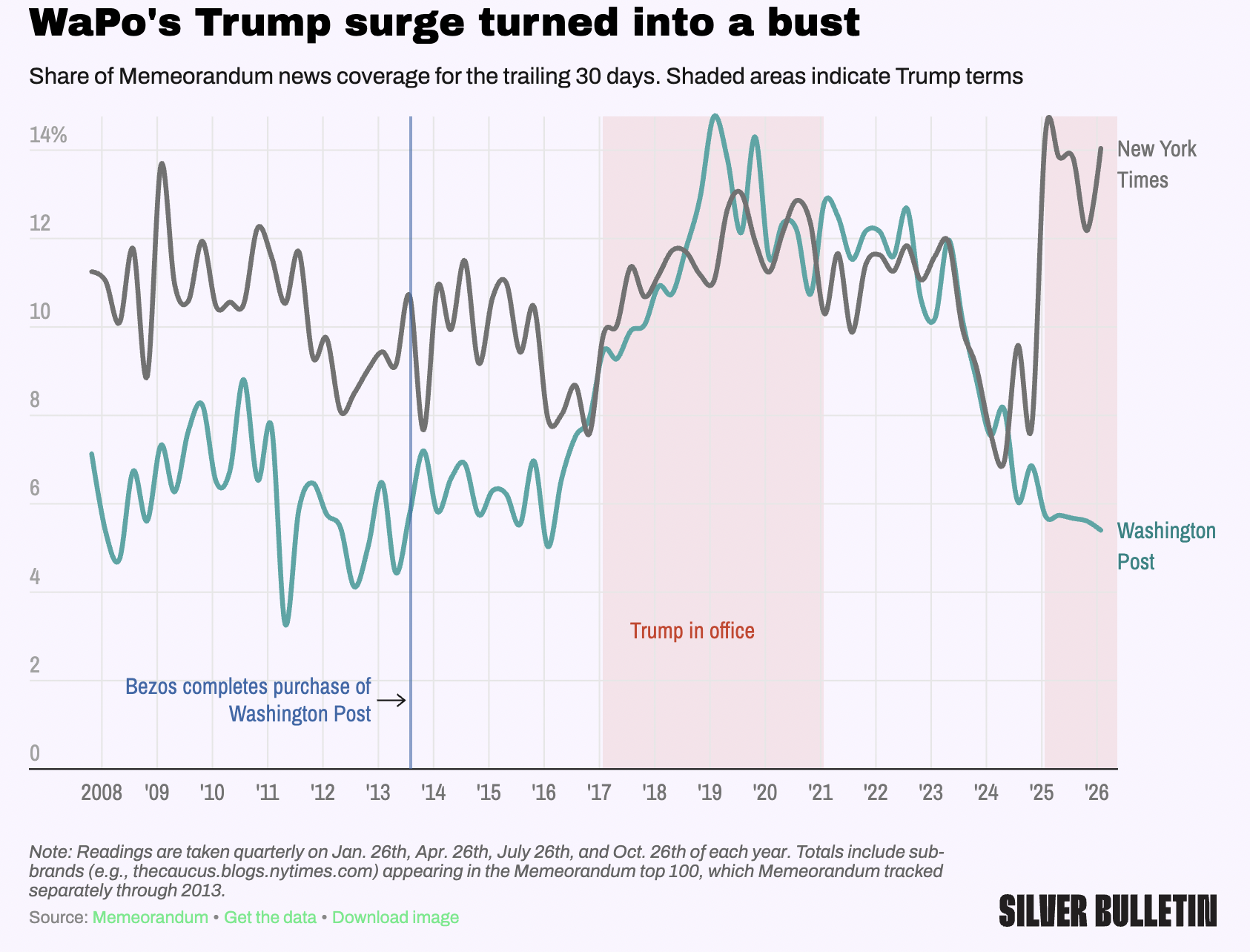
Hmm, maybe in November 2024 WaPo journalists mysteriously and suddenly stopped writing stories that people wanted to read. Or maybe the paper’s leadership made a concerted effort to alienate the paper’s core readership to curry favor with a particular political candidate and has absolutely no plan to replace any of the lost readers and subscribers. This is an unknowable question, like the sum of one and six.