
Erik Visits an American Grave, Part 2,037
 By
By This is the grave of Patrick Hurley.
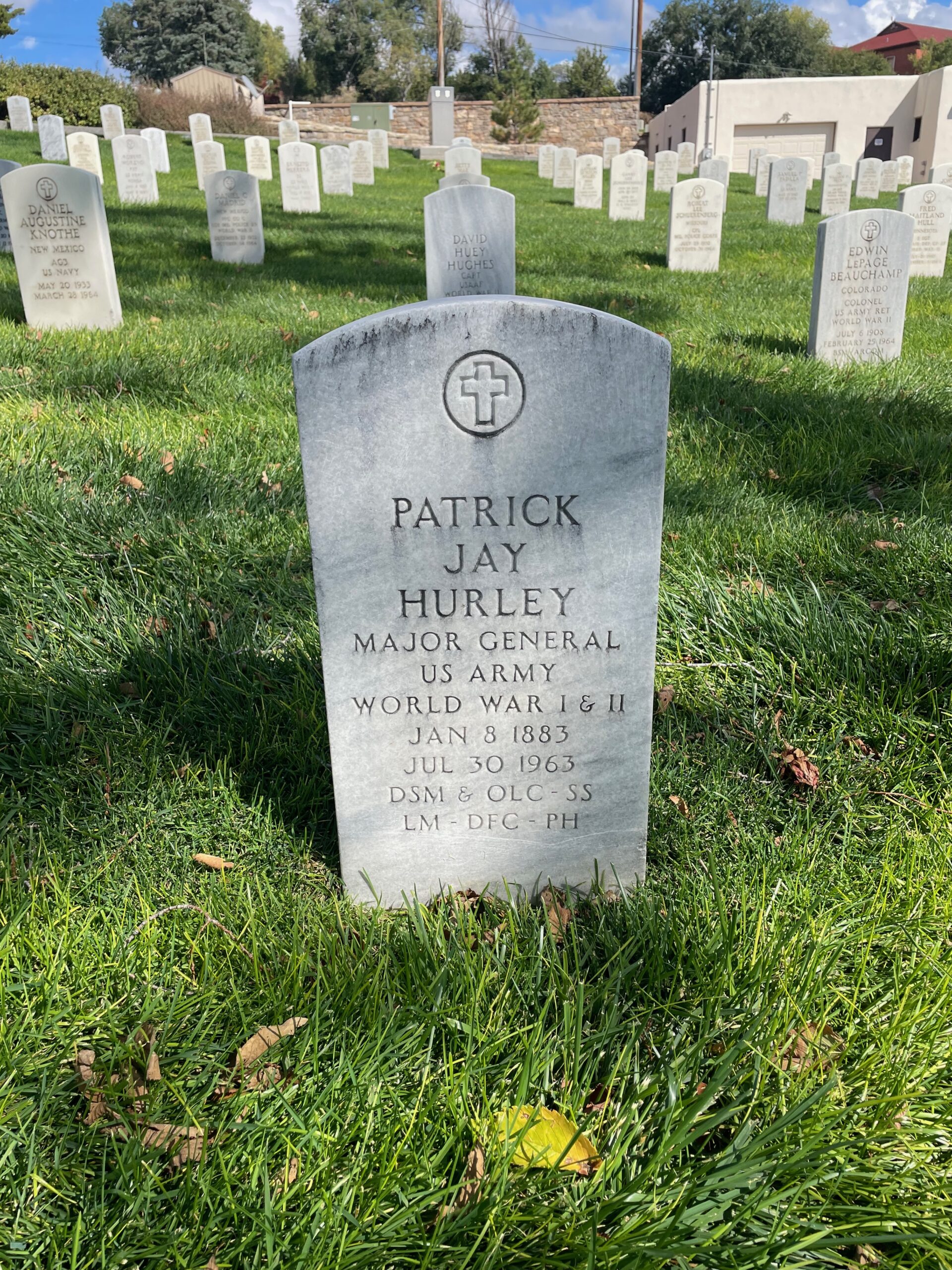
Born in 1883 in Lehigh, Oklahoma, Hurley came out of the Irish immigrants who rushed into Indian Territory when they weren’t supposed to do to steal land, in this case the Choctaw. They were a poor family, like most Irish immigrants. His father worked in coal mines and Hurley joined him at the ripe age of 11. He wanted adventure though. At the age of 15, when Theodore Roosevelt’s agents were combing that part of the country for cowboy types who would join the Secretary of Navy to steal Cuba for the United States, Hurley attempted to join the Rough Riders but he was only 15 and so was rejected in the end for being too young. But he had no intention of being an Oklahoma coal miner for one second longer than he had to. He became a cowboy and met a young man named Will Rogers. They became lifelong friends and rose in society together, if in very different ways.
Hurley decided to put himself through college cowboying and did so at what is today Baccone College, a school mostly for Native Americans in Muskogee. With an actual college degree, he went east and enrolled in law school at the National University School of Law, graduating in 1908. He went back to Tulsa and started a law practice that focused primarily on oil and gas. He became rich, invested in real estate, and started working in the local Republican Party. That was most certainly the minority party in early statehood Oklahoma, but did have access to a lot of rich people. In 1911, William Howard Taft named him attorney for the Choctaw, which was a patronage position at that time because of course the Choctaw could not appoint their own attorney. He went back to Washington, went to a better law school–George Washington–and got a second degree that would gain him the kind of respect from national legal leaders he craved.
Hurley’s other interest was the military. He was active in the Oklahoma National Guard and was called up in 1916 to serve in John Pershing’s idiotic expedition to go chase down Pancho Villa in northern Mexico. Being a well-connected guy with some military groundwork, during World War I, he was sent to Washington to work with the Judge Advocate General’s Corps and then was a JAG in France, where he worked with Luxembourg to allow American troops to pass through it, even as it was trying to stay neutral.
After the war, Hurley returned to Oklahoma, worked in the law and in banking, and became a leader of the Oklahoma Republican Party, which again, wasn’t that hard since it was an overwhelmingly Democratic state. However, when Hurley managed Herbert Hoover’s 1928 electoral campaign in the Sooner State, he pulled the Republican to a victory there, as happened throughout the nation except for the very deep South, due to Al Smith being a scary Catholic. Hoover paid Hurley off for his work, naming his assistant Secretary of War. But then the actual Secretary of War, James William Good, died shortly after his confirmation and Hurley was promoted to fill his role. There’s almost nothing of interest to say about his time in Hoover’s Cabinet because defense policy was simply not important to Republicans of the interwar period, as they were busy embracing isolationism. After he left office in 1933, Hurley spent the next few years in the oil industry, doing a lot of legal work for companies working in Mexico.
Hurley was one of the Republicans that Franklin Delano Roosevelt could work with. He became FDR’s personal diplomatic ace in the hole, someone who could handle tricky situations. There were a lot of them at the beginning of the war. It was Eisenhower who put Hurley in Roosevelt’s sights. Eisenhower needed a good politician to get the Australians to hand over a bunch of money to help get American soldiers out of the Bataan peninsula. That didn’t work, but Roosevelt thought he did a good job. Much of tricky work for Hurley was in Asia, and he would be sent to places such as Iran and Afghanistan. He also became the first American to see Soviet lines on the Eastern Front, as he was representing the Roosevelt administration to Stalin, about as tricky and important as it gets. He was in Stalingrad during the counterattack in 1942 that started pushing the Nazis back. He went back to the U.S. saying we needed to provide the Soviets all the material we could and also open a second front as soon as possible. Hurley was appointed as ambassador to New Zealand in 1942, but that only lasted a few months as Roosevelt wanted him for other tasks.
In 1944, Roosevelt appointed Hurley ambassador to China. But Hurley was completely in the thrall of Chiang Kai-Shek and his Americanized wife. He wanted to fight for Chiang by any means necessary. The problem of course is that as the Japanese were being pushed back, Chiang was incompetent and brutal, without popular support. Smart people on the ground realized that, like it or not, Mao’s Communist movement was far more popular and more likely to win the reignited civil war with the Japanese gone. Hurley was not one of these smart people on the ground. He simply believed that the State Department’s China experts were all a bunch of commies themselves and were actively supporting Mao. In fact, Hurley had become a broader ideological anti-communist. So between what he saw from the State Department in China and his disgust over American and British concessions to Stalin at Yalta, Hurley resigned from his position and was one of the loud voices complaining about a soft on communism foreign policies from American elites. Hurley was also just terrible at his job, gaining no respect as anything but a hack from both contemporaries and historians. Evidently, he was drunk a lot of time, refused to even learn to say names correctly, and tried to make deals for Chiang without even consulting the man. Mao had complete contempt for Hurley’s abilities and Americans in China felt the same.
Oh, Hurley was also the kind of guy who liked to be called “General” by everyone who dealt with him (he had risen to major general in the Reserves) and he also used the “we” pronoun to describe himself. Hurley’s first act as ambassador was to have the embassy redone to be fancy like he thought an American embassy should be (like the Trump White House) and to buy himself a huge Cadillac.
After this, Hurley moved to New Mexico, where he reinvigorated his Republican credentials around anticommunism. He became the Republican candidate for the Senate in 1946, 1948, and 1952, but he lost all three times. He nearly defeated Dennis Chavez in 46, was pounded by Clinton Anderson in 48, and almost beat Chavez again in 52. Outside of this and his general bitterness, Hurley invested in New Mexico uranium mines, helping to supply the radioactive mineral rush of the Cold War, something horrible for the workers, white or Navajo, who labored in those mines.
Hurley died in 1963, at the age of 80. Because he died, Herbert Hoover became the only president to outlive his entire Cabinet. Was rooting for Carter, but didn’t happen.
Patrick Hurley is buried in Santa Fe National Cemetery, Santa Fe, New Mexico.
If you would like this series to visit other Secretaries of War, you can donate to cover the required expenses here. James William Good is in Cedar Rapids, Iowa and Newton Baker is in Cleveland. Previous posts in this series are archived here and here.