
Erik Visits a (Non) American Grave, Part 2,222
 By
By This is the grave of Isaac Newton.
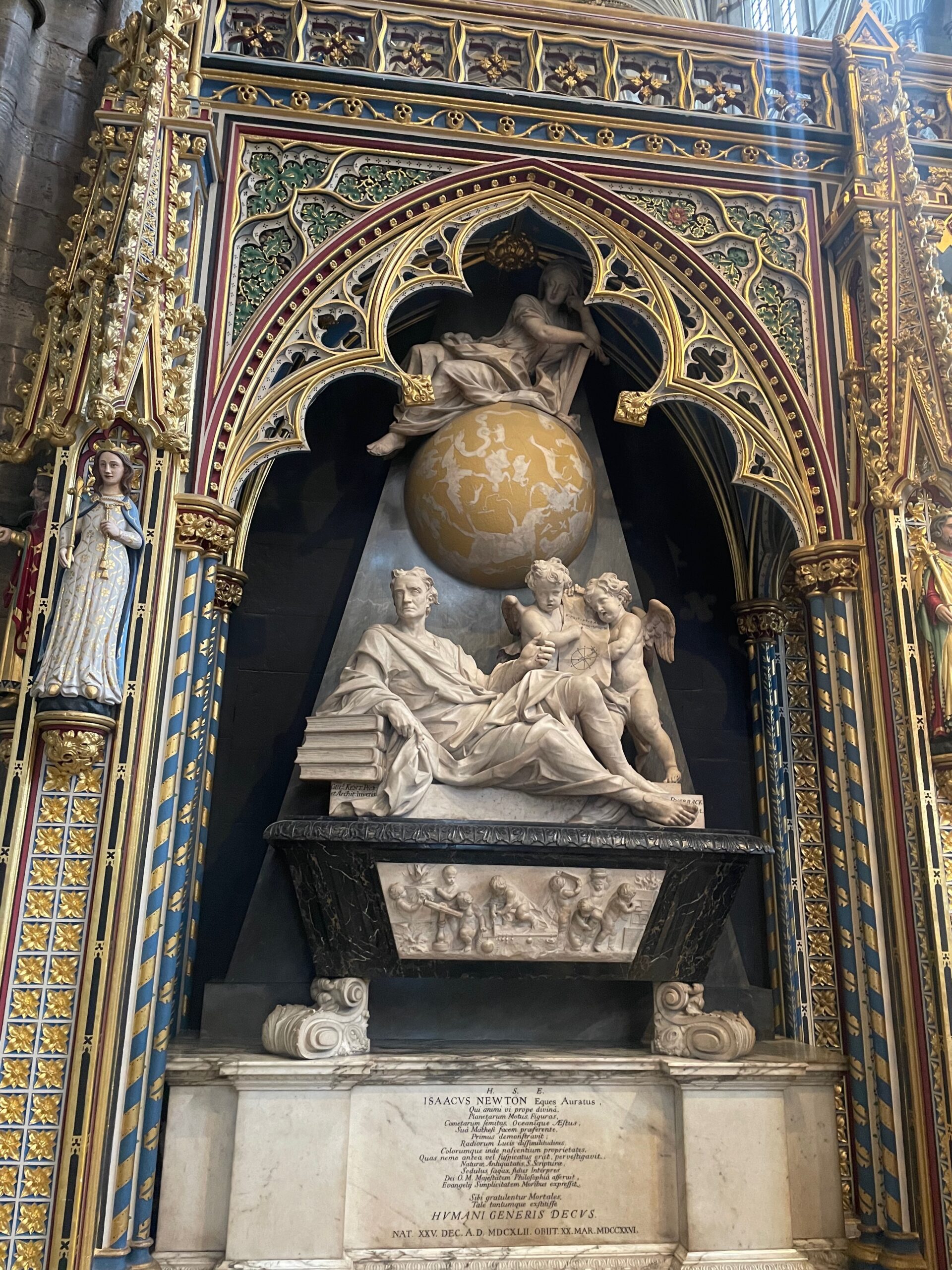
Hmmm….what even to say here to give Newton justice? Well, I’ll throw a few things out there and you all can do what you want in comments. Most of you probably more about his ideas and scientific advances than I do.
Born in 1642 in Woolsthorpe-by-Colsterworth (no name more English), Lincolnshire, England, Newton was lucky to live. He was premature. His father had also just died, so that didn’t help any kid. But the tiny baby managed to survive (it’s really amazing anyone survived back then; how many times would you be dead now if it wasn’t for modern medicine? At least once for me, I had appendicitis when I was 15) and his mother remarried. But she also abandoned him to her own father, a minister, who raised the boy. He never forgave her and hated his stepfather. He evidently threatened them with burning their house down with them inside, as he stated in a list of sins he wrote down. No reason not to believe that. Somehow I find this as interesting as all the science.
Ah, yes…the science. Well, Newton went to the King’s School at Grantham. But then his stepfather died. His mother forced him out of school so he could become a farmer and support her. She seems nice. He was not having it. His principal intervened and told her, you have got to be kidding me, do you know how smart your kid is? So he returned and was leader of the class, as you’d expect. Then it was Trinity College at Cambridge. And then everyone saw him as a genius, he got a position at Cambridge and he became Isaac Newton. What did he do again?
OK, well, there’s the Philosophiæ Naturalis Principia Mathematica, published in 1687, which merely was the first truly great understanding of physics, setting out his Laws of Motion, and creating the foundation of modern science. That seems impressive…..Then there’s the Law of Universal Gravitation, describing gravity and stating that any particle attracts any other article with a force proportional to the product of their masses and inversely proportional to the square of the distance between their centers of mass. Interestingly, Newton was so far ahead of the scientific world on this that no one really tested the theory until Henry Cavendish in 1798. It took all the way until Einstein’s theory of general relativity for someone to advance beyond Newton’s understanding of the issue.
Newton built the first reflecting telescope. While color theory goes back to the Greeks, Newton significantly advanced it by figuring out that white light is not in fact “white” but made from the spectrum of colors and color reflects different wavelengths. This he developed in 1672 in a paper. Every thing to do with color after that starts here. He continued to work on this and in 1704, published Opticks, which laid out his ideas and placed him on par with Kepler and Huygens in studies of light during the Scientific Revolution.
I am not a historian of science by any means, nor am I a historian of the 17th and 18th centuries. So while I know all of this stuff more or less in passing, it’s astounding to just read about Newton, either whenever I run across an essay in a journal or literary magazine, or when I have reason to do so for some quasi-professional reason like, say, a grave post. So a post like this is just a list of things that can’t even begin to explore his true impact. There’s the role he played in proving Kepler’s laws of planetary motion to be true, finally giving that scientist the respect he deserved, though long after the latter’s death. He explained the Magnus effect. He created calculus. He massively advanced the binomial system of algebra. He created what is today known as the Newton-Cotes formula for numerical integration. Well, he did the first part of it; Cotes is Roger Cotes, a contemporary and collaborator of Newton’s who also did necessary work to complete the idea. He formulated and then solved the first major problem in what today is called geometric probability. I mean, I don’t even understand most of this stuff, but his contributions are overwhelming in a short grave post like this. There’s his work on prisms, which centuries later became critical for the development of lasers and, unfortunately for the concept and their impact on culture, light sabers I suppose.
Newton was also in Parliament on two separate occasions, in 1689 and in 1701. He seems to have done nothing. He was a Whig at least. He was Warden of the Mint under King William III, starting in 1696, moving up to Master of the Mint in 1699. He did this for the rest of his life and undertook the recoining of the country. You know, in his free time. He was also obsessed with counterfeiters and spent tons of his time personally tracking them down. He was super rich, though lost a lot of his money in the South Sea Bubble of 1720.
Can we talk about Newton the person for a second? I think we should. Interesting guy. Totally driven, by all accounts. How could he not be? He had a rare care about animal treatment for the time. He refused to eat rabbit because they were killed by strangulation. He wouldn’t eat black pudding because it was made from blood, though that’s an aesthetic choice I’d think more than a moral one. I’ve been known to enjoy a bit of blood sausage in my time. He was not interested in women at all. He was just completely and totally obsessed by figuring out how the world’s mechanics worked. Unsurprisingly, he was skeptical about religion, though only up a point given the period. But he knew the Bible and other core religious texts, to the point that John Locke relied on Newton’s knowledge to help him with his own writings. He came to the conclusion that Christ was a man, not a God, and thus worshipping him was idolatry. But he couldn’t get past the idea of divine power as how the universe ultimately operated. I mean, even the Big Bang Theory can’t explain what went on before it or how it all started, so such a belief is still completely fair, in my opinion, even if it something I can’t really get behind. He also did tons of experiments in alchemy, which went exactly as far as they all went.
There’s so, so, so, much more to say and I am not smart enough to say most of it. So we will end there and leave it to comments.
Newton died in 1727, at the age of 84. His body laid in state in Westminster Abbey.
Isaac Newton is buried in Westminster Abbey, London, England. He was the first scientist honored with burial there.
If you would like this series to visit American scientists, you can donate to cover the required expenses here. Arthur Compton is in Wooster, Ohio and William Corlett is in Cleveland. Previous posts in this series are archived here and here.