
Erik Visits an American Grave, Part 2,201
 By
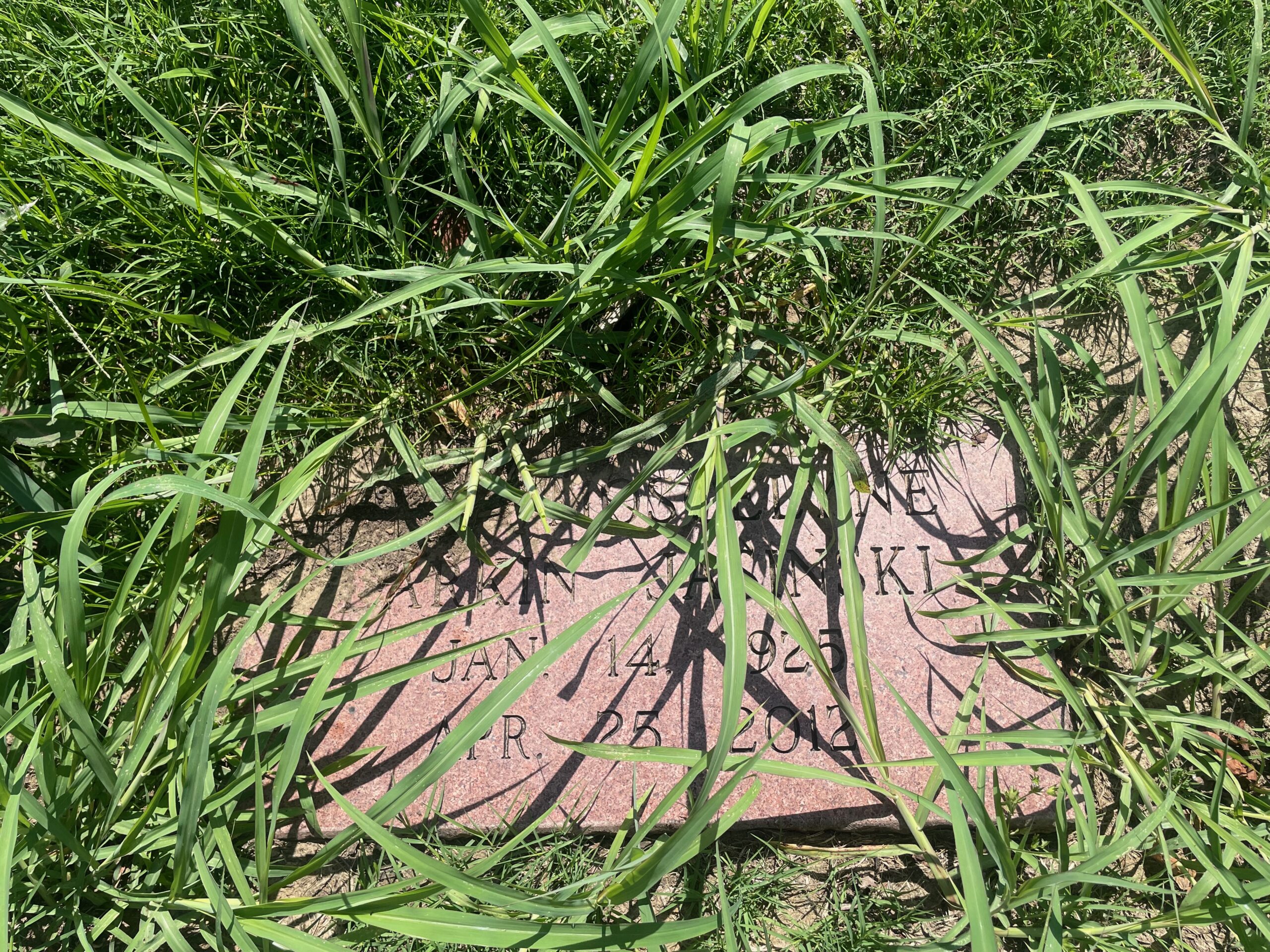
By This is the grave of Moscelyne Larkin, despite it being so overgrown you can’t really read it, a problem with the flat gravestones of the mid to late twentieth century unless the cemetery really makes a conscious effort to control the grass, which it can take more than just a good mow to handle.
Born in 1925 in Miami, Oklahoma, Larkin was half Native and half Russian. Her father was Eastern Shawnee and Peoria. Her mother was a ballet dancer. I’m not sure why the mother ended up in Oklahoma, but she did. She wanted her daughter to follow her into dance and she made it happen. She trained young Moscelyne at home for some years and then they had enough money and help presumably to get professional training in New York.
This was a moment for Native dancers from Oklahoma. There was a whole generation of ballet dancers from Oklahoma. The most famous was Maria Tallchief, but there was also Marjorie Tallchief, Yvonne Choteau, and Rosella Hightower. Collectively they became known as “The Five Moons.” Maria Tallchief has a claim to be the most influential ballet dancer in American history. This all isn’t exactly a coincidence but the through line for all of this proves a bit harder to figure out than I expected. The Tallchiefs were Osage who had struck it rich with oil rights (I assume all of you have seen Killers of the Flower Moon or at least read the book, though the latter pays too little attention to the Osage and too much to the FBI). Larkin had her mother and those connections. Hightower’s father got a good paying job on the railroad and that family had moved to Kansas City where her mother got her dance classes. Choteau’s father worked in oil, but she was really an Oklahoma City girl inspired when she was taken to see Alexander Danilova dance there when the former was a small girl. So the Five Moons seems to be somewhat coincidental.
In any case, it’s hard to overstate the importance of all five of these women and not only in the dance world. Midcentury America was not great for Native America. The Eisenhower administration was the worst for the Tribes in the entire 20th century, with Termination stripping rights and status and forcing people into cities where they had little ability to thrive. A generation of women dancers not only being famous in the U.S. but being famous globally as women, as dancers, and as Native Americans was enormously important in building pride and bringing positive attention to all the amazing things that indigenous Americans could do if they had a fair shake.
By 1941, the 15 year old Larkin was selected to be part of a touring ballerina group called Original Ballet Russe, which was established in 1931 by René Blum and Wassily de Basil. This was a big touring company. Hard work for dancers, but it also paid them to do what they loved and to see the world. Long way from small town Oklahoma here. Larkin was on it for most of its final years, before it closed in 1947. While in Europe, she met another dancer, a man named Roman Jasinksi, from Poland. They married in South America in 1943. They had a son in 1954 and both more or less retired to Tulsa, where they opened a dance school. Interesting that she wanted to go back to Oklahoma after seeing the world, but then Oklahoma was Native country. And in fact, the Tulsa Ballet is one of the top ballet schools in the country to this day. This means a lot of parents have to spend time in Tulsa for reasons that befuddle them (in fact, a friend of mine was just in that town for his kid and wondering what had led his life in the direction of summer in Oklahoma).
As Larkin and her fellow Native dancers aged, new generations of artists started to honor them. For example, in 1967, Louis Ballard, a Quapaw and Cherokee man who is considered the first important classical music composer of Native American heritage, wrote a piece called The Four Moons, for the Five Moons. He evidently combined the two Tallchief sisters here. But they performed in it.
As she aged, and Larkin lived a very long life, she was honored repeatedly in her home state. She was painted by Mike Larsen for a mural called Flight of Spirit that hangs in the Oklahoma state capitol building. She was inducted into the Oklahoma Hall of Fame in 1978 and received a major award from Dance Magazine in 1988. She spent her later years deeply involved in working to include dance in Oklahoma public schools and anything positive in that rotted out system is rare indeed, though more so since Larkin died. That death took place in 2012. She was 87 years old.
We can watch a bit of Larkin’s work:
Moscelyne Larkin is buried in Memorial Park Cemetery, Tulsa, Oklahoma.
If you would like this series to visit other American dancers, you can donate to cover the required expenses here. Josephine Baker is in Monaco, if you have some Euros laying around for me to take and then waste at the roulette tables. Maria Tallchief is in Fairfax, Oklahoma and Alvin Ailey is in Whittier, California. Previous posts in this series are archived here and here.