
Erik Visits an American Grave, Part 2,199
 By
By This is the grave of Peter J. Maguire.
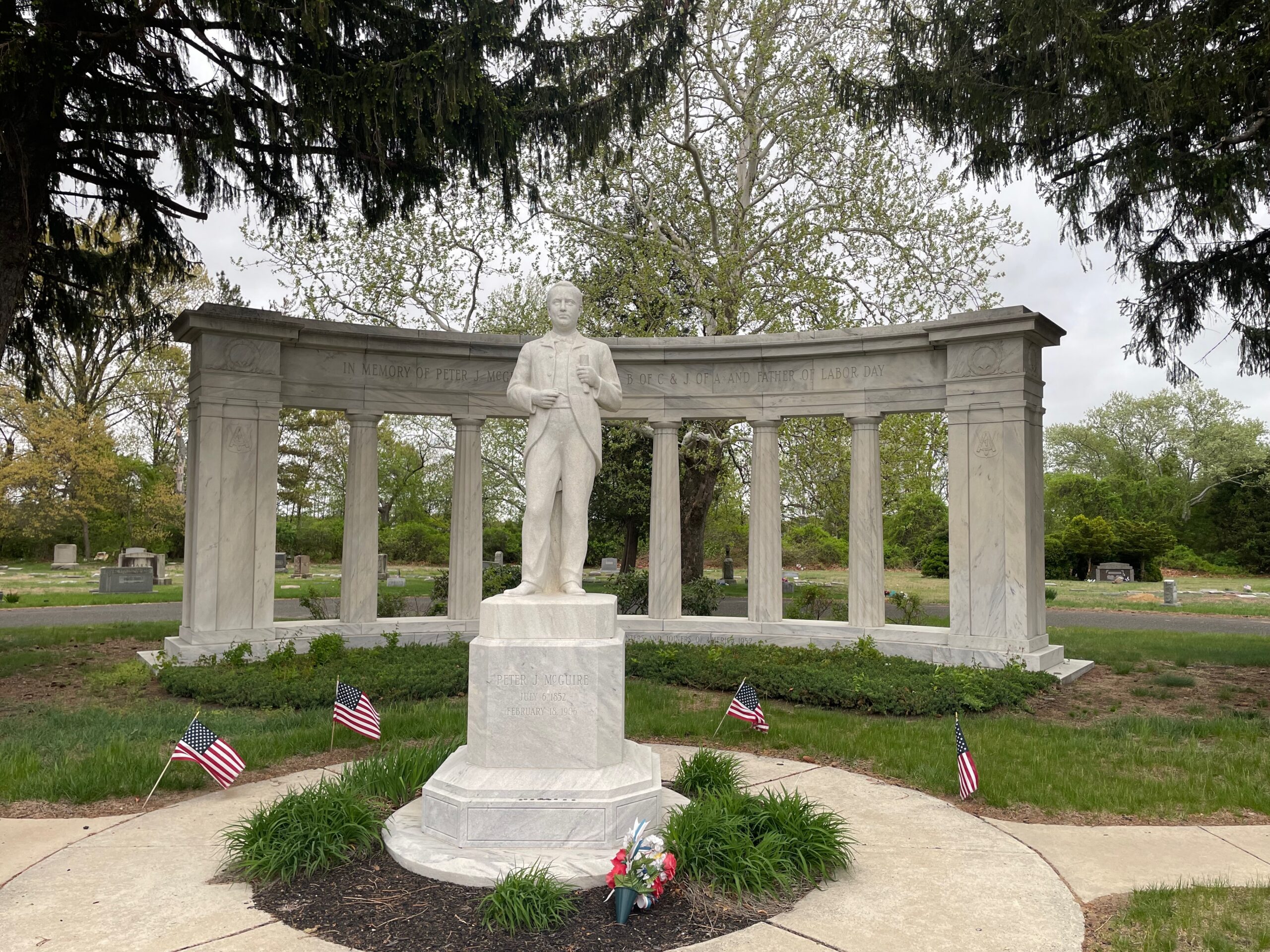
Born in 1852 in New York, Peter Maguire grew up very poor, in an Irish Catholic family that had immigrated to the U.S. like so many during the potato famine and the general terrible economic conditions of the isle. He had a little schooling, but by the time he was 15, was apprenticed to a piano maker. But he also attended a lot of lectures at Cooper Union and was interested in the intellectual world of his time.
From the time he was young, Maguire was interested in the fight for worker justice. He was no real radical, but in the 1870s, any challenge to the developing system of free market capitalism was seen as revolution by the forces of order. The Panic of 1873 was a terrible time for American workers. Its impact was somewhat localized, but in some cities, unemployment rose well into double digits. New York was one of those places. People in the burgeoning labor movement had an idea–the city should employ us until we can get private sector jobs again. Pretty radical! Well, the media and politicians sure thought so. Saying that this new movement was the Paris Commune come to American shores, in early 1874, when these workers started gathered in Tompkins Square Park to march to the mayor’s office for these demands, the cops on horseback beat the ever living shit out of them, to the cheers of the nation’s growing very conservative establishment, many of whom had been strong abolitionists and were at that time still supported a vigorous Reconstruction. Among those workers beaten that day was young Peter Maguire. He became a committed labor activist for his experience in what became known as the Tompkins Square Riot.
Shortly after this, Maguire started working with Adolph Strasser to form the Social-Democratic Workingmen’s Party of North America, in 1874. Strasser was the long-term cigar workers leader. This all came out of the German socialists who had moved to the United States in the aftermath of 1848 and other revolutionary movements that failed. The U.S. was a place these people could go and organize in peace and if they rarely threatened the economic domination of capitalism here, it wasn’t for lack of trying, though their imagination did begin to get a bit restricted by the 1870s. Later, this would become the Socialist Labor Party.
For the next decade, Maguire was more interested in political organizing than labor organizing. He became a Greenbacker and moved to St. Louis. It was there that he started supporting himself as a carpenter. That brought him to unionism. With the decline of the Greenback-Labor Party, he moved into the Knights of Labor. The boundaries of these somewhat half-thought out movements were constantly shifting in the 1870s and 1880s anyway and lots of reformer types moved through many of them as they tried to figure out what was wrong with America. He was involved in getting the state of Missouri to establish a Bureau of Labor Statistics that was a precursor to the federal version. He began to believe that the labor movement needed a federation of trade unions.
The Knights were not really for Maguire–the one giant union thing seemed unworkable to him. So he was part of the Federation of Organized Trades and Labor Unions, which was founded in 1881. This was the idea of skilled laborers coming together as men (very gendered here) and voluntarily (very important here too) engage with other unions in federation to work together, when possible, which in truth was not often that frequently, certainly not enough for consistent and sustained action. Here, he was working with rising cigarmaker named Samuel Gompers. Together, they would form the American Federation of Labor in 1886. They would promote what they called “pure and simple unionism,” by which they meant wages, hours, and working conditions, as the core of the American labor movement. This meant nonpartisan politics and avoiding any talk of radicalism, socialism, or larger political change. It put sharp limits on what it meant to be an unionist in America. But in the aggressively capitalist nature of the United States, it also had more long-lasting success than these more political organizations.
Maguire also became the founder what would become one of the nation’s oldest and largest unions, the United Brotherhood of Carpenters, in 1881. This was his vision to dominate this complicated field that had a lot of different unions. It took quite awhile before he could take control over those other unions, but he did. He was the dominant figure of the Carpenters for twenty years and one of the most important unionists period in the late 19th century. He was less dictatorial than some other labor leaders and he knew there was jealousy from some of these other organizations, so he allowed them some autonomy when they joined the UBC.
Maguire was also central to the creation of Labor Day. The impetus behind this was the Arthur administration’s refusal to enforce the limited 8-hour day for federal workers that Congress had passed in 1868. This reinforced the beliefs of men such as Maguire and Gompers that the labor movement could never trust the government to do anything and had to rely on their own manly resistance, working together. Maguire stated, “We want an enactment by the workingmen themselves that on a given day eight hours shall constitute a day’s work, and they ought to enforce it themselves.” He actually suggested May 1, 1884 as the Labor Day and that May 1 day did in fact later become the international workers’ holiday, but that came about in recognition of the Haymarket victims after some idiot anarchist threw that bomb on May 1, 1886, which Maguire and Gompers abhorred. So the idea for a Labor Day continued to percolate and Oregon made the first Monday in September a day off in 1887. That became a federal law in 1894, when Grover Cleveland signed such a bill to siphon off a bit of the hatred he had received from organized labor over using the Army to bust the Pullman strike.
While Maguire basically paid for the Carpenters to exist for much of his time, he also started taking money and the records showed that he was taking dues for himself. He was arrested for embezzlement in 1901 and kicked out of union leadership at the 1902 convention. It’s not entirely clear how true these embezzlement charges were. It may have just been bad bookkeeping that his enemies took advantage of and he was never convicted. He was also a heavy drinker by this time–what workingman wasn’t really–and I am sure getting in legal trouble and evicted from the movement he loved didn’t help. So he drank himself to death in 1906. He was 53 years old.
Peter J. Maguire is buried in Arlington Cemetery, Pennsauken, New Jersey.
If you would like this series to visit other late 19th century labor leaders, you can donate to cover the required expenses here. John Jarrett, president of the Iron and Steel Workers, is in Pittsburgh. Josiah Dyer, general secretary of the Granite Cutters, is in Concord, New Hampshire. Previous posts in this series are archived here and here.