
A Kavalcade of Kavanaugh stops
 By
By 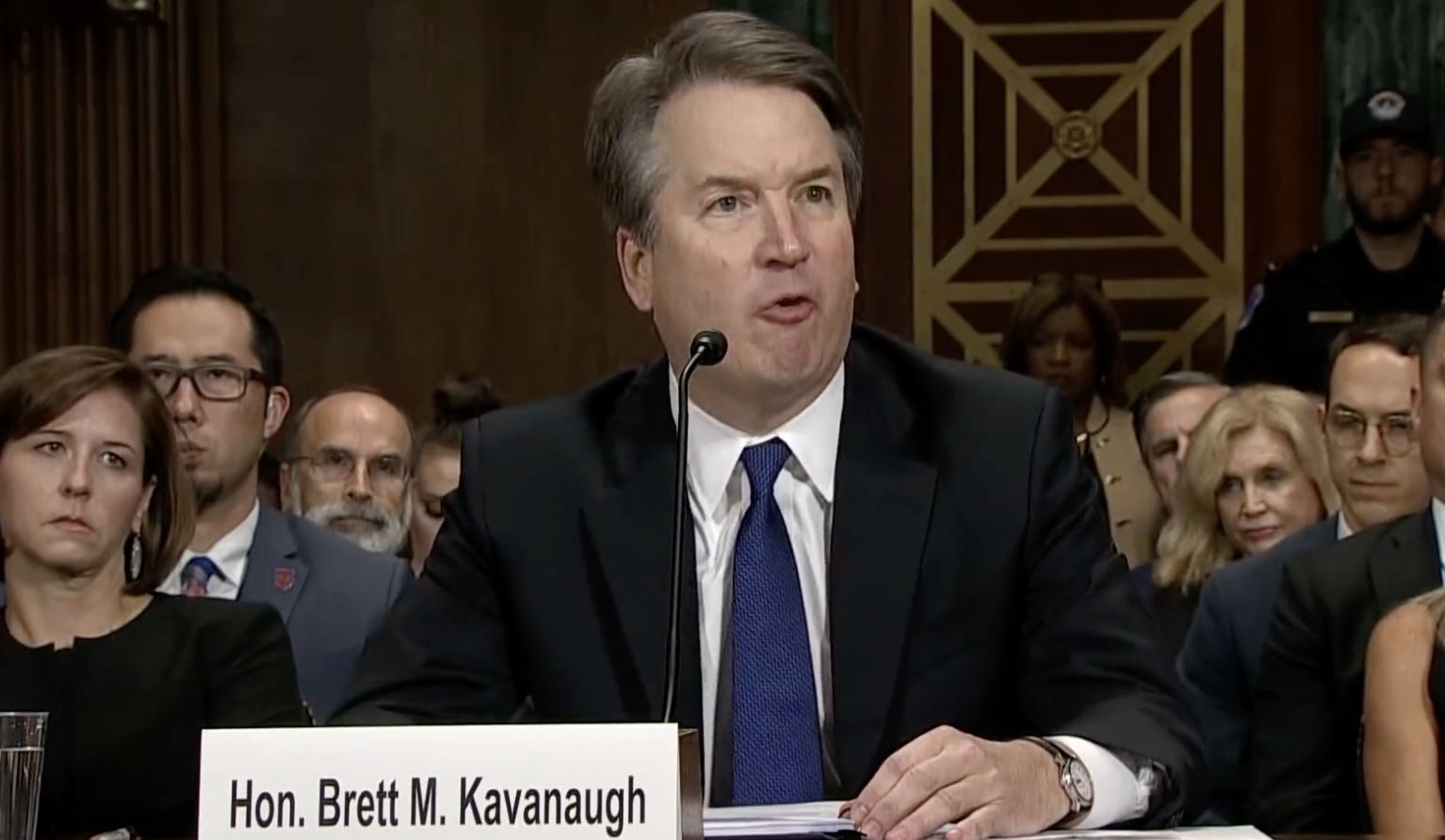
ICE took the road map to racial profiling Brett Kavanaugh handed them and run as hard with it as you’d expect [gift link]:
Since immigration agents began carrying out a string of big, aggressive sweeps last year, civil rights groups have argued that the Trump administration’s mass deportation campaign has been defined by brazen racial profiling.
Now, body-camera footage, text messages and other documents emerging from lawsuits around the country reveal how race and ethnicity have figured in the dragnets that unfolded in Los Angeles, Chicago, Minneapolis and other U.S. cities.
In several instances documented in court filings, federal agents referred to targets as “tonks” — a derogatory term typically used to refer to Mexican immigrants and intended to echo the sound of agents’ flashlights striking their heads. Migrants suspected of being undocumented were described as “wet,” shorthand for the slur wetback. And an agent who led an operation in Southern California later described the appearance of individuals he considered suspicious: “older Hispanic males.”
Yet even as evidence of racial profiling has come to light, what seemed like settled law — that law enforcement officers could not question or detain someone solely based on their race or ethnicity — has turned out to be far more of an open question when it comes to immigration enforcement.
Last year, the Supreme Court took a step toward upending a half-century of jurisprudence when Justice Brett Kavanaugh gave a provisional blessing to such racial profiling by agents seeking out undocumented immigrants. The government has maintained that their operations are constitutional.
The lawsuit that led to the court’s temporary decision and other similar suits are still working their way through lower courts, and it could be months before they are resolved and years before the Supreme Court has a chance to say more.
In the meantime, civil rights lawyers are continuing to amass what they hope will be a valuable trove of evidence that racial profiling by immigration agents is prevalent — and that it is unconstitutional in the manner that it is being carried out today.
In 1975, the Supreme Court cleared the way for some degree of racial profiling in immigration enforcement when the justices allowed race and ethnicity to be one of the factors — but not the only one — used by agents deciding when to stop a car on suspicion that the occupants include undocumented immigrants.
Jennifer M. Chacón, a Stanford law professor who studies immigration law, said the current wave of cases — and the Supreme Court’s recent order — engages with the question of whether the 1975 decision, in U.S. v. Brignoni-Ponce, still holds.
“Is this still good law, and even if it is, when does agency behavior cross the line of what is permitted?” Professor Chacón said.
The latest batch of depositions, videos and surveillance records in Los Angeles, first reported by CalMatters and The Los Angeles Times, show that immigration agents and officers were focused on finding “day laborers.” But civil rights groups argue that their vague and varying explanations for whom they were looking for often defaulted to anyone who looked Latino, had darker skin or spoke English with an accent. That reliance on perceived race and ethnicity, they argued, also ended up unlawfully sweeping up U.S. citizens.
In one sworn declaration, a driver in a traffic stop in San Bernardino, Calif., said an officer told him he had been pulled over “because he looked like a ‘paisa,’” a slang term for a Mexican compatriot or newly arrived immigrant.
In another declaration, Angel Santiago Tafolla, a U.S. citizen in Anaheim, Calif., said that agents chased him — a dark-skinned Latino man — while ignoring his light-skinned co-workers at the Orange County carwash. One agent discharged a Taser, arcing electricity in front of Mr. Tafolla, whose clothes were wet from his work. He was handcuffed and loaded into a van, according to the document.
The original sin here is Powell’s opinion for the Court in Brignoni-Price — as Douglas said in his concurrence, it was essentially inevitable that allowing race to be used as a factor would allow it to be used as the dominant if not sole factor, with it being trivially easy to come up with another ostensibly race-neutral factor as a pretext:
…by specifying factors to be considered without attempting to explain what combination is necessary to satisfy the test, the Court may actually induce the police to push its language beyond intended limits and to advance as a justification any of the enumerated factors even where its probative significance is negligible.
Exactly what Kavanaugh approved, and for all intents in purposes the reasoning in Brignoni-Price has swallowed the holding.