
The congressional gerontocracy
 By
By 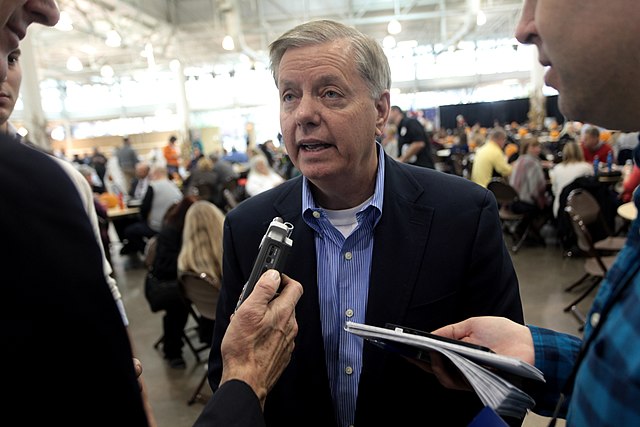
As a follow-up to Paul’s earlier post, more on the advancing age of Congress:
For more than a month since Senator Mitch McConnell, Republican of Kentucky, entered the hospital, Washington has been on something of a death watch for the frail 84-year-old former leader, who has provided no information about his condition.
So the news of the sudden death on Saturday night of another lawmaker more than a decade younger, Senator Lindsey Graham, Republican of South Carolina, came as a particular shock to his colleagues. Many of them are around the same age as Mr. Graham, who died two days after his 71st birthday, and did not think of his age or health as an issue.
Together, Mr. McConnell’s lengthy hospitalization and the unexpected passing of Mr. Graham offered the latest reminders that the Senate is run by a geriatric class of lawmakers — some old, and some very old — many of whom hang on to their positions of power long past their primes, and long after the age when most Americans have retired.
Mr. Graham was energetic, omnipresent and in the midst of a re-election campaign that he had been expected to win handily for another six-year term. His age was barely remarked upon in the Senate, an institution that is sometimes only half-jokingly referred to as the world’s most prestigious nursing home.
There, the average age is just under 66, and more than one-third of members are Mr. Graham’s age or older, according to a New York Times analysis of data from the @unitedstates project.
[…]
Even as remembrances poured in, so did calls for change to what many people view as a broken system that is making government more dysfunctional.
“The constant deaths in office we’ve seen over the last few years aren’t shocking when you have a gerontocracy where too many elected officials would rather die at their desks than let anyone new fix people’s problems,” said Rohan Patel, the executive director of Majority Democrats, a political action committee that backs the next generation of Democrats and soon plans to roll out a campaign targeting older lawmakers.
Mr. Patel added: “If you haven’t worried about child care in 50 years, applied for a job in 40 or bought a house in 30, you cannot understand the problems Americans are facing today, and the rest of us are paying the price.”
Even as the two oldest presidents in history, former President Joseph R. Biden, Jr. and President Trump, have in recent years pushed the issue of aging in office into the forefront of voters’ minds and the political conversation, this Congress is the oldest in modern history.
Of the 530 voting members of the House and Senate, 131 of them — nearly a quarter — are 70 or older.
The other relevant context is that we’re in a period of very close party competition in which margins in Congress are very narrow and bipartisan lawmaking relatively rare, making unexpected deaths even more potentially consequential.
As I pointed out in 2024, there is a disconnect in which increased concern about the aging of our political class has not actually been reflected in the revealed preferences of primary voters, who continued to support old candidates even when viable younger candidates were available and in a time when the power of incumbency was declining. An interesting question is whether the regrettable end of the Biden presidency combined with the rolling disaster of Trump 2.0 will change the calculus of voters. The total failure of Janet Mills to get any traction against a candidate covered in red flags may just be a one-off aberration, but I wonder if something may actually be changing.