
Erik Visits an American Grave, Part 2,189
 By
By This is the grave of George Ross.
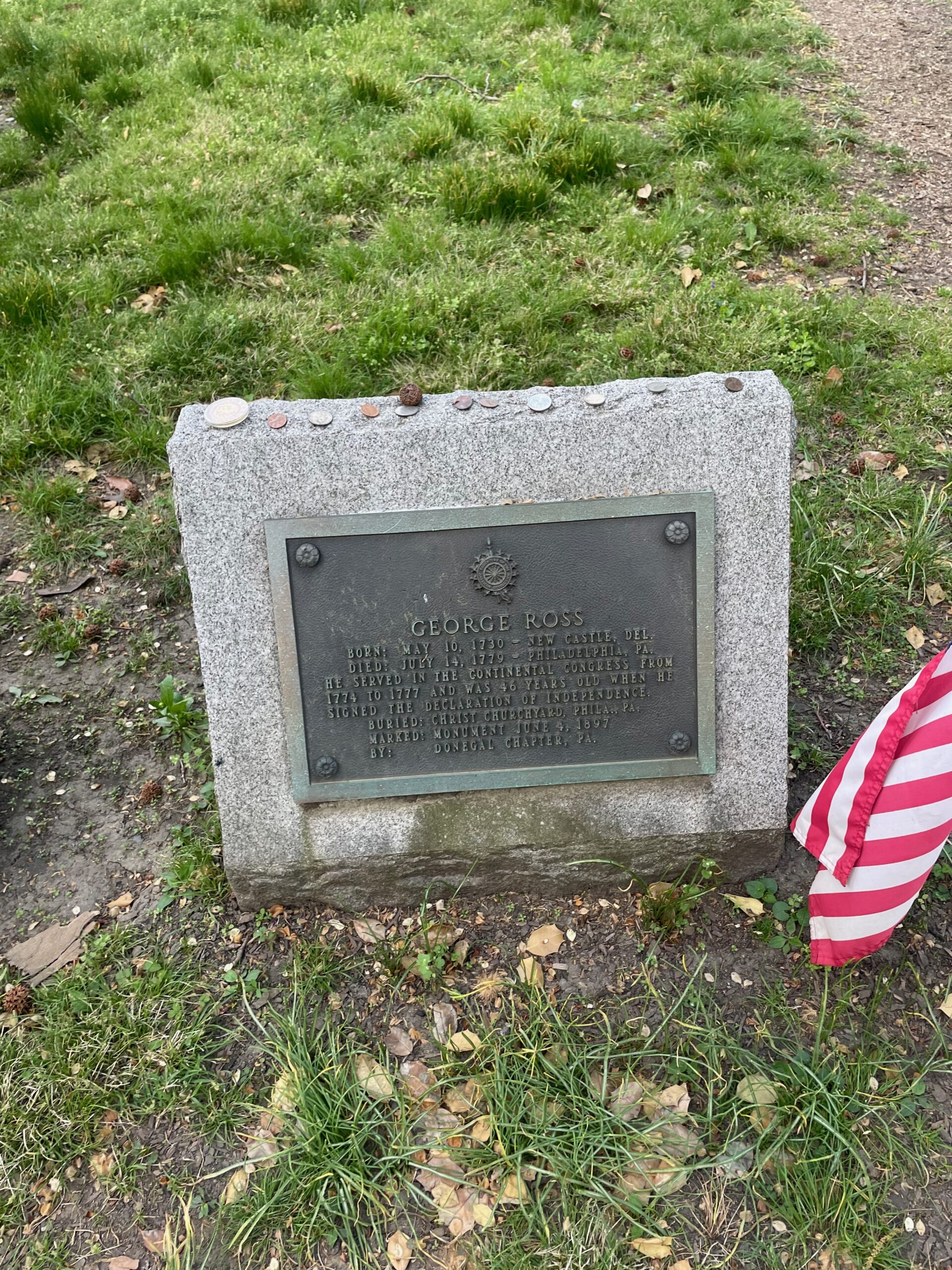
Born in 1730 in New Castle, Delaware, Ross was pretty well off, the son of a prominent minister. There weren’t a lot of schools, even for a smart kid, so mostly he was taught privately at home. His older brother had moved to Philadelphia, as any person ever from Delaware has always done if they wanted to do anything with their lives (except for Joe Biden, who did not grow up there) as a lawyer. So Ross moved there and read with his brother and was admitted to the bar in 1751. He moved to Lancaster to start his own practice.
As Philadelphia became one of the centers of resistance to reasonable British taxation on the colonies to pay for wars the colonists loved to start with the tribes and the French, Ross became a big supporter of the Patriots. But it took a lot of time. He was initially a quite vocal Tory. He was a Crown prosecutor beginning in 1768 and that helped shape those beliefs. But he became to see the cause of the Patriots as just. That same year he was elected to the colonial legislature and interacted more with people opposed to this taxation. So by 1774, he was happy to stand for the First Continental Congress and he was elected again in 1776 and 1777. When the Revolution started, he gladly joined and was commissioned as a colonel.
The only reason we have heard of Ross today is that he signed the Declaration of Independence. There were 56 men who signed that document. Unsurprisingly, if because of location if nothing else, Pennsylvania led the list of signatories with 9. Ross was one of them. While a few of them are among the most famous Americans to ever live, including the men tasked with drafting the document, the large majority of these guys are totally forgotten today. That very much includes Ross, one of the most obscure signers of the document.
The reason Ross remains so obscure–or at least the most proximate reason–is that he just didn’t live very long. It’s also worth remembering how close death’s door was for folks back then, even those with money. Part of the reason that we do remember John Adams and Thomas Jefferson and Benjamin Franklin is that they lived forever, especially for those times. Even George Washington’s death at 67 made him a pretty old guy for that era. James Madison, John Jay, these were men with very long lives. Alexander Hamilton’s death is obviously a different deal. But you could be a healthy leader of your colony one day and the next you were in the ground.
That’s the case with quite a few of the Declaration’s signers. Ross was really committed to the cause. He was a colonel after all, not just some merchant who supported the Revolutionary War for his own pecuniary interests, not that there was per se anything wrong with that. But he had the opportunity to be a more prominent leader than is remembered today. He was reelected to the Continental Congress in 1777. But he started to get sick. Gout seems to have been the issue. He resigned from the Congress shortly after that election. He got an appointment to the Pennsylvania Court of Admiralty instead. He was able to work some and issued a decision that centralized courts from Congress could not overrule a state court in a lawsuit between two men from different states. That decision was overruled by a court of appeals from Congress, but it really centered the question of the states versus the federal government that would be a major issue in the years ahead.
Incidentally, Betsy Ross was the wife of George’s nephew John.
Still, Ross could not stay healthy and he died in 1779. He was 49 years old. Probably it was the gout, which has to be really bad to kill you, though having had two pretty damned severe cases in my life, wanting to die might be part of it. I guess at that stage, where you have untreated gout for a very long time and repeated horrible cases of it, it can cause heart and kidney disease, as well as sepsis in extreme cases. So presumably it was one or more of these underlying issues. And let’s face it, early Americans drank a lot (like a truly insane amount, it’s shocking to read about and the quality of the water was only one small factor) and ate a ton of red meat. It was not a healthy country. MAHA baby! Seriously though, if severe gout ain’t going to make you change your lifestyle, I don’t know what will.
George Ross is buried in Christ Church Burial Ground, Philadelphia, Pennsylvania.
If you would like this series to visit other signers of the Declaration, you can donate to cover the required expenses here. William Paca is buried in Queen Anne’s County, Maryland and Matthew Thornton is in Merrimack, New Hampshire. Previous posts in this series are archived here and here.