
Erik Visits a (Latin) American Grave, Part 2,181
 By
By This is the grave of Jose Tomas Ovalle.
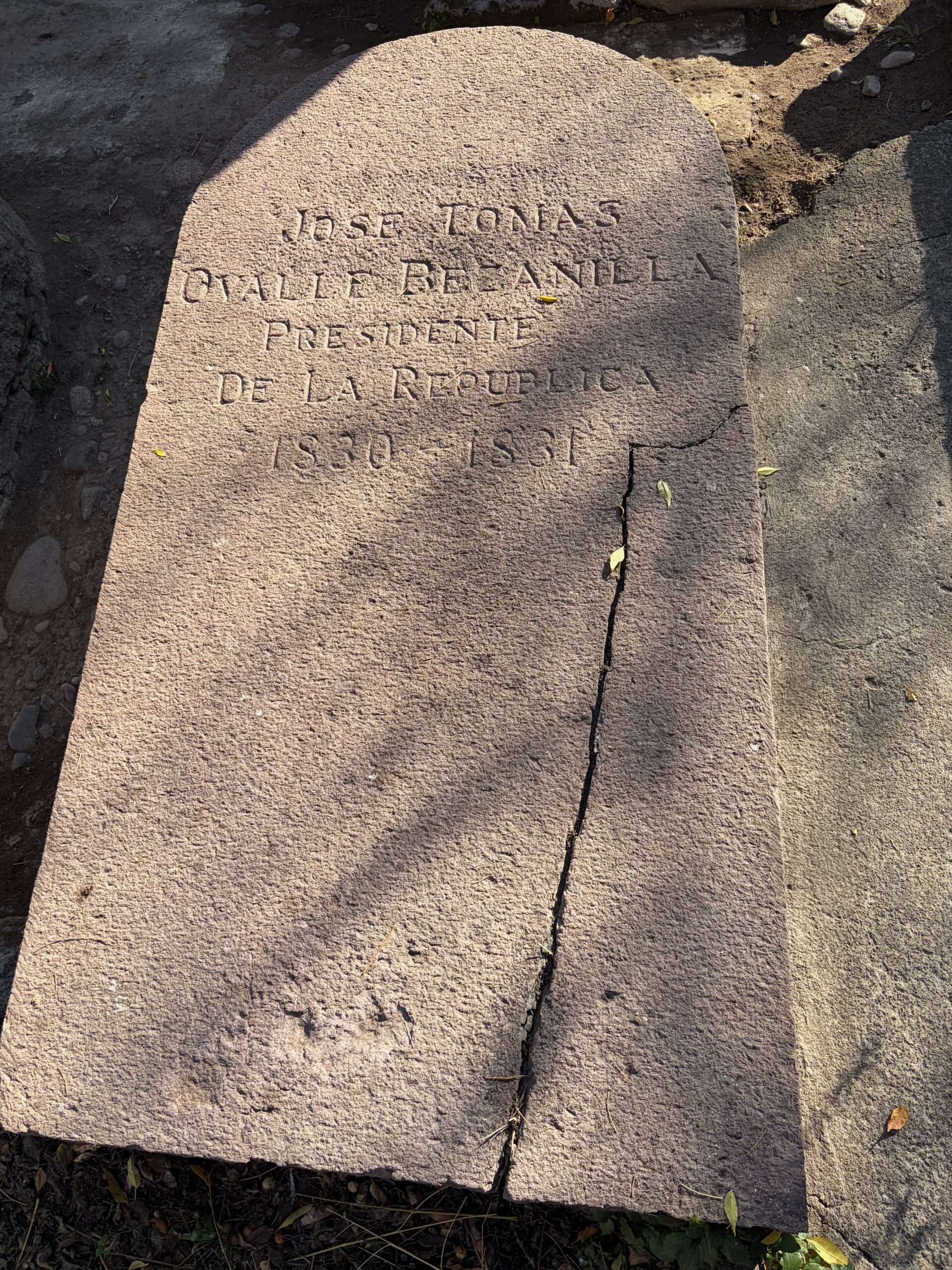
Born in 1787 in Santiago, Chile, Ovalle grew up rich. He went to law school at the Universidad de San Felipe, which is today the Universidad de Chile, the most important school in the country. He got his doctorate of laws there in 1809. This was just before the revolutions against Spain. Ovalle wasn’t super involved at first it seems. He was a young guy practicing law after all. Then in 1823, he was elected as a deputy to the national legislature from Santiago.
In 1829, civil war broke out in Chile, as they were throughout South America. This is going to be a theme for awhile in this series, the endless 19th century civil wars in Argentina and Chile. Basically, the contours were that conservatives wanted a centralized orderly government with them in control. Liberals were more interested in the system that had developed in the United States, one of federalism that kept those in the provinces basically governing themselves, but with them firmly in control too. The conservatives overwhelmingly won this battle in Chile and by and large, because they managed to hold onto power, the nation was less unstable than Argentina.
In this whole thing, Ovalle was a neutral figure. He was more or less trusted by everyone. He was a guy you could bring in at a tricky time and know you were going to get a basic level of competence, or at least he wasn’t going to try to centralize power in himself like everyone else wanted to do. So that year, after the conservatives defeated the liberals at the Battle of Ochagavia, they came to a deal with liberal leader Francisco de la Lastra. Well, he wasn’t totally the political leader of the liberals, he was the defeated liberal army general and the actual liberal political leader Ramon Freire was totally cut out of the deal. Anyway….they needed a guy everyone could live with to run the government for a short time. Ovalle was that guy. No one hated him. What more could you ask for in South America in the decades after the revolutions? It seemed that his reputation was good, honest, not that bright, and easily influenced. So of course that was going to be the guy you wanted in power. Everyone also thought they could control him.
Ovalle only ruled for a few months in 1829 and 1830 and then Francisco Ruiz-Tagle took over as provisional president. But Ruiz-Tagle lasted all of six weeks. People did hate him and that included his own ministers. Claiming health problems, he resigned at the end of March 1830 and Ovalle, who had become vice-president, took back over for a second stint in running this disaster of a country. Now, Ovalle didn’t have a problem with this. He was happy to have power. But there was one problem–his advanced tuberculosis. And in fact, it was really advanced. Less than a year into being president again, he had to take a leave of absence that he never recovered from. He died a few weeks later, at the age of 43. A very 19th century story.
Jose Tomas Ovalle is buried in Santiago General Cemetery, Santiago, Chile. Or maybe he is. He was first buried the cathedral in the center of Santiago and this stone was put in the cemetery. Then they were lost during renovations. They were found again in 2004. I’m not completely sure if they were just placed back in the cathedral or are under this stone. Whatever, who really knows what if anything is under any stone?
If you would like this series to visit 1830s politicians in the United States, you can donate to cover the required expenses here. James Watson Webb is in The Bronx and Willie Magnum is in Bahama, North Carolina. Previous posts in this series are archived here and here.