
Kalling out Kavanaugh
 By
By 
I can’t recall a sitting Supreme Court justice calling out a colleague this directly before, which needless to say I mean as a compliment:
Justice Sonia Sotomayor criticized a fellow member of the US Supreme Court for failing to grasp the real-world effects of an unsigned order last year that allowed immigration enforcement sweeps in Los Angeles to resume.
“I had a colleague in that case who wrote, you know, these are only temporary stops,” Sotomayor said, referencing a concurrence written by Justice Brett Kavanaugh, during an event Tuesday hosted by the University of Kansas School of Law. “This is from a man whose parents were professionals. And probably doesn’t really know any person who works by the hour.”
In a Sept. 8 emergency order issued without any majority rationale, the justices paused lower court rulings temporarily barring immigration agents from targeting people based solely on their language, occupation, race, or presence at locations such as car washes or bus stops.
In a concurrence, Kavanaugh asserted that legal residents’ encounters with immigration agents are “typically brief,” and impacted individuals “promptly go free.”
Immigration lawyers said that’s at odds with the experiences of clients who have been tackled or detained by federal officers. Progressives have nicknamed such encounters “Kavanaugh stops.”
Although Sotomayor didn’t name Kavanaugh during her remarks Tuesday, she suggested that the financial consequences of even short detentions can be significant, particularly for hourly workers.
“Those hours that they took you away, nobody’s paying that person,” she said. “And that makes a difference between a meal for him and his kids that night and maybe just cold supper.”
During the Lawrence, Kansas event Tuesday, Sotomayor addressed questions about the responsibility she feels as the first Latina to serve on the Supreme Court and what motivated her sharply worded dissent in the case decided last summer.
“Life experiences teach you to think more broadly and to see things others may not,” Sotomayor said. “And when I have a moment where I can express that on behalf of people who have no other voice, then I’m being given a very rare privilege.”
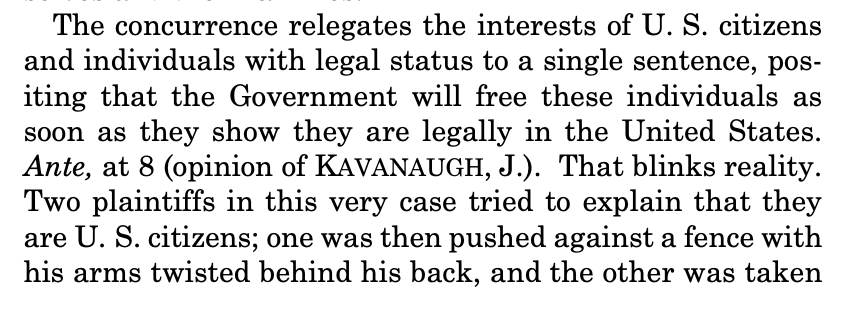
The 71-year-old justice, who was elevated to the court in 2009 by President Barack Obama, has long been known for her dissents. In her September dissent in the immigration stops case, Sotomayor said Kavanaugh’s concurrence, “relegates the interests of U.S. citizens and individuals with legal status to a single sentence, positing that the Government will free these individuals as soon as they show they are legally in the United States.”
“That blinks reality,” Sotomayor wrote.
Sotomayor said Tuesday she wrote her dissent “not as a Latina who’s insulted,” but to try to convince Kavanaugh he was upending decades of court precedent.
“I was not talking as a Latino justice,” she said. “I was talking about a justice who respects precedent. And I was explaining why that precedent is being violated.”
And this is the key point about the shadow docket order that rationalized Kavanaugh Stops. It’s not just that he made a bad prediction about what would happen when citizens were the targets of racial profiling, he was ignoring clear evidence about what was already happening, including the facts of the case under review. As Sotomayor said in her dissent:

He should never hear the end of this.