
Erik Visits an American Grave, Part 2,128
 By
By This is the grave of Charles Marlatt.
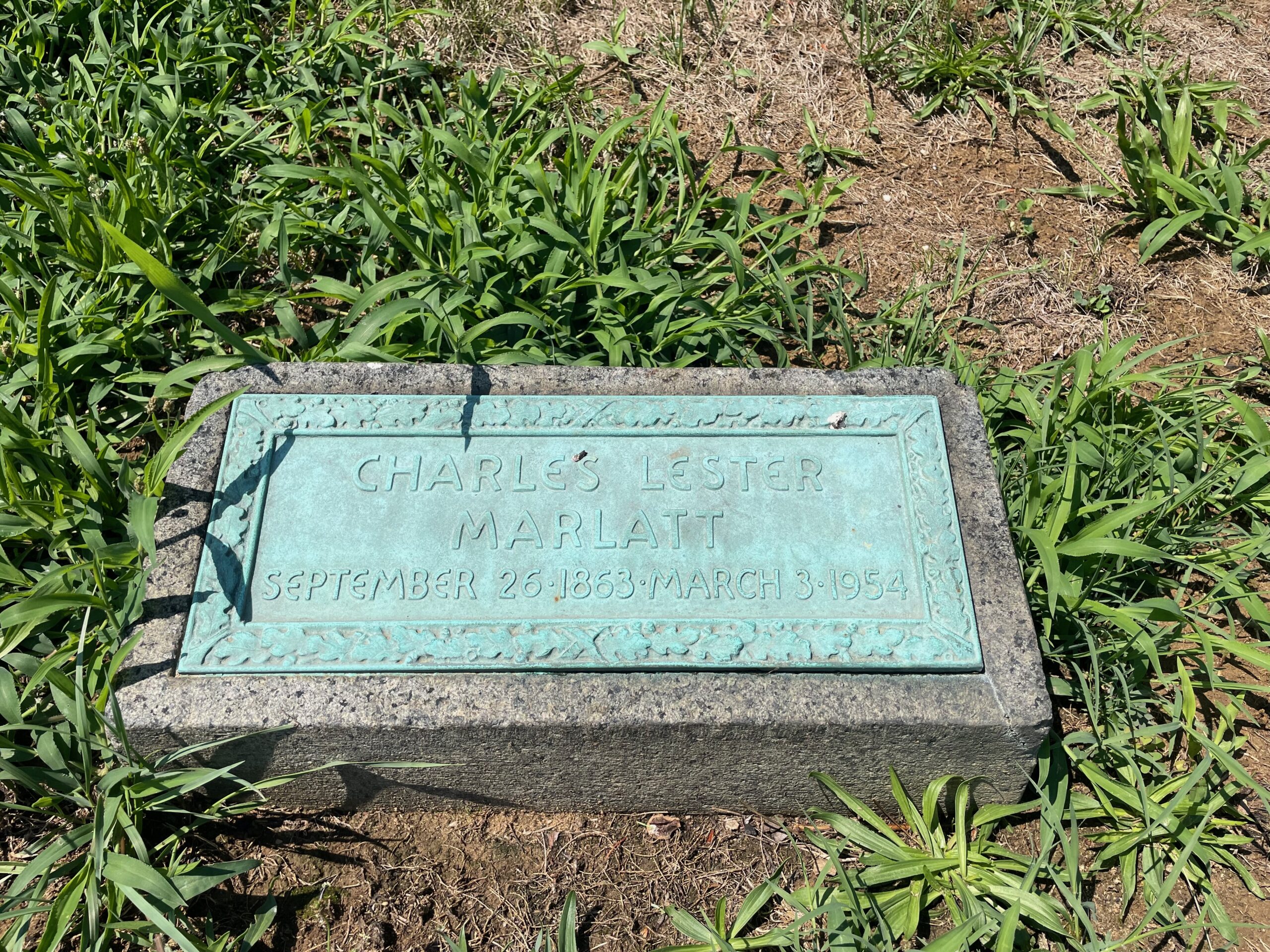
Born in 1863 in Atchison, Kansas, Marlatt went to what became Kansas State University, the land grant school for that state. He went into agriculture, got a job at the University of Kansas, stayed a couple of years, and then got hired by the U.S. Bureau of Entomology in the Department of Agriculture, right as it was created in 1894. It stayed open for 40 years before it was merged into other things, but its job was to work on the intersection of insects and farming, which is of course a tremendously important topic, though often done without really thinking through the consequences.
Marlatt became perhaps the premier entomologist in the United States over his life. One of the biggest things to do at this time in this field was to introduce non-native species to counter other non-native species, a sequence whose logic led to one of my favorite bits ever from the Simpsons. So there was a bug called the San Jose scale, because it was discovered near there, in California. But it was from China and was introduced thanks to the globalization of the shipping industry that continues to bring non-native species to the Americas especially that absolutely destroy plant life. A guy brought it over on some trees in about 1870 and it spread across the country by the end of the century. It’s not unnatural I suppose to think, well, maybe we should also introduce something that eats this scale. This was the red-spotted lady beetle, which is actually from Italy, but which eats scales. Marlatt decided in 1902 to bring it over to the U.S. in order to eat the scale. I am not sure the extent to which this worked, but the scale is definitely still around in the U.S. today. In fact, said decision was based on his honeymoon. He got married in 1901 and what better honeymoon than a trip to China and Japan to look for insects. Of course he had to be pretty rich to make that work. In any case, his wife got sick on that trip and died shortly after. But at least he got his scale studies in.
Despite this, Marlatt was one of the early advocates to actually care about stopping pests from entering the country, which most of the agricultural world thought was a minor point at best at the turn of the twentieth century. He considered the importation of plants to be very dangerous because of what they carried with them, whereas most people just saw a useful plant and didn’t consider secondary questions. The growth of the exotic fruit market, increasingly possible thanks to refrigeration technologies in shipping, really turbocharged this issue. In 1909, Marlatt began lobbying for a bill to regulate the importation of exotic plants. He actually wanted a complete ban. But he couldn’t get any regulations either. The nursery lobby was too strong and don’t underestimate that. Americans were getting very into their exotic plants.
It was the next year after all that the Japanese cherry trees were planted in Washington and everyone loved them. But….Marlatt had an opportunity. He got the ability to inspect the trees. He found scales and all sorts of things. He publicized this. President Taft ordered the trees burned. There were concerns over an international incident. It was two years later that another group of trees came from Japan that passed inspection and there we have it today. But of course Marlatt was right. The bugs were coming in. Look at the state of the eastern hardwood forest today. The chestnut blight was just hitting at this time. The elm are basically gone thanks to Dutch elm disease. The ash are rare now due to the emerald ash borer. The hemlock is declining thanks to the woody adelgid. And now the beech are going extinct, just starting last year in my state. All of this is due to the importation of bugs and diseases on foreign plants. The forest is undergoing rapid ecological disaster and Marlatt, to an extent, warned about this. But the logic of capitalism demands treating the planet as a sewer. But Marlatt did get the Plant Quarantine Act passed in 1912, which helps a little bit sometimes.
Marlatt’s true expertise was cicadas. You might think they are all the same, but they are of course not. He discovered–or at least made the claim–that there are 30 different broods of cicadas in the United States (turns out they are called broods, who knew). It turns out that there are only 15 different broods thanks to further research, but Marlatt laid the groundwork for studying these animals. Every few years, one of the big cycles hits and it is a big story for the summer since they make a lot of noise. Of course, cicadas are in decline because humans are the worst species to ever exist on the planet. We are the only species smart enough to completely transform the planet but too dumb to contain those changes. So since cicadas live underground, the massive growth of suburban construction and the car-sprawl development that goes along with it has destroyed a lot of cicada habitat. In any case, there are 17 year cicadas and 13 year cicadas and Marlatt created sequencing for us to understand what is going on with them.
In fact, Marlatt was so dedicated to his cicada studies that when he built himself a big fancy home in Washington, D.C. in 1908, he had the wooden bannisters carved with cicada figures. Because of this, the home is not only known today, but somewhat famous. The family held it until 1970. Then they sold it to the Soviets of all things. The Soviets then used it as housing for their KGB agents and other officials in the U.S. Brezhnev even stayed in it. I didn’t see this post including Brezhnev, let me tell you that.
Marlatt retired in 1938. He lived forever, dying in 1954, at the age of 90.
Charles Marlatt is buried in Rock Creek Cemetery, Washington, D.C.
If you would like this series to visit other entomologists, you can donate to cover the required expenses here. Vernon Lyman Kellogg is in Monterey, California and Royal Norton Chapman is in Roseville, Minnesota. Previous posts in this series are archived here and here.