
Erik Visits an American Grave, Part 2,101
 By
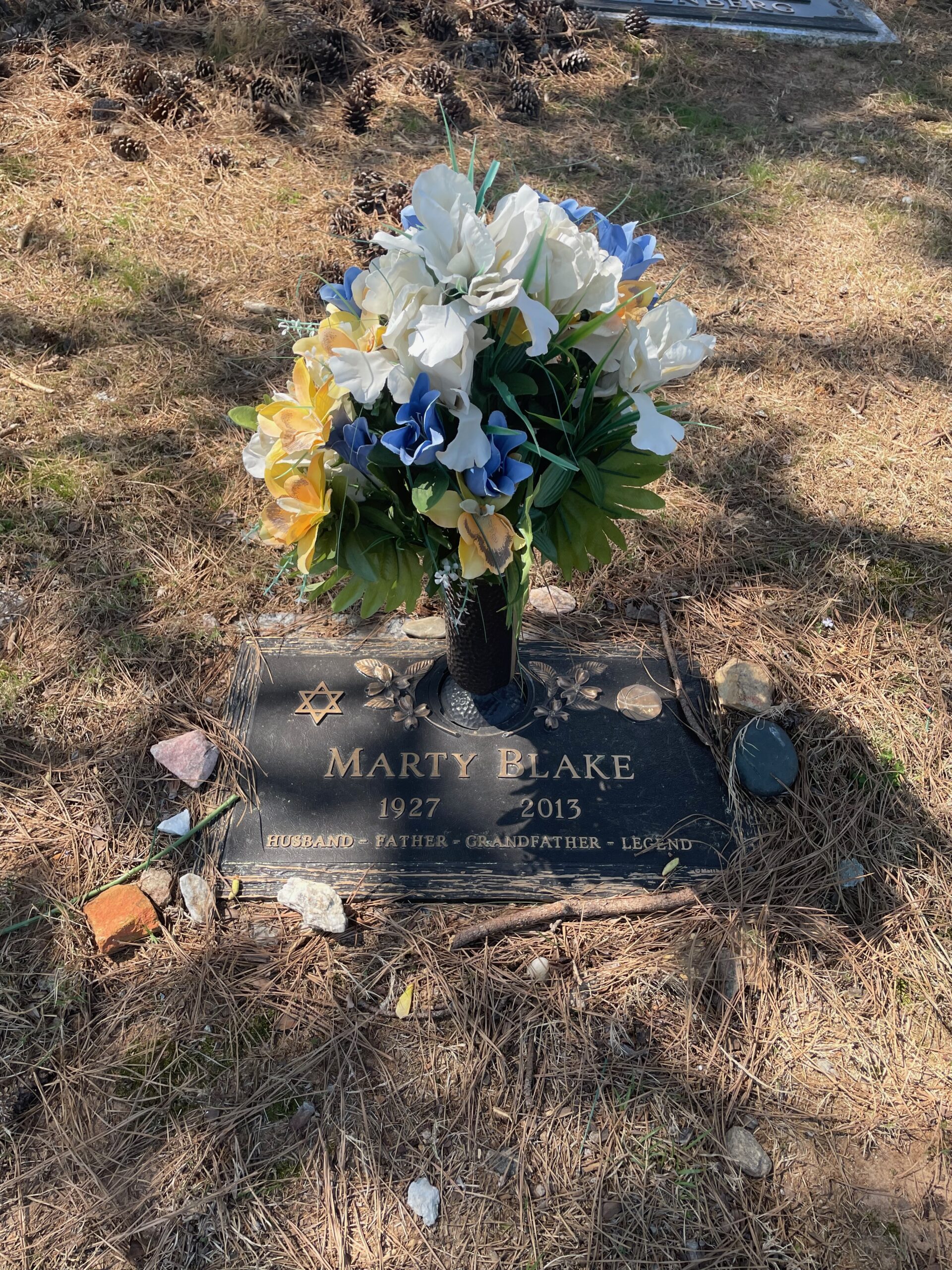
By This is the grave of Marty Blake.
Born in 1927 in Paterson, New Jersey, Blake grew up in a Jewish immigrant household in a family that had migrated from Russia and, presumably, changed their name at some point. When Blake graduated from high school, he immediately joined the military and served at the very end of World War II. Mustered out, he enrolled at Wilkes College in Wilkes-Barre, Pennsylvania. He wasn’t particularly interested in his studies though. Blake liked sports. He wasn’t much of an athlete himself, but he wanted to find a way to dedicate his life to sports. So he went into promotion–boxing matches, stock car racing, things like this one could do on a local level.
In a professional sports world that, outside of baseball, was still quite nascent, there was room for a talented to kid to find his way up pretty quickly. Football and basketball teams found Blake’s talents useful and it would be in the NBA that he would make his mark. In fact, Marty Blake is one of the real architects of the NBA. In 1954, the Milwaukee Hawks hired him to do various things. They didn’t really have a general manager yet. So Blake did it, and went far to create what such a role was. He wasn’t the first GM or anything like that, but it was a very vague role and he did a lot to solidify it. He stayed with the Hawks until 1970, as that team moved to St. Louis and then to Atlanta.
Blake’s genius was scouting. He would go anywhere and everywhere to find talent. He proved himself a quite good GM for an underfunded Hawks team. One of his first great finds was a point guard for Providence named Lenny Wilkens, who he drafted in 1960 after attending the NIT to find talent. And who goes to the NIT for that today? It still exists though–I’m rooting for my New Mexico Lobos to win a tournament even Lobos fans don’t really care about. Pete Maravich was another player he drafted for the Hawks, in 1970, right at the end of his time there. The Hawks would stupidly trade him to the Jazz a few years later. It was thanks to Blake’s talent acquisition that the Hawks won what is today still their only title, in 1958, thanks especially to the great Bob Pettit. He was also a promoter–he knew that games could be events. So he hired Duke Ellington and Stan Kenton to play halftime or after the game when he was in St. Louis.
In 1970, Blake decided he needed something new. He decided to helm a new American Basketball Association team, the Pittsburgh Condors. That didn’t last long and neither did the Condors. So Blake dedicated himself to what he really cared about–scouting. No one would put more energy into finding obscure players than Blake. In 1970, his last year with the Hawks, he pioneered the drafting of foreign players, which no one had ever done before. The team drafted two that year, one from Mexico and one from Italy. They never played in the NBA–the Hawks didn’t have the money to sign them. But the point is that Blake was actually finding guys around the world during times when there was no one even looking at small colleges in the U.S.
And really, here is Blake’s genius. In the 1980s, there was a lot of great players from small colleges out in the sticks that no one had ever heard of before. Blake either discovered them himself through his extensive small town networks or he played a major role in bringing them to public attention. That included Scottie Pippen from the University of Central Arkansas. It included John Stockton from Gonzaga. Dennis Rodman from Southeastern Oklahoma State. Karl Malone from Louisiana Tech. Joe Dumars from McNeese State. Terry Porter from Wisconsin-Stevens Point. Jack Sikma from Illinois Wesleyan. Tim Hardaway from UTEP. Ben Wallace from Virginia Union. Blake was critical in finding all of these players. He stared a scouting service that really honed his expertise and the rest of the NBA soon relied on Blake and his employees to find the real gems out there. He also developed events specifically for the small school finds to play against each other in front of scouts, all of whom trusted Blake to find guys.
One thing I wonder–the great Blazers teams of the early 90s were made up of tons of these guys. Not Clyde Drexler of course, who was great at the University of Houston with Hakeem Olajuwon (if only Portland had won that fucking coin toss to draft him instead of Sam Bowie, now I will cry) but Porter, Jerome Kersey (Longwood), and Kevin Duckworth (Eastern Illinois). I assume Blake brought those guys into the fold at well, though I am not sure. Blazers drafted all those guys.
This is hard to imagine now. Impossible, really. The NIL era with constant transfers and players getting paid, combined with the rise of YouTube and video footage everywhere has totally transferred the game. The last really small college player was Ja Morant, who came out of Murray State a few years, being drafted by the Memphis Grizzlies and being a fantastic scorer before decided to be a wannabe gangster and not taking his career seriously. But that’s another issue. Even now, Morant might have played a year at Murray, tops, and then transferred to a bigger school who would have come with a bag of now legal cash to pay him. And that’s great, players are. making money now. It is not peon ball anymore. A good player is hauling in 7 figures for a year of work.
So sure, it’s a different era now. Blake seems like the guy who developed the minor leagues in baseball or something. But that was really important too. Blake transformed the game through his indefatigable interest in finding obscure players. In fact, when the NBA and ABA merged in 1976, Blake was named Director of Scouting Services. No one was better. No one will ever be better. He truly is the GOAT for a very specific thing and every hoops fan should thank him for it.
Blake worked til nearly the end. In fact, late in life he started a blog to follow his travels watching players in weird players. Good to know that series is now covering bloggers, that’s really leading toward the inevitable conclusion for all of us here. Blake died in 2013, at the age of 86.
Marty Blake is buried in Green Lawn Cemetery, Roswell, Georgia.
In 2005, Blake was awarded the John W. Bunn Lifetime Achievement Award by the Basketball Hall of Fame, which is its highest award for loing-time contributors who have not in fact been inducted. It’s stupid that Blake hasn’t been inducted as a matter of fact. Anyway, if you would like this series to visit other Bunn Award winners (some of whom were later inducted), you can donate to cover the required expenses here. Former NBA commissioner J. Walter Kennedy is in Stamford, Connecticut and Dave Gavitt, long-time Big East head honcho, is in Providence. OK, I can probably get to that one myself. Previous posts in this series are archived here and here.