
Erik Visits an American Grave, Part 2,109
 By
By This is the grave of Henry Laurens.
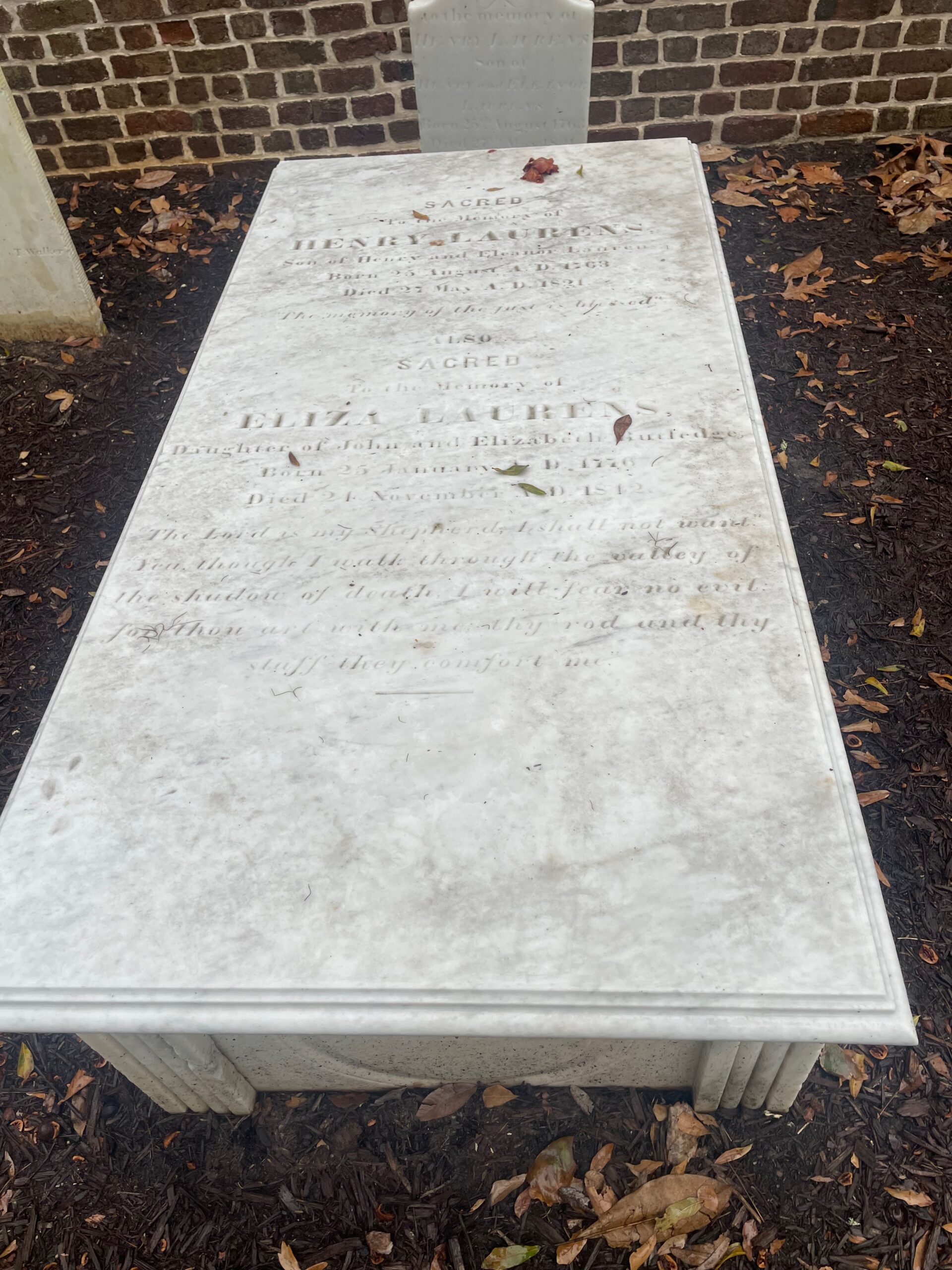
Born in 1724 in what is today Charleston, South Carolina but was then known as Charles Town, Laurens grew up in an upwardly mobile family. The family were Hugenot refugees who found their way to New York in the late 17th century and then to South Carolina. His father made saddles, which doesn’t sound like the business of an elite operator, but increasingly was when he was both really good at it and also expanded the firm to be the largest saddler in the colonies. The idea was for young Henry to go into the family business and the family had the money to send the boy to London in the 1740s for real business training. In 1747, his father died and Henry got the inheritance. It was big–land, slaves, etc. Basically, he was a planter as well as a saddler.
Well, like many young men of the time, Laurens was in the colonial militia. He enjoyed it and was good at it and rose in it. The real target of the militia at this time was of course the tribes. Genocide and slavery are the founding principles of the United States after all and everything comes after that. Laurens was central to both. There was a big war against the Cherokee that broke out in 1757 and lasted until 1761. By this time, Laurens was a lieutenant colonel. This came out of the continued expansion of Americans onto Native lands and the Cherokee, who had been allies of the British at one time, turning increasingly to the French as a way to hold off the greedy murderous colonists. This was part of the precursor to the French & Indian War that became the Seven Years War on a global scale in the 1750s. Laurens was involved in military operations through this period.
Unsurprisingly, being rich and good at the military meant Laurens could have political ambitions. Voters sent him to the colonial assembly for the first time in 1757 and he was there every year until the American Revolution except for one year when he declined because he was arranging education for his sons in London. As the tensions rose between the colonies and London, Laurens was something of a moderate, though with sympathies toward the colonists. But, in 1765, a Stamp Act mob invaded his house to search for stamped papers, thinking him a sympathizer of the British. Like a lot of moderates, concern over the mob was very real and now he had experienced it first hand, or his wife had anyway as he was not home at that moment. But his sympathies were real and he was also pretty openly running his shipping operations without paying the duties the British demanded. So the Navy seized his schooners on a couple of occasions in the late 1760s. That led to him both writing about how awful this all was and also challenging one of the customs officers to a duel, which I believe was not consumated.
In the early 1770s, after his wife died, Laurens went to Europe to deal with his sons’ education, as mentioned above. While there, he became a representative for the grievances of the Americans in London and gained respect back home for his work on this. He presented petitions to Parliament and King George III for redress of what had been destroyed by British policies in America. So by 1774, when Laurens came back to South Carolina, it really was a different place than when he left. The move toward separation was growing and Laurens, despite his continued mistrust of the mob, supported it by and large.
Still, Laurens defined himself as a moderate and remained that way. As such, or perhaps in spite of it, he was a respected figure in South Carolina and a lot of people trusted him. So he was sent to represent the state in the Second Continental Congress in 1777 after supporting the colony moving away from Britain and declaring itself independent the year before.
Now, Laurens is known as a moderate on slavery. South Carolina had those in the 1770s. But let’s not overstate this point. He was like Thomas Jefferson here. Sure, he didn’t like slavery in principle. And he’d talk about it in that way. But he still traded in slaves and made much of his fortune off the forced labor of Africans. And it’s not like as time went on, he did anything about it. In 1790, he owned 298 slaves! That’s a lot of people!! But because he wrote that slavery was bad and maybe the United States would, in theory, have been better off if the British hadn’t introduced it, people see him as a moderate. I guess if your alternative is John C. Calhoun or what South Carolina would become by the 1850s, that means something. To me, this means nothing.
Anyway, Laurens was a leader in the Continental Congress and soon became one of the most important of the so-called “Founding Fathers” (and damn Warren Harding for coining that term), even if he is largely forgotten to everyone but historians today. He was immediately seen as a smart, moderate guy who could be trusted with real governance. That meant he was more important promoting the American cause in Europe than dealing with the hopeless Continental Congress. So in 1779, Congress sent him to get a loan from the Dutch.
The British stopped the ship. They took Laurens and threw him in the Tower of London. This infuriated the Americans. He was charged with high treason and remained in the Tower for 15 months. He was released at the end of 1781. Some later claimed it was the Tower that ruined his health, but it was massive, endless gout from his horrible diet that did that. Anyway, he was not in great shape when he got to Paris to help negotiate the end of the war. He couldn’t play the major role that Benjamin Franklin, John Jay, and John Adams did. He had already left Paris by the time the treaty was actually signed.
Laurens would remain in not great health for the rest of his life. He decided to leave public life in 1785 and when elected to represent South Carolina in the Constitutional Convention in 1787, he declined. He also rejected a request to be part of the state constitutional convention in 1790. He did however support the new federal Constitution and agreed to help push the state to ratify it in 1788. Much of the later years of the war had been fought in the Carolinas and it took a severe toll on his property, so he spent most of his energy on that. He died in 1792, at the age of 68.
Maybe the most interesting thing about Laurens is that he is the first known case of cremation in the United States. Evidently, he had heard some story about someone being buried alive and so he demanded that he be burned so there was no chance of that happening to him, which he was really scared of. Huh. Everyone has their issues.
Henry Laurens is buried in Laurens Family Cemetery, Moncks Corner, South Carolina. His plantation would much later be purchased by Henry and Clare Boothe Luce, who then gave it to the Trappists when she died. So it’s a monastery today. I wonder what he’d think about that.
If you would like this series to visit other so-called Founding Fathers, you can donate to cover the required expenses here. Patrick Henry is buried in Aspen, Virginia and Richard Henry Lee is in Coles Point, Virginia. Previous posts in this series are archived here and here.